

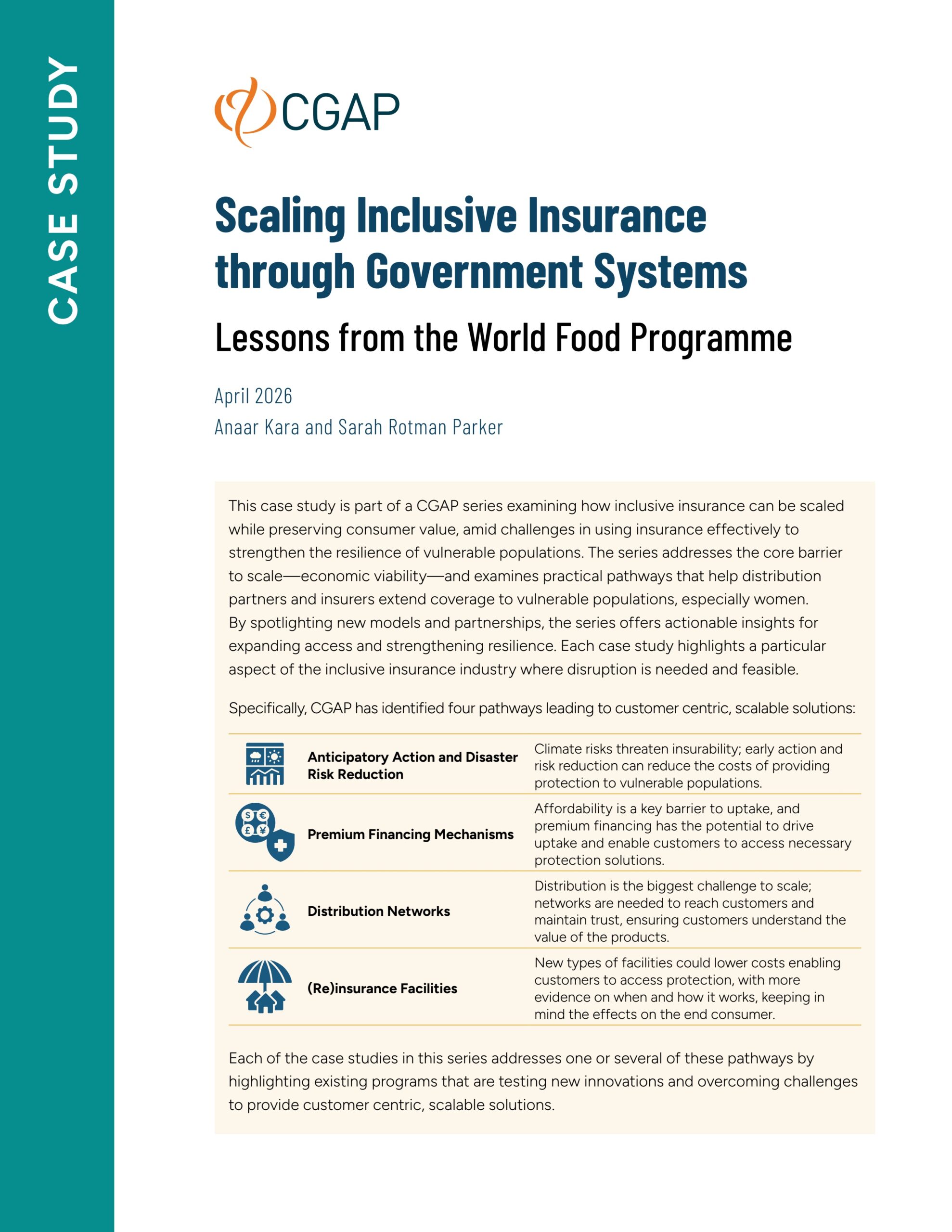
Scaling inclusive insurance through government systems: Lessons from the World Food Programme
This case study examines scaling inclusive insurance through government systems, highlighting World Food Programme initiatives in Zambia, Ethiopia, Cuba, and Guatemala. It explores pathways like distribution networks and anticipatory action to strengthen smallholder resilience. Key findings emphasise embedding insurance in national policies and linking premiums to risk-reduction behaviours for sustainability.
Please login or join for free to read more.

OVERVIEW
Scaling inclusive insurance through government systems
This case study, part of a CGAP series, examines pathways to scaling inclusive insurance for vulnerable populations, specifically focusing on the World Food Programme (WFP). It addresses the core barrier of economic viability by exploring four pathways: anticipatory action and disaster risk reduction, premium financing mechanisms, distribution networks, and (re)insurance facilities. The research aims to understand how public-private partnerships can effectively scale insurance while preserving consumer value and how risk reduction can lower costs.
Highlights
Key findings indicate that embedding insurance within government systems is an effective path to scale, lowering distribution costs and increasing uptake. Linking premiums to risk-reducing behaviour is a powerful lever for affordability, as it manages sustainability challenges at the source. Furthermore, forecast-based payouts can outperform traditional insurance by enabling earlier action and reducing humanitarian costs. WFP acts as a market shaper and system integrator, roles that are critical for achieving scale.
The opportunity: Building food-secure nations by leveraging insurance
Governments face increasing pressure to build food-secure nations amid intensifying climate shocks and shrinking budgets. Smallholder farmers produce around one-third of the world’s food but remain the most vulnerable to disruptions. Empowering them with adaptive tools and climate-smart practices is essential for securing sustainable food systems. Building their resilience is viewed as both a moral imperative and a strategic necessity.
Implementing climate risk insurance through government networks
Over the past 15 years, WFP has provided climate-responsive financial services to nearly 15 million people. Initially developed through the Rural Resilience Initiative (R4), this work transitioned in 2025 into an Inclusive Risk Financing (IRF) approach. Evidence suggests insurance payouts following shocks offer households a vital source of income, allowing them to maintain consumption levels and expand cultivated land. Embedding insurance in government systems is considered a prerequisite for maintaining insurability in climate-exposed agricultural systems.
Using government systems as distribution networks
Government delivery systems, including agricultural input programmes and social assistance schemes, serve as distribution platforms. In Zambia, climate insurance has been embedded in the Farmer Input Support Programme (FISP) since 2021, reaching over a million farmers. The government pays 50 per cent of the premium, with farmers contributing the remaining 50 per cent (approximately ZMW 100 or USD 5.2). Products include Area Yield Index Insurance (AYII) and weather index insurance.
In Ethiopia, WFP redesigned its microinsurance programme to link with the government’s Input Voucher System (IVS). Coverage grew from 20,000 households in 2022 to nearly 250,000 in 2024. Between 2023 and 2025, the scheme provided over USD 868,000 in compensation for losses. This integration allows farmers to access insurance while obtaining inputs like fertilisers and seeds.
Aligning government priorities and insurance: Risk reduction and anticipatory action for stronger insurability and policy delivery
In Cuba, WFP introduced an innovative model with the state-owned Empresa de Seguros Nacionales (ESEN), tying premium costs to farmers’ climate vulnerability levels. Using a matrix of 28 indicators, farmers with lower vulnerability pay reduced premiums, creating an incentive for adopting risk-reduction practices. Early results show 80 per cent of participants experienced decreased vulnerabilities, with crop losses falling from 15 per cent to 7 per cent.
In Guatemala, WFP is designing Forecast Index Insurance (FII) to finance anticipatory action against drought, with a pilot scheduled for Q3 2026. This proactive approach aims to deliver aid before disaster strikes. The Food and Agriculture Organisation (FAO) estimates that every USD 1 invested in anticipatory action can generate a return of more than USD 7 in avoided losses.
Key enablers: What it takes to make inclusive insurance viable at scale
To make inclusive insurance viable at scale, three enablers are identified. First, insurance must be linked to existing government initiatives to reduce customer acquisition costs. Second, solutions should be locally owned and developed through participatory design to ensure buy-in from local insurers and farmers. Third, insurance should be bundled with complementary financial tools, such as savings and loans, to address various levels of risk.
Key challenges to scaling inclusive insurance
Transitioning from pilots to government systems is a long-term process requiring multi-year funding and institutional capacity building. Financial sustainability remains difficult as schemes often rely on subsidies. Additionally, ensuring payouts are adequate and valued by farmers is a challenge; for example, in Zambia, payout levels sometimes fail to cover full input costs, which can undermine confidence in the product.
The next frontier
WFP’s model is unique due to its global reach and relationship with government actors. Moving forward, it is recommended that insurance be embedded within broader national agricultural development policies rather than treated as a standalone intervention. Investing in risk reduction is also critical to ensure financial protection remains accessible as climate risks intensify.




