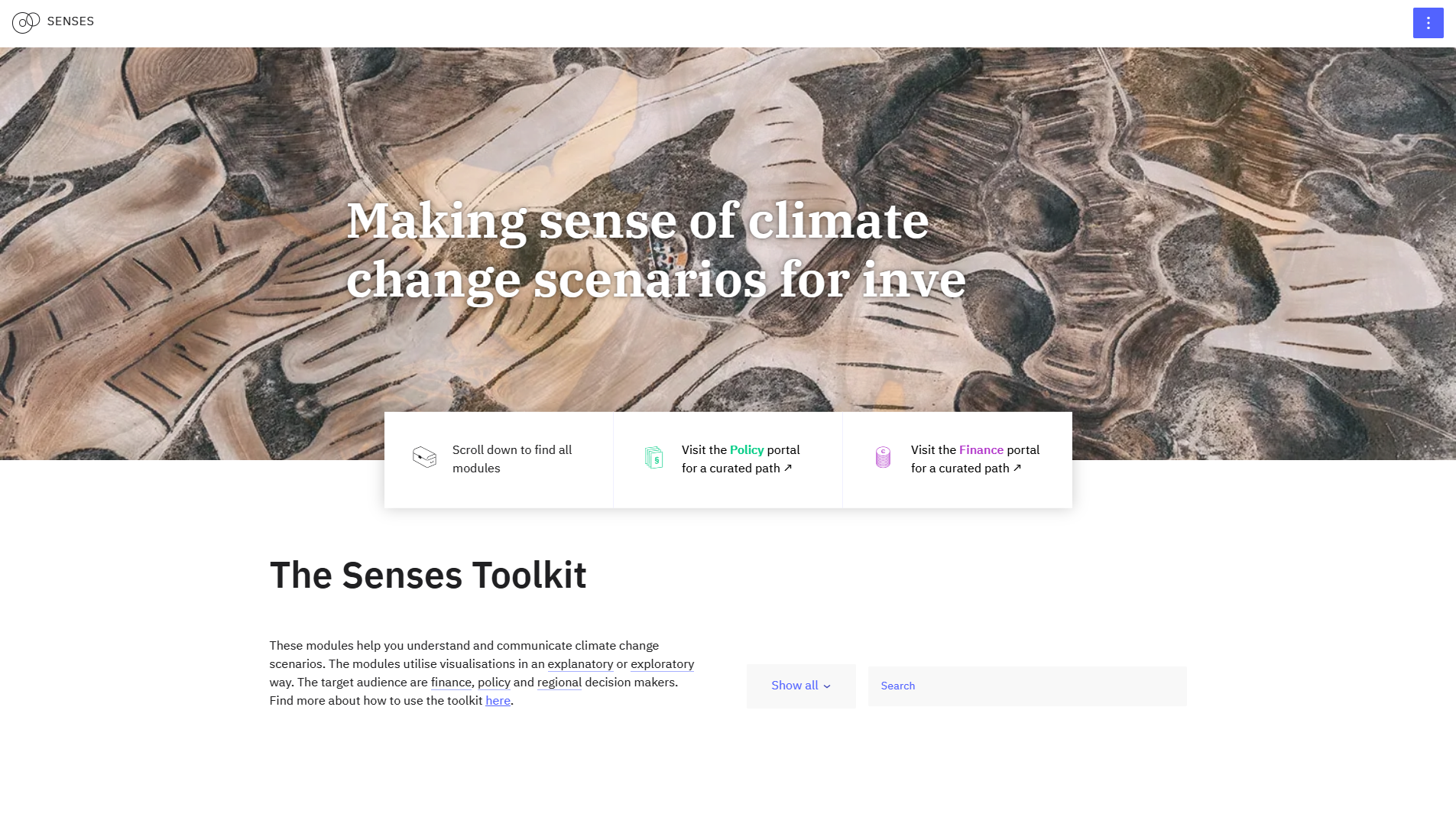
Overview
The SENSES Toolkit is an open, interactive online platform designed to help users understand, explore and apply climate change scenarios. It offers educational modules, visualisations and scenario filters to make complex climate data accessible. Finance professionals may use it to inform risk assessments, stress testing and long-term planning with climate scenario insights.
Organisation behind the tool
The SENSES Toolkit was developed through the SENSES project, a collaborative research initiative involving multiple institutions, including the Potsdam Institute for Climate Impact Research (PIK) and partners such as the International Institute for Applied Systems Analysis (IIASA), Stockholm Environment Institute (SEI), Wageningen University and others. It was created as part of the European Research Area for Climate Services (ERA4CS) and funded by national ministries and the European Union.
What the tool does
The SENSES Toolkit provides:
- Interactive learning modules on climate scenarios, processes and key concepts.
- Visualisations of climate impacts, mitigation pathways and socio-economic futures.
- Scenario Explorer and filters to browse and select quantitative scenario outputs (e.g. IAMC scenarios).
- Exploration of risks including extreme events, transition risks and sectoral impacts.
- Databases and tools for co-production techniques and adaptation strategies.
- Manuals and guidelines to support application of scenario knowledge.
Target audience
Primary users:
- Decision makers in finance, policy and regional planning.
Other audiences:
- Researchers and academics.
- Business and civil society users interested in climate scenario insights.
Relevance to finance professionals
Risk assessment
- Examine exposure to physical risks such as extreme climate events under various warming levels.
- Explore transition risks relating to energy decarbonisation and fossil fuel sectors.
ESG analysis
- Support environmental disclosures with scenario-based insights on emissions pathways and impacts.
Market/commodity insights
- Inform analysis of energy, land use and food systems trajectories affecting markets.
Investment context
- Provide long-term scenario data on mitigation pathways and structural change for strategy and stress testing.