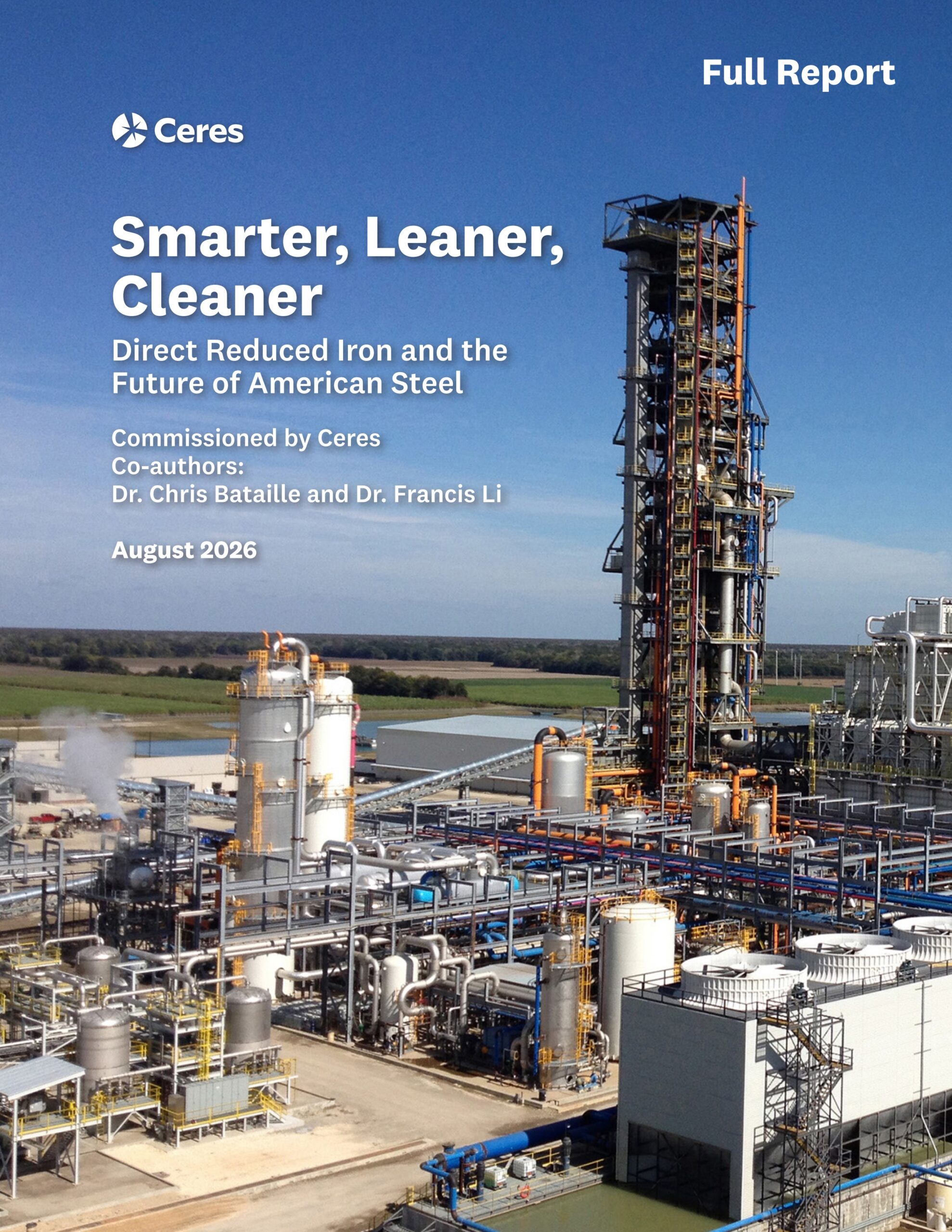
Smarter, leaner, cleaner: Direct reduced iron and the future of American steel
Direct Reduced Iron (DRI) is the most cost-effective new-build investment for the American steel sector. This analysis confirms that natural-gas-based DRI meets investment hurdles across all regions, offering a 15% real return and significant emissions reductions while providing flexibility for future hydrogen integration.
Please login or join for free to read more.

OVERVIEW
Executive summary
The report details a technical-economic analysis of Direct Reduced Iron (DRI) potential in the United States, conducted between February and June 2026. The study evaluates the feasibility of various iron- and steel-making technologies across diverse economic conditions. It highlights that the U.S. steel sector is entering a critical capital investment cycle where aging blast furnaces and coke ovens must be refurbished, replaced, or retired. These multi-billion-dollar decisions will define the industry’s structure for decades.
Findings
The investment case for DRI is robust, as it represents the most attractive destination for new capital. U.S. blast furnaces require relining every 15 to 20 years, costing hundreds of millions of dollars, while coke-battery rebuilds can exceed a billion dollars. New-build DRI is identified as the lowest-cost option in all four modelled regions, clearing the 15% real rate of return typically sought by investors at current tariff-supported U.S. prices.
DRI offers significant environmental advantages, operating with approximately 40% lower greenhouse gas emissions and over 80% lower local air pollution compared to traditional methods. Furthermore, flex-fuel DRI furnaces provide a hedge against future energy costs by allowing producers to switch between natural gas and hydrogen. Domestic production of DRI pig iron could also compete with imports, potentially replacing supplies formerly sourced from Russia and Ukraine.
Recommendations
The report offers specific guidance for various stakeholders. Steelmakers are encouraged to use the analysis as a baseline for site-specific evaluations. Investors should look toward near-term, new-build opportunities in flex-fuel DRI projects. Policymakers at state and local levels are advised to engage with steelmakers to support industrial development through tools like tax incentives and streamlined permitting.
Service providers should offer site visits to familiarise stakeholders with DRI’s potential to modernise the national steel production system. These visits can highlight the capacity to onshore production of critical materials and manage various business risks while spurring local economic development.
The case for regional analysis of Iron and steelmaking in the United States
Industrial transitions in U.S. heavy industry must be understood through regional lenses rather than just technology rankings. The U.S. industry is already hybridised, with electric arc furnaces (EAFs) accounting for 71% to 72% of raw steel production in 2023-2024. Geography plays a decisive role in determining commercial viability due to variations in energy prices, infrastructure access, and proximity to end-markets.
Comparative results
Levelised cost of steel (LCOS) analysis reveals that natural gas DRI is the lowest-cost pathway in every region, followed by blast furnace steelmaking and natural gas DRI with carbon capture. Median LCOS for natural gas DRI falls between $610 and $628 per tonne, whereas blast furnace clusters are slightly higher at $634 to $639 per tonne.
Hydrogen-based DRI remains substantially more expensive, with a premium of $170 to $250 per tonne. Regional sensitivity is pathway-specific; while blast furnace costs vary little due to globally traded inputs, hydrogen DRI shows a large regional spread driven by electricity costs for renewable supply. Minnesota’s Iron Range possesses the lowest potential costs for hydrogen DRI.
System architectures and transition pathways
The transition is best understood as a reconfiguration of system architecture rather than a simple technology switch. The report identifies key system configurations: regionally integrated production and domestic iron corridors. The Gulf Coast is a strong candidate for integrated production due to deepwater port access and low-cost gas. Domestic iron corridors allow the decoupling of ironmaking from steelmaking, with regions like the Iron Range specialising in upstream production to feed downstream EAFs.
Implications for the future of American Steel
The U.S. steel system is expected to reconfigure rather than substitute. Natural gas DRI paired with EAF steelmaking is the most commercially viable pathway for new investment under current conditions. While the existing integrated fleet may continue to reline legacy assets into the 2040s, no new blast furnaces are likely to be built. DRI’s flexibility as a bridging architecture allows for staged decarbonisation, incorporating carbon capture or hydrogen as infrastructure and economic conditions evolve.