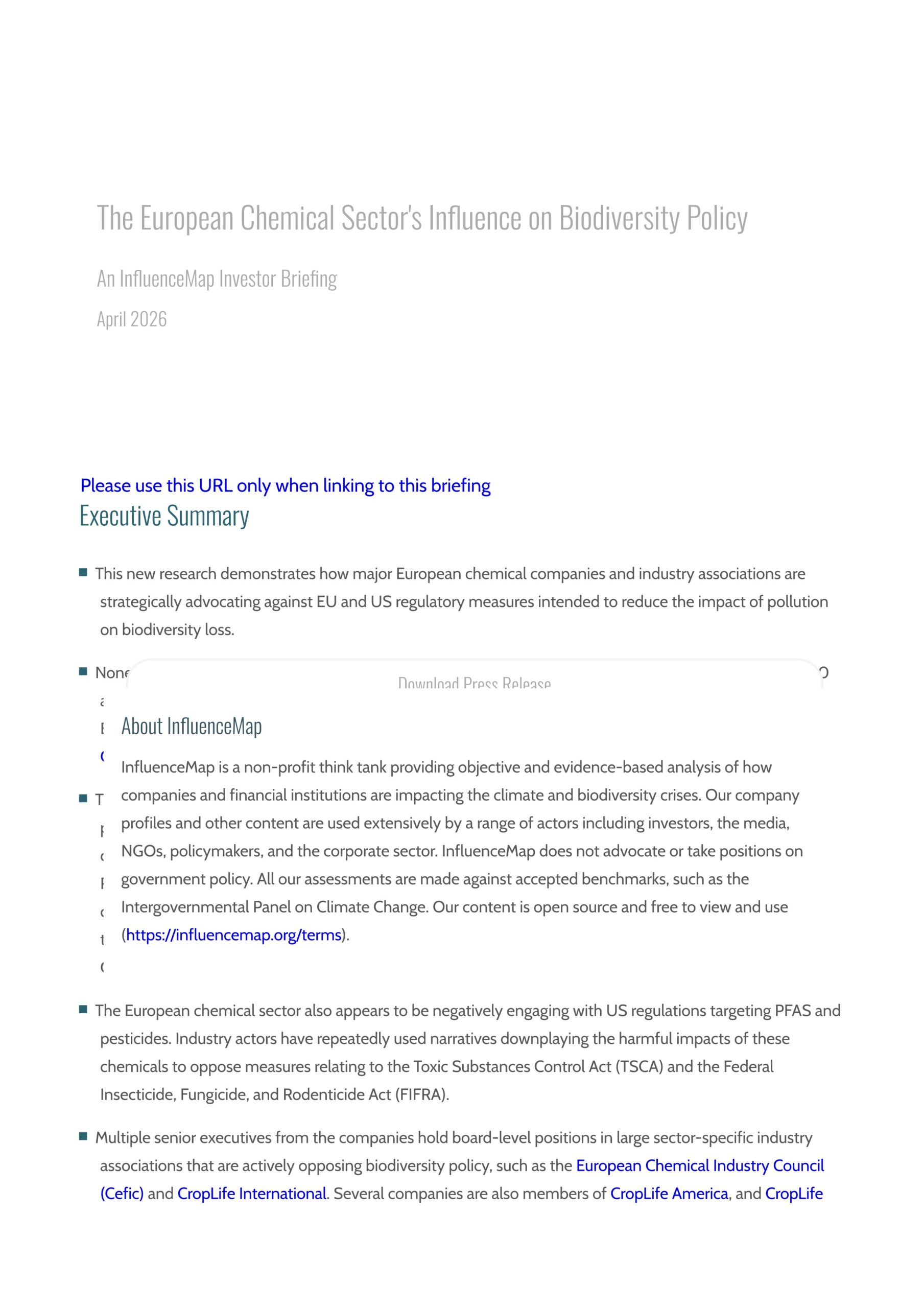
The European chemical sector's influence on biodiversity policy
This report analyses how major European chemical companies and industry associations influence biodiversity policy in the EU and US. It reveals that no assessed company aligns fully with science-based biodiversity goals, highlighting oppositional lobbying against critical regulations concerning pesticides, PFAS, and harmful chemicals.
Please login or join for free to read more.

OVERVIEW
Introduction
The report examines the policy engagement of major European chemical companies and industry associations, evaluating their influence on biodiversity-related policies.
The Importance of investor engagement on biodiversity policy engagement
There is scientific consensus that 1 million (page 2) species are threatened with extinction. Investors have previously engaged 164 (page 3) corporate emitters on climate policy, and attention is now shifting toward biodiversity lobbying.
The chemicals sector and biodiversity
The chemical sector drives biodiversity loss through harmful substances like pesticides, fertilisers, and PFAS. Chemical pollution is one (page 3) of the five (page 3) direct drivers of global biodiversity loss. The Global Biodiversity Framework aims to halve the risks posed by highly hazardous chemicals by 2030 (page 3).
Methodology
The assessment of corporate engagement on biodiversity closely follows established methodologies used for evaluating climate lobbying.
Selection of companies and industry associations
The briefing covers five (page 3) European-headquartered chemicals companies engaged with under investor initiatives.
Findings
No assessed company has advocacy consistent with science-aligned biodiversity policy. Two (page 4) companies have partially aligned direct advocacy, while three (page 4) have misaligned engagement. Despite European headquarters, Bayer, BASF, and Solvay have significant engagement with US regulations.
Overview of policy engagement
The Organisation Score measures support or opposition to biodiversity policy from 0 to 100% (page 4). Scores of 50 (page 4) and below indicate increased opposition. Engagement intensities are high. Bayer holds the highest engagement intensity at 23% (page 4).
Industry engagement on specific policies
This section highlights engagement across three (page 6) key EU policy areas and US policies.
REACH
The REACH regulation manages risks from harmful chemicals. The industry has consistently advocated against strengthening it. Cefic has directly engaged on REACH on over 40 (page 7) occasions since 2021 (page 7), opposing the inclusion of mixture assessment factors.
Sustainable use of pesticides directive (SUD)
The SUD aims to minimise pesticide impacts. A proposal to set legally binding reduction targets was abandoned in February 2024 (page 8). Companies have advocated against stringent pesticide reduction targets and supported weakening regulations governing maximum residue levels.
PFAS legislation
PFAS cause harm through ecosystem bioaccumulation. Companies have opposed comprehensive EU restrictions. Solvay opposed an EU restriction in multiple documents obtained in March 2024 (page 9), while Cefic has repeatedly opposed EU restrictions.
US policy
European companies have repeatedly engaged with US regulations. In August 2023 (page 9), Solvay advocated against excluding PFAS from low volume exemptions. Bayer and BASF have also opposed stringent pesticide restrictions under federal acts and challenged bans on specific herbicides.
Transparency
The quality of disclosure by the assessed companies is not aligned with investor expectations, such as the 14 (page 10) indicators of the Global Standard on Responsible Climate Lobbying. Clariant, Solvay, and dsm-firmenich exhibited limited transparency, while BASF and Bayer had mixed transparency regarding their direct engagement activities.