

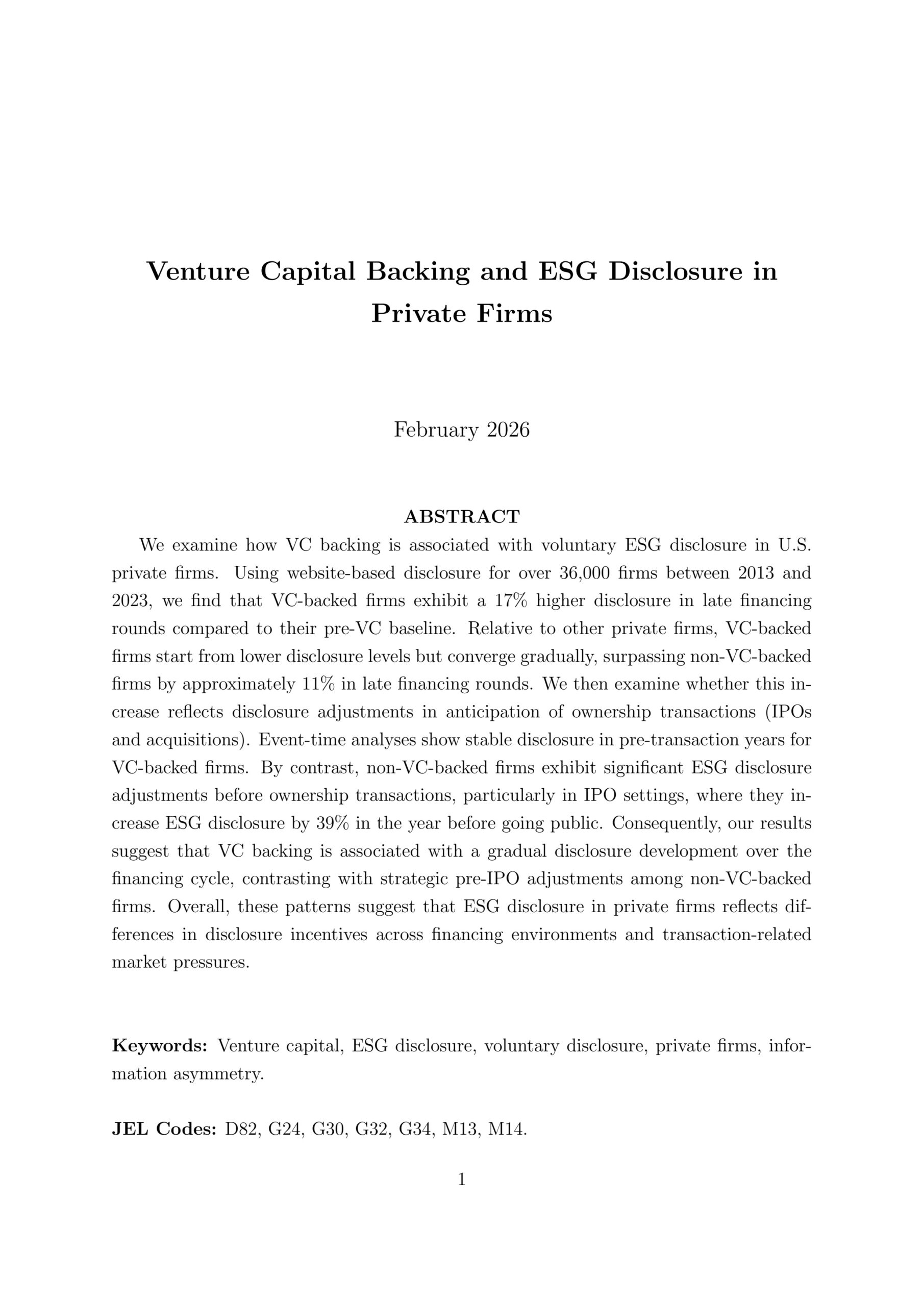
Venture capital backing and ESG disclosure in private firms
This research examines the association between venture capital backing and voluntary ESG disclosure in U.S. private firms. It finds that VC-backed firms develop disclosure gradually through professionalisation. Conversely, non-VC-backed firms exhibit strategic disclosure increases immediately before initial public offerings to reduce information asymmetry.
Please login or join for free to read more.

OVERVIEW
Introduction
Venture capitalists (VCs) are frequently characterised as value-adding intermediaries who professionalise young, innovative firms by improving governance, management teams, and productivity. While previous research has documented the effects of VC involvement on operations, evidence regarding their impact on environmental, social, and governance (ESG) practices remains limited and mixed. This research examines how VC backing is associated with voluntary ESG disclosure in U.S. private firms, specifically investigating how such disclosure evolves over the financing cycle and around major ownership transactions like initial public offerings (IPOs) and acquisitions.
Data and descriptive statistics
The study utilises a novel dataset of over 36,000 U.S. private firms between 2013 and 2023, identifying 7,303 VC-backed firms and 29,495 non-VC-backed firms. To measure voluntary disclosure, the authors retrieved historical firm website content via the Wayback Machine and constructed a dictionary-based metric. This measure was validated against ESG scores from Refinitiv and S&P Capital IQ Pro for listed firms, and its ability to predict B Corp certification among private entities was confirmed. The analysis reveals that ESG communication on private-firm websites has intensified over time, with the aggregate ESG ratio rising from 28.03 in 2013 to 47.20 in 2023. This upward trend was particularly pronounced after 2020, driven by a significant expansion in social and environmental disclosures.
VC backed firms and ESG disclosure
The empirical analysis finds that VC-backed firms exhibit approximately 17% higher disclosure in late financing rounds compared to their pre-VC baseline. This increase is primarily concentrated in the environmental and social pillars, while governance effects are not statistically significant relative to pre-VC levels. When compared to other private firms, VC-backed entities initially start with lower disclosure levels but gradually narrow the gap across successive financing rounds. They only surpass non-VC-backed firms in late stages, such as Round 6 and beyond, where disclosure is approximately 11% higher. This staged pattern suggests that the association between VC backing and ESG disclosure emerges progressively through firm professionalisation rather than appearing immediately upon VC entry.
ESG disclosure around ownership transactions
The research distinguishes between gradual disclosure build-up and strategic pre-transaction adjustments. Event-time analyses show that VC-backed firms maintain stable disclosure levels in the years leading up to an ownership transaction. In contrast, non-VC-backed firms exhibit a sharp increase in ESG disclosure immediately before an IPO, increasing their disclosure by approximately 39% in the year prior to going public. This pattern is concentrated in IPO settings; acquisition-related effects were found to be statistically insignificant for both groups. These findings suggest that for non-VC-backed firms, ESG disclosure serves as a strategic signal to reduce information asymmetry in anticipation of public market entry, whereas VC-backed firms rely on a more consistent development of disclosure capacity over the investment cycle.
Conclusion
The study concludes that ESG disclosure trajectories in private firms are shaped by different organisational structures and market pressures. VC backing is associated with a gradual development of disclosure capacity, consistent with the professionalisation of portfolio companies. Conversely, non-VC-backed firms respond to information asymmetry incentives by making abrupt adjustments before entering public markets. These results have practical implications for venture capital investors, private firms preparing for exits, and policymakers debating disclosure frameworks in relatively opaque private markets. Limitations of the research include its focus on website-based communication and the identification of systematic associations rather than definitive causal effects.




