
Library | SASB Sustainability Sector
Insurance
Refine
293 results
REFINE
SHOW: 16


ASEAN 2019 Green finance: State of the market
An overview of data by the Climate Bonds Initiative, illustrating market growth in ASEAN’s green, sustainable bond, and loan markets. ASEAN is an intergovernmental organisation integrating economic, educational, and sociocultural integration. ASEAN's issuance grew 98% in 2019 and makes up 3% of the global total.
Norden is leading the world on fossil fuel divestment
This briefing examines the world-leading divestment strategies of Nordic countries from the fossil fuel industry. It looks at the current policies of pension funds, insurers, banks, development finance institutions, credit agencies and central banks.
Over 100 global financial institutions are exiting coal, with more to come
This report published by IEEFA highlights the fact that over a hundred globally significant financial institutions are divesting from coal projects. It mentions that these major financial institutions, including commercial banks, insurance companies, pension funds, asset management companies, and development finance institutions, are building up the momentum against coal projects.
How to invest in the low-carbon economy: An institutional investors' guide
This report introduces the investment strategies available to investors in their efforts to align their portfolios with a lower carbon, more climate-resilient economy. The guide focuses on three main areas for investor action: climate-aligned investment opportunities, integration of climate-related risks and opportunities into investment processes, and phasing out investment in thermal coal.
The case for sustainable bond investing strengthens
This report is an expanded research study on a previous study conducted by Barclays. It provides deep insight into the relationship between environmental, social and governance (ESG) factors and their influence on credit portfolio performance. In particular, looking at the effect of ESG on euro-denominated and US investment grade and high-yield bond markets.
ESG in fixed income
This guide created by BMO Global Asset Management shows how and why they incorporate ESG factors and stewardship activities into their corporate fixed income investments and engagement approach. The guide also looks at how the growing sustainable bonds market is enabling fixed income investors to align investments with sustainability goals.

Sustainable investing and bond returns
A research study conducted by the Barclays Research team seeking to assess the link between environmental, social and governance (ESG) ratings and credit portfolio performance. In addition, the report provides a general overview over sustainable investing and the top trends driving the rapid rise of its popularity.
Fixed income investor guide: Putting responsible investment into practice in fixed income
This is a guide for fixed income investors to implement responsible investment (RI) principles. A key application is using environmental, social and governance (ESG) integration to determine an issuer's creditworthiness. Motivations for applying RI in fixed income vary from pursuing financial value through the management of risks and opportunities to ethical motivations and reputational concerns.

Institutional investors and the behavioral barriers to taking action on climate change
The report examines why leading climate investors are rapidly outpacing their peers despite having access to the same information. As part of the report, investment professionals and key stakeholders were surveyed and interviewed, revealing cognitive biases to be an important barrier to taking action on climate change.

Protecting our best interests: Rediscovering fiduciary obligation
ShareAction (formerly FairPensions) report on the fiduciary obligations of different types of investors, exploring how the interpretation of this relationship has shifted from its traditional meaning. A detailed analysis concludes with recommendations for government departments, regulators and investors, to ensure that fiduciary principles are indeed protecting beneficiaries.
The Inevitable Policy Response: Preparing financial markets for climate-related policy/regulatory risks
The Inevitable Policy Response (IPR) is a project to prepare investors for the investment risks associated with the most likely responses to climate change. The likely impacts of climate change and mechanisms in the Paris Agreement are likely to force substantial policy introduction in the near future with investment implications.

Investor action on climate change
The report assesses the investment practices of signatories to the Principles for Responsible Investment (PRI) on the topic of climate change. In partnership between PRI and Novethic, the report includes themes such as long-termism, climate-related risks and opportunities, scenario analysis and innovation for a successful transition to a low carbon economy.
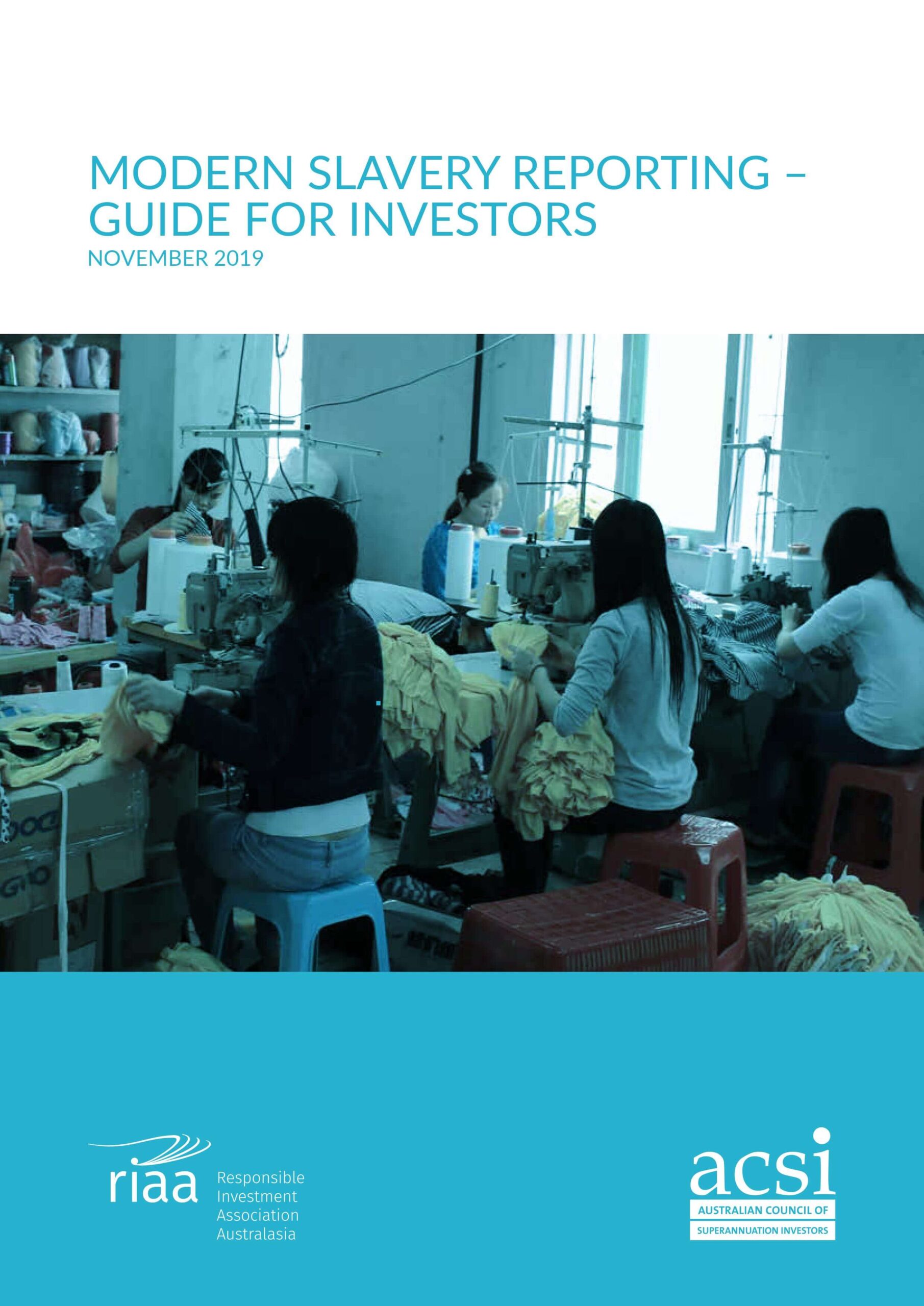
Modern slavery reporting - Guide for investors
This report aims to guide reporting entities and investors on the requirements of the Australian Commonwealth Modern Slavery Act 2018. It informs and provides suggestions to companies and investors on how to identify, manage and reduce the risks and impacts of modern slavery.
Guide to unlocking prosperity: Finance, investment and sustainable development
Companies and institutional investors can contribute to the Sustainable Development Goals (SDGs) through their business activities and investment decisions. This guide lists the many actions that these financial industry participants can take to achieve these goals across sectors including education, clean energy, agriculture, and health.
Climate change: Awareness to action
Australian Prudential Regulation Authority (APRA) has highlighted the financial risks of climate change facing financial services organisations, saying that they are material, foreseeable and actionable now. APRA’s survey of 38 entities summarises the activities that those entities are adopting to mitigate financial risks. This information paper provides APRA's insights into responses to their survey.

SDG Industry Matrix: Financial services
The Matrix provides industry specific ideas for action and industry specific practical examples for each relevant SDG. It profiles opportunities which companies expect to create value for shareholders as well as for society.


