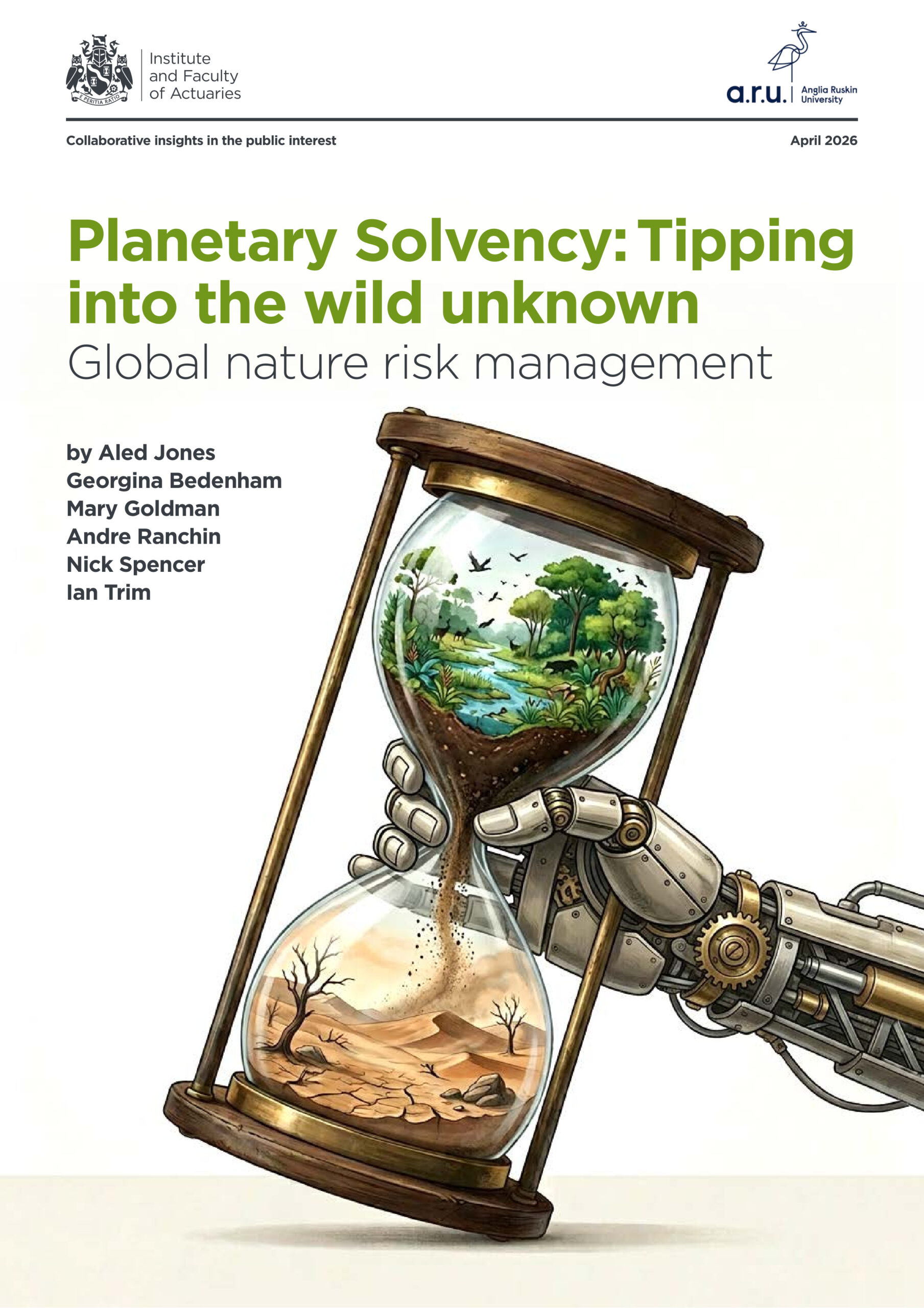
Planetary solvency: Tipping into the wild unknown: Global nature risk management
This report outlines how the degradation of global ecosystems threatens societal and economic resilience. It highlights immediate risks to food systems and health, long-term ecosystem tipping points, and the necessity of integrating biodiversity into financial models. Actuaries and policymakers are urged to adopt systemic, narrative-based risk management strategies.
Please login or join for free to read more.

OVERVIEW
The planetary solvency dashboard
Ecosystems act as a critical balance sheet generating dividends like clean air, fertile soil, and food security. Withdrawals currently exceed deposits, pushing planetary boundaries toward irreversible tipping points. The planetary solvency dashboard indicates that nature-based risks are currently likely to highly likely with limited to severe impacts. Without immediate policy action, risk trajectories push all risks out of appetite soon, potentially breaching risk tolerances before 2050.
Significant short-term risks from nature
Food systems and zoonotic diseases present severe near-term threats. Global agricultural output has grown over 400% in the past century, yet this efficiency relies on overdrawn planetary boundaries. Chronic risks, such as declining soil health causing $2.8bn in annual losses in the US corn belt, compound with acute shocks like extreme weather. By 2023, UK food price inflation soared to almost 20%, driving 9.3 million people into severe hardship. Furthermore, land-use changes and deforestation drive pandemics. Around 70% of emerging diseases originate from wildlife, and land-use changes have caused over 30% of new diseases reported since 1960. Global strategies to prevent pandemics are estimated to cost between $22bn and $31.2bn, significantly lower than the trillions in economic damages caused by events like Covid-19.
Long-term risks and ecosystem tipping points
Ecosystem tipping points risk irreversible changes to the global economy. By 2050, up to 47% of the Amazon rainforest could reach critical tipping points, escalating financial exposure via stranded assets and disrupted supply chains. Pollinator collapse threatens food systems worth over $250bn annually, with UK pollinating insects losing a quarter of their habitat since 1980. Additionally, marine tipping points—such as coral reefs projected to decline by 90% by 2050—risk destabilising food systems and exposing half a billion people to annual flooding events.
Modelling nature risk – Complexity and interactions
Current economic models typically omit biodiversity, leading to misleading scenarios and an underestimation of risk. Modellers must integrate both climate and biodiversity pathways, as they are intrinsically linked. Approaches that rely solely on land-use metrics are useful but insufficient for capturing multidimensional tipping points. Financial professionals must adopt narrative-based scenarios to avoid false confidence in flawed quantitative models and better prepare for systemic macro-economic impacts, such as global food price inflation driven by climate and water scarcity.
Key recommendations
Policymakers must shift their mindset to become planetary solvency managers, integrating nature into risk management, economic planning, and national security. This requires accelerating global coordination alongside proactive investments in prevention and monitoring rather than reactive responses. For the financial sector, actuaries must quantify biodiversity risk using tools like ENCORE and the TNFD framework while understanding the limits of traditional financial models. Embracing qualitative narratives and recognising the systemic nature of tipping points are essential steps to navigate interconnected climate and nature risks.