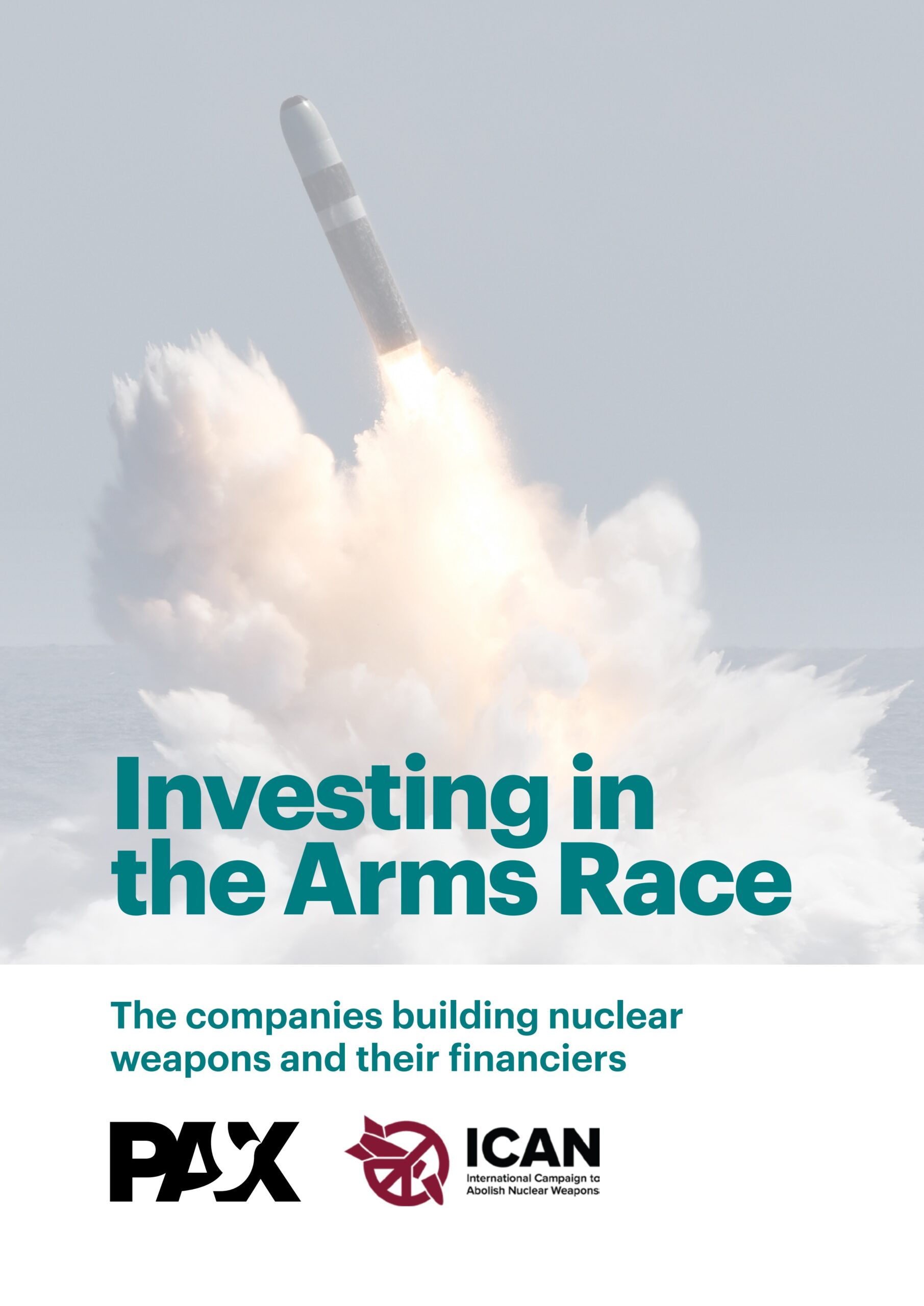
Investing in the arms race: The companies building nuclear weapons and their financiers
This report analyses 25 companies producing nuclear weapons and their financial backers. Highlighting over $1 trillion in total investments and financing from 301 institutions, it urges the financial sector to use its leverage to reject nuclear armament and make choices that benefit global security and humanity.
Please login or join for free to read more.

OVERVIEW
Key Findings
Between January 2023 and September 2025, 301 banks, pension funds, insurance companies, asset managers, or other financial institutions had financing or investment relations with one or more of the 25 nuclear weapon producing companies (4). Investors held $709,157 million in shares and bonds in these companies, representing an increase of over $195 billion since the last financial analysis (4). Furthermore, $299,722 million was provided to these manufacturers in loans and underwriting, reflecting an increase of $29.8 billion (4).
Methodology
The report describes the involvement of 25 companies heavily embedded in the nuclear weapons industry, providing key components or services contributing to the development, production, manufacture, possession, and stockpiling of nuclear weapons. Contributions to the construction and maintenance of nuclear-armed submarines also fall within the methodological scope.
Introduction
Amid ongoing wars and geopolitical tension, nuclear weapons remain a severe threat. France has recently announced plans to start producing more nuclear warheads, increasing the size of its nuclear arsenal for the first time since 1992 (17). All nuclear-armed states continue to modernise or expand their nuclear arsenals, with over $100 billion spent in 2024 alone (17). By contrast, more than half of eligible countries have signed, ratified, or acceded to the Treaty on the Prohibition of Nuclear Weapons, supporting an alternative approach to peace and security that seeks to eliminate weapons of mass destruction.
25 Nuclear weapon producing companies
The 25 companies profiled are based in China, France, Germany, India, Italy, the Netherlands, the United Kingdom, and the United States (4). General Dynamics, Honeywell International, and Northrop Grumman are the largest nuclear weapons profiteers, holding outstanding contracts with potential values of at least $28 billion, $75 billion, and $16 billion respectively (4). Companies like BAE Systems, Bechtel, Leonardo, Lockheed Martin, and RTX also hold multi-billion-dollar contracts for nuclear weapon production and sustainment (4).
Financiers and profiteers
The 301 institutions financing these companies originate from 23 countries. The top 10 investors are mostly based in the United States, and their combined investments total $477,037 million, accounting for over 67% of all investments. Meanwhile, the top 10 creditors provided $179,277 million in loans and underwriting, representing more than 59% of all financing.
Conclusion
Nuclear weapons have returned to the forefront of national security agendas. While major global defence contractors profit significantly from intensive nuclear modernisation programmes, the risk of nuclear conflict is greater than it has been in decades. Because every investment is a choice, it is recommended that banks, pension funds, and other financial actors positively use their leverage by making investment choices that benefit humanity and steer away from existential threats.