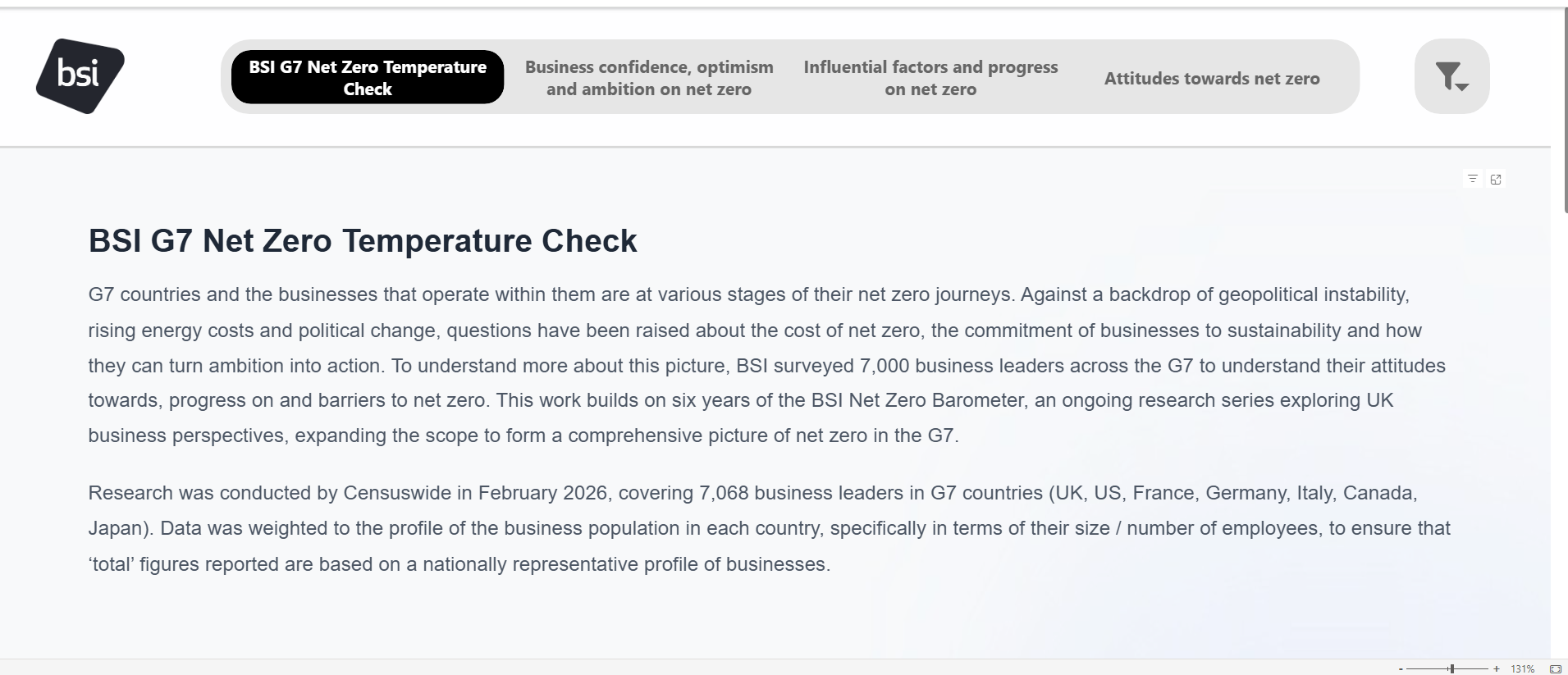
The G7 Net Zero Temperature Check
BSI’s G7 Net Zero Temperature Check benchmarks corporate net zero progress across G7 nations, surveying over 7,000 business leaders on climate strategy and commitments.
Please login or join for free to read more.

OVERVIEW
The G7 Net Zero Temperature Check is a research benchmark produced by BSI (British Standards Institution) that tracks the net zero progress and climate strategies of businesses across G7 nations. The tool provides a benchmark to help organisations assess their position on net zero and identify next steps. It is relevant to finance professionals monitoring corporate climate commitments and ESG performance across major economies.
Organisation behind the tool
The tool is developed and published by BSI (British Standards Institution), a global standards and testing organisation headquartered in the United Kingdom.
What the tool does
The G7 Net Zero Temperature Check surveys business leaders across G7 countries — including the UK, United States, France, Germany, Italy, and Canada — to assess the state of corporate net zero commitments and climate action. The 2026 edition, titled Business Insights 2026, polled more than 7,000 business leaders. Key findings from the 2026 edition include that G7 businesses remain committed to net zero but are seeking clearer guidance as they adapt their plans, and that firms are engaging in “climate-coding” — keeping net zero progress alive while reframing messaging and placing greater emphasis on resilience.
Target audience
The primary audience includes business leaders, sustainability professionals, and policymakers across G7 nations. It is also relevant to finance professionals, ESG analysts, and investors seeking to understand corporate climate strategy and net zero progress at a cross-country level.
Relevance to finance professionals
The tool supports finance professionals in several ways: it provides cross-country benchmarking data on corporate climate commitments useful for ESG analysis and portfolio assessment; it highlights emerging trends such as the reframing of net zero messaging, which is relevant to greenwash risk; and it offers insights into how businesses in major economies are adapting climate strategies, informing long-term investment and risk assessment decisions.