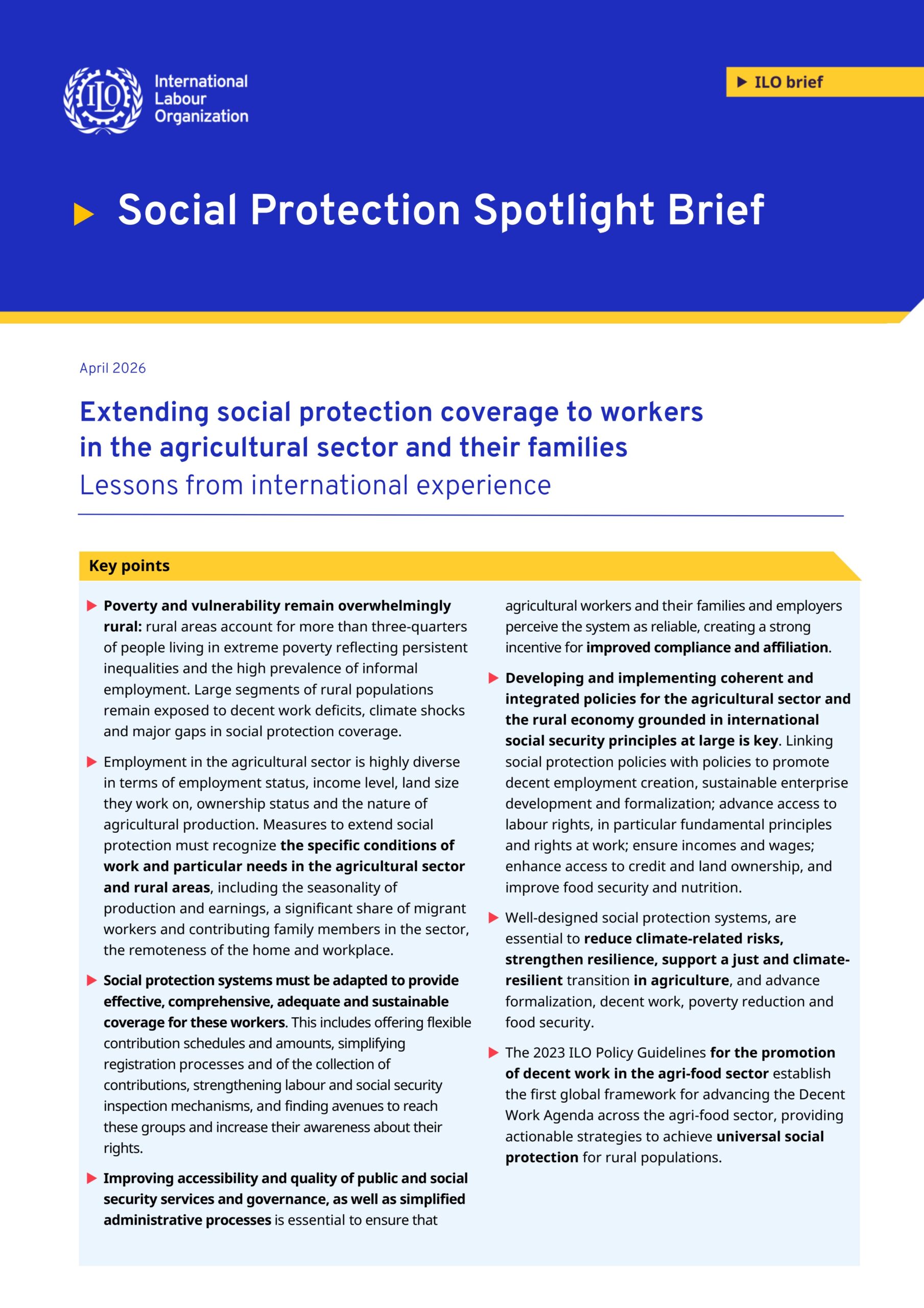
Extending social protection coverage to workers in the agricultural sector and their families: Lessons from international experience
Report examines extending social protection to agricultural workers. Highlighting that rural areas account for more than three-quarters of the extreme poor, it identifies barriers like legal exclusion and informal employment. It presents international solutions, including flexible contribution schedules and mobile service delivery, to achieve universal coverage for rural populations.
Please login or join for free to read more.

OVERVIEW
Introduction
Currently, about half of the world’s population and more than three-quarters of the global poor live in rural areas. While rural areas hold significant economic importance, with the agricultural sector at their core, significant inequalities remain regarding income and access to public services. The agricultural sector employs nearly one billion people worldwide, representing around 26 per cent of all those in employment. Many of these workers are in informal employment with volatile and low earnings, with 96.3 per cent of agricultural workers lacking social protection coverage.
As a result of insufficient coverage, agricultural workers face higher risks of poverty, malnutrition, and direct exposure to natural disasters and climate change. Contributing family workers are a defining feature, making up 10 per cent of the global workforce; in the European Union, 86.1 per cent of the agricultural workforce were family members. This group is highly gendered, as almost two-thirds (63 per cent) of contributing family workers are women. Additionally, 7.1 per cent of all migrant workers in 2019 were employed in agriculture. Health coverage is substantially lower for rural populations, with 56 per cent of the population excluded compared to 22 per cent of the urban population.
Challenges in extending social protection to workers in the agricultural sector
The workforce is highly diverse, encompassing salaried workers, self-employed farmers, and subsistence producers. This inherent heterogeneity makes extending social security challenging, as groups are often excluded due to employment status or land tenure. Seasonal, labour-intensive work and high informality constitute challenges for registration and contribution collection. Many workers are legally excluded from social protection law, or subject to separate legislation providing lower levels of protection. Even where legislation exists, qualifying conditions such as minimum thresholds for employment duration can result in the effective exclusion of seasonal and casual workers.
Low and fluctuating earnings limit the capacity of workers to contribute to social insurance. Agricultural workers are also frequently exposed to idiosyncratic shocks, such as personal injury, and covariate shocks, including climate-related events like droughts or floods. Administrative barriers, such as the absence of local offices in rural areas and limited internet access for digital services, further constrain access. Weak enforcement and control mechanisms are common, as labour administration often lacks sufficient human and financial resources to inspect agricultural enterprises over extensive geographic areas. Finally, limited literacy and digital skills restrict the ability of workers to advocate for their social security entitlements.
Good practices and possible solutions
Building on the International Labour Organisation (ILO) normative framework, countries have moved towards including agricultural workers under general social security legislation. In Canada, an unemployment insurance scheme provides certain seasonal workers with an additional 5 weeks of benefits to cope with income gaps. The Philippines provides for reduced contributions by self-employed workers earning less than 1,000 pesos a month and allows for quarterly payments. Ecuador’s Peasants’ Social Insurance (SSC) covers approximately 73 per cent of the rural population, reaching 1.2 million people in 2017. Spain has enshrined a specific scheme for agricultural workers that includes benefits for the cessation of business activities.
To facilitate registration, Bulgaria utilises ex officio registration through the National Revenue Agency for all categories of workers. Brazil’s pension scheme eliminates the requirement for extensive documentation to prove 15 years of work in family farming, instead using online questionnaires and mobile agencies such as buses and ships. During harvest periods in Costa Rica, collective enrolment for independent pickers is coordinated through cooperatives. South Africa employs mobile services to facilitate the registration and payment of social assistance in remote villages. Portability of benefits is also critical; for example, 15,000 Moroccan women travelling to Spain for seasonal work receive social security benefits through a bilateral agreement.
Flexible financing mechanisms have been adopted to accommodate income volatility. In the Republic of Korea, agricultural workers can pay contributions quarterly and are exempted from payments while benefiting from disaster relief acts. Subsidisation is another common strategy; the Islamic Republic of Iran subsidises contributions through its Rural and Nomad Social Insurance Fund, where the government contributes an additional 10 per cent for every 5 per cent contributed by beneficiaries. India’s Mahatma Gandhi National Rural Employment Guarantee Act (MNREGA) provides a legally guaranteed source of income with at least 100 days of paid work at minimum wage, while Kenya adopted a strategy in 2024 to extend social protection to informal and rural workers through decentralised services.
Conclusion
Extending coverage is vital to accomplish universal access to social protection. Because a one-size-fits-all approach cannot provide comprehensive protection, schemes must be adapted to the specificities of the agricultural sector. Measures should include streamlining administrative procedures, developing flexible financing mechanisms, and linking social protection to other policy areas such as employment creation and climate resilience. Building trust through transparent administration and responsive mechanisms is essential to increase registration and improved compliance amongst rural populations.