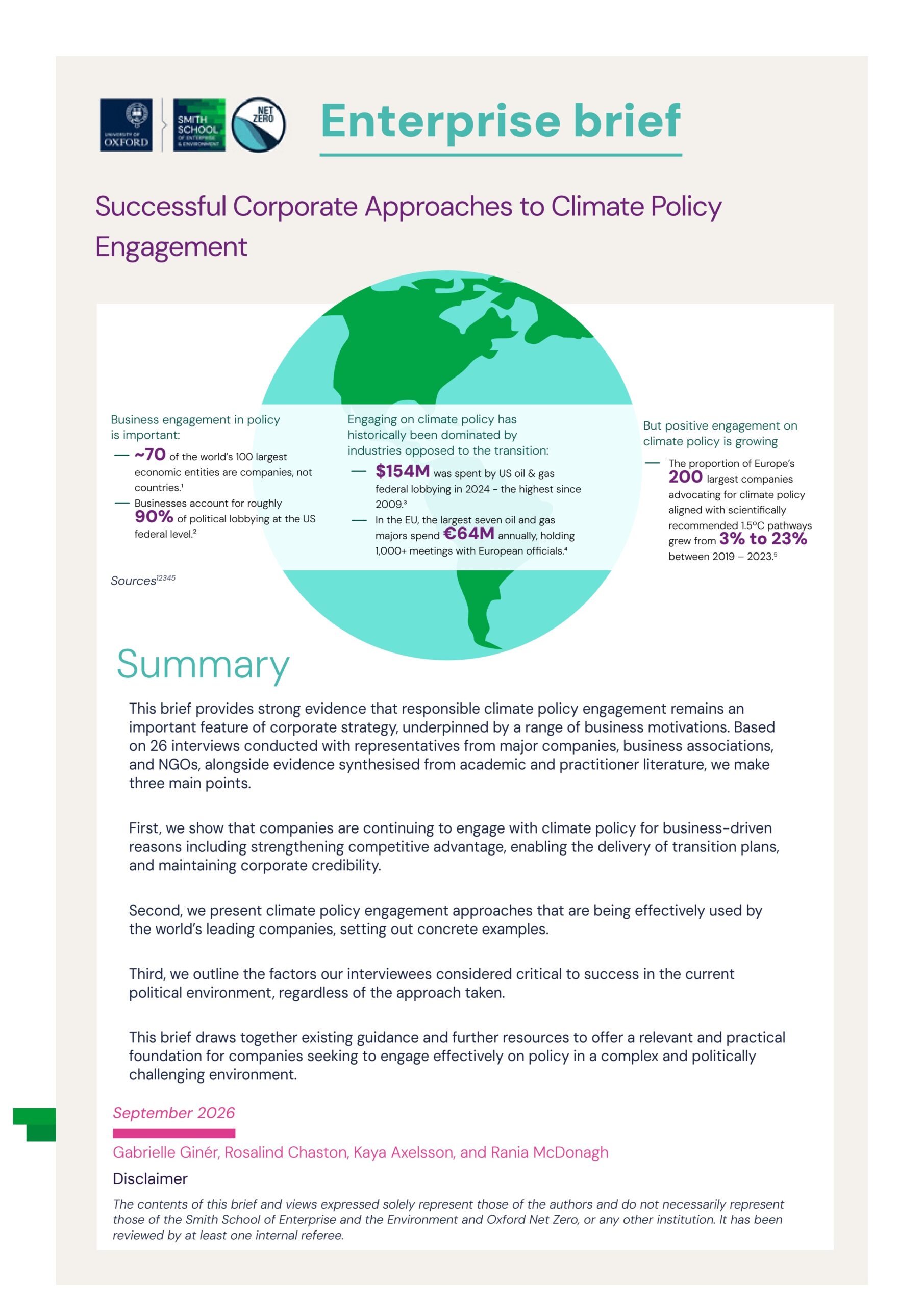
Successful corporate approaches to climate policy engagement
This research examines how leading companies maintain climate policy engagement despite geopolitical challenges. It identifies three core approaches—direct engagement, trade association influence, and coalition forming—driven by business motivations such as competitive advantage and transition plan delivery. Success depends on timing, transparency, and alignment with corporate decarbonisation goals.
Please login or join for free to read more.

OVERVIEW
Summary
Responsible climate policy engagement is a critical component of corporate strategy, driven by diverse business motivations. This brief, based on 26 semi-structured interviews with representatives from multinational companies and NGOs, demonstrates that policy engagement is no longer a peripheral sustainability activity but an increasingly strategic function. By the end of 2025, 9,764 companies had validated science-based targets, with validated net zero targets rising by 61% during that year. This growth highlights the necessity for enabling factors, such as decarbonised transport systems and reliable renewable energy availability, which are directly shaped by policy and regulation.
Motivations for corporate climate policy engagement amid shifting geopolitical landscapes
Despite challenges like the rollback of US climate policies and the Russian invasion of Ukraine, underlying motivations for corporate engagement remain robust. Historically, policy engagement was dominated by industries opposed to the transition; for instance, US oil and gas federal lobbying reached $154 million in 2024. However, positive engagement is growing. The proportion of Europe’s 200 largest companies advocating for policy aligned with 1.5ºC pathways grew from 3% to 23% between 2019 and 2023. Engagement helps create a level playing field, ensuring first-movers do not pay a ‘green premium’ for their decarbonisation efforts. Furthermore, 13 of the 15 companies interviewed actively map policy dependencies to ensure the feasibility of their transition strategies.
Effective approaches used for corporate climate policy engagement
Leading companies utilize a toolbox of three main approaches to guide their strategy. Rather than relying on a single method, companies advocate for a holistic strategy that combines these tactics in parallel to build broad support and amplify specific policy messages depending on the context.
Approach #1: direct policy engagement
Direct engagement involves organisations interacting with policymakers through their own channels. While requiring greater organisational capacity, it is valued for its ability to foster long-term trust and represent tailored interests. Interviews revealed that companies prefer proactive measures, such as direct meetings and written communications, to influence the agenda rather than reacting to existing proposals. Data from 2025 shows that 23% of occurrences for the interviewed sub-set involved ad-hoc meetings. Initiating these efforts early in the policy cycle is critical for shaping legislation before ideas crystallise and opinions become polarised. Case studies, such as SSE’s involvement in the UK’s Clean Power 2030 Action Plan, illustrate how successful industry engagement can support significant investment in clean energy.
Approach #2: influencing and engaging through trade associations
Trade associations remain influential voices, accounting for 74.8% of indirect policy engagements disclosed to CDP in 2025. However, misalignment is a significant issue. While 90% of companies report their positions are consistent with their associations, research by InfluenceMap found only 12% of trade associations align their engagement with science-aligned policy. Effective strategies involve active participation to challenge obstructive activity. Companies may choose to publicly distance themselves from misaligned positions, as demonstrated by Unilever and Nestlé regarding European sustainability reporting directives. Enel provides an example of a two-stage escalation process for addressing association misalignment with the Paris Agreement.
Approach #3: coalition forming
Coalition forming allows companies to partner with aligned organisations to increase the legitimacy of their positions. These range from broad ‘big tent’ initiatives like EV100 to granular, country-specific groups. The UK Electric Fleets Coalition, comprising 28 commercial fleet operators, successfully promoted policies to accelerate the transition to electric vehicles. Successful coalitions are often diverse, including ‘surprising collaborators’ like NGOs and academics, which enhances credibility and broadens the political appeal of proposals beyond traditional industry interests.
Factors for success in engaging on climate policy
Several factors are critical to strategy development regardless of the approach taken. Firstly, strategies must be closely tied to the business’s transition plan needs and core decarbonisation dependencies. Secondly, timing is essential, with early engagement providing greater agency. Thirdly, strategies must be tailored to the specific political context or jurisdiction. Fourthly, engagement must be dynamic and adaptive to changing socioeconomic conditions. Fifthly, the choice of messenger is vital, with shifts toward climate risk and resilience language helping to counter scepticism. Finally, transparency and reporting are fundamental to fostering stakeholder trust and avoiding accusations of greenwashing.
Conclusion: we find that climate policy engagement is increasingly seen as a strategic business function
Climate policy engagement has transitioned from a peripheral activity to a strategic mechanism for delivering transition plans, managing risk, and maintaining credibility. As expectations from investors and standard setters evolve, companies will be judged not only on their targets but on whether their political influence enables or hinders the policies required for the net zero transition. Organisations that combine clear strategic objectives with trusted relationships and transparent governance are best positioned for success.