Carbon Impacts Tracer
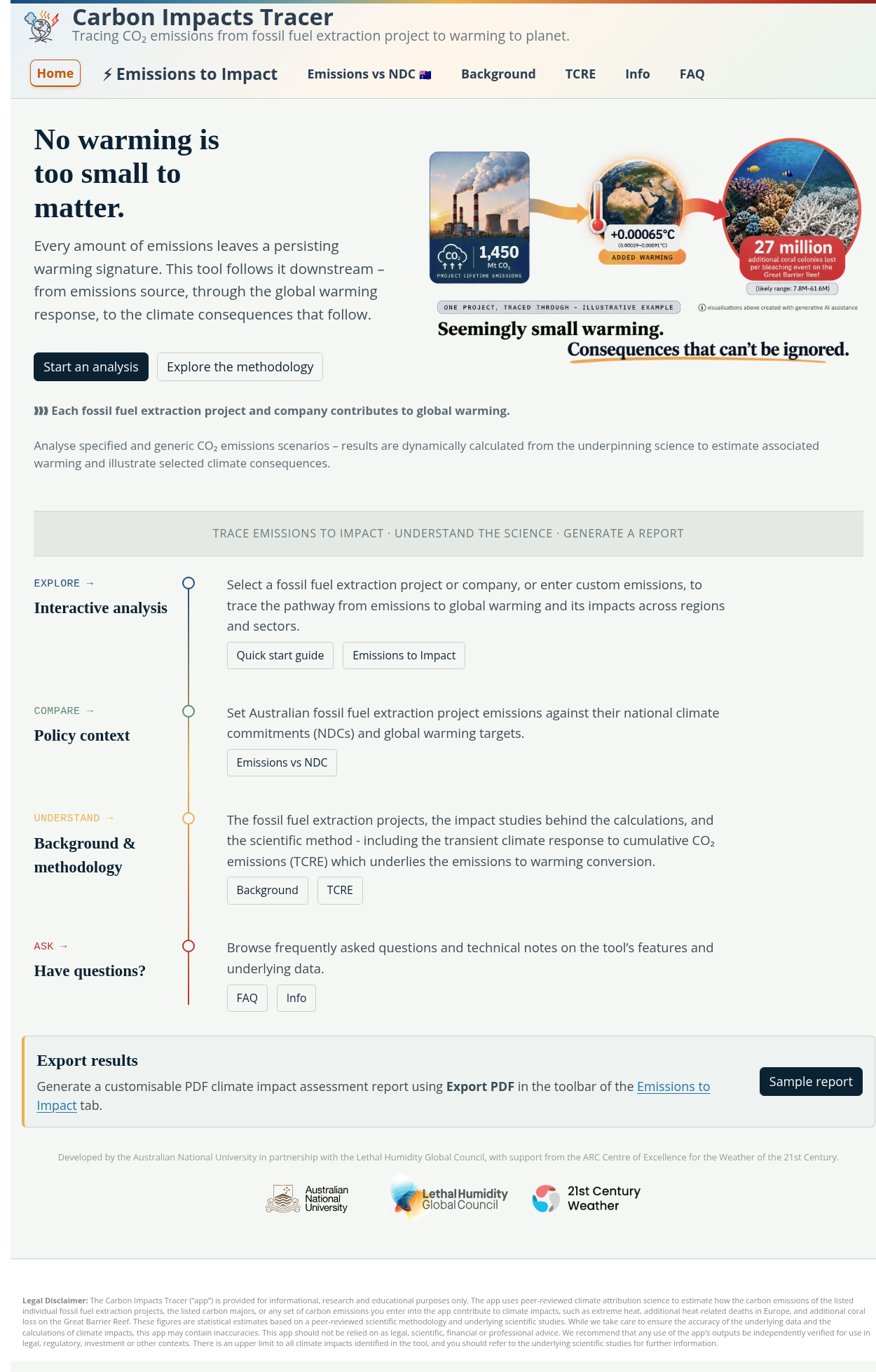
The Carbon Impacts Tracer is a scientific tool that links CO2 emissions from specific fossil fuel projects and companies to global warming impacts. It enables users to quantify climate consequences such as heat stress, crop loss, and coral degradation.
Please login or join for free to read more.

OVERVIEW
Carbon Impacts Tracer is an interactive analytical tool designed to trace carbon dioxide (CO2) emissions from specific fossil fuel extraction projects and major companies to their subsequent global warming impacts. It utilises peer-reviewed climate attribution science and the transient climate response to cumulative CO2 emissions (TCRE) to estimate how individual entities contribute to global temperature rises and specific environmental consequences. For finance professionals, it provides a scientific basis for assessing the physical risk and climate liability associated with specific fossil fuel assets and corporate portfolios.
Organisation behind the tool
The tool was developed by the Australian National University (ANU) in partnership with the Lethal Humidity Global Council. It received additional support from the ARC Centre of Excellence for the Weather of the 21st Century.
What the tool does
- Allows users to select from a database of Australian and international fossil fuel projects or “carbon major” companies to view their projected emissions impacts.
- Provides a custom emissions entry feature to trace generic scenarios to warming outcomes.
- Calculates specific climate consequences, including heat-related deaths in Europe, Great Barrier Reef coral loss, crop production loss, and glacier retreat.
- Compares Australian fossil fuel project emissions against National Determined Contributions (NDCs) and global warming targets.
- Generates customisable PDF climate impact assessment reports for specific scenarios.
Target audience
The primary audience includes researchers, legal professionals, and policymakers, as well as investment and finance professionals seeking to verify the climate impacts of specific fossil fuel extractions.
Relevance to finance professionals
- Risk assessment – Quantifies the contribution of specific projects to physical climate hazards such as extreme heat and labour productivity loss.
- ESG analysis – Offers data-driven metrics for environmental reporting by linking corporate emissions directly to specific ecological and social damage.
- Investment context – Helps investors understand the long-term environmental and economic consequences of fossil fuel extraction in their portfolios.
- Legal and regulatory – Provides peer-reviewed statistical estimates that can be used to inform discussions on climate liability and regulatory alignment.