

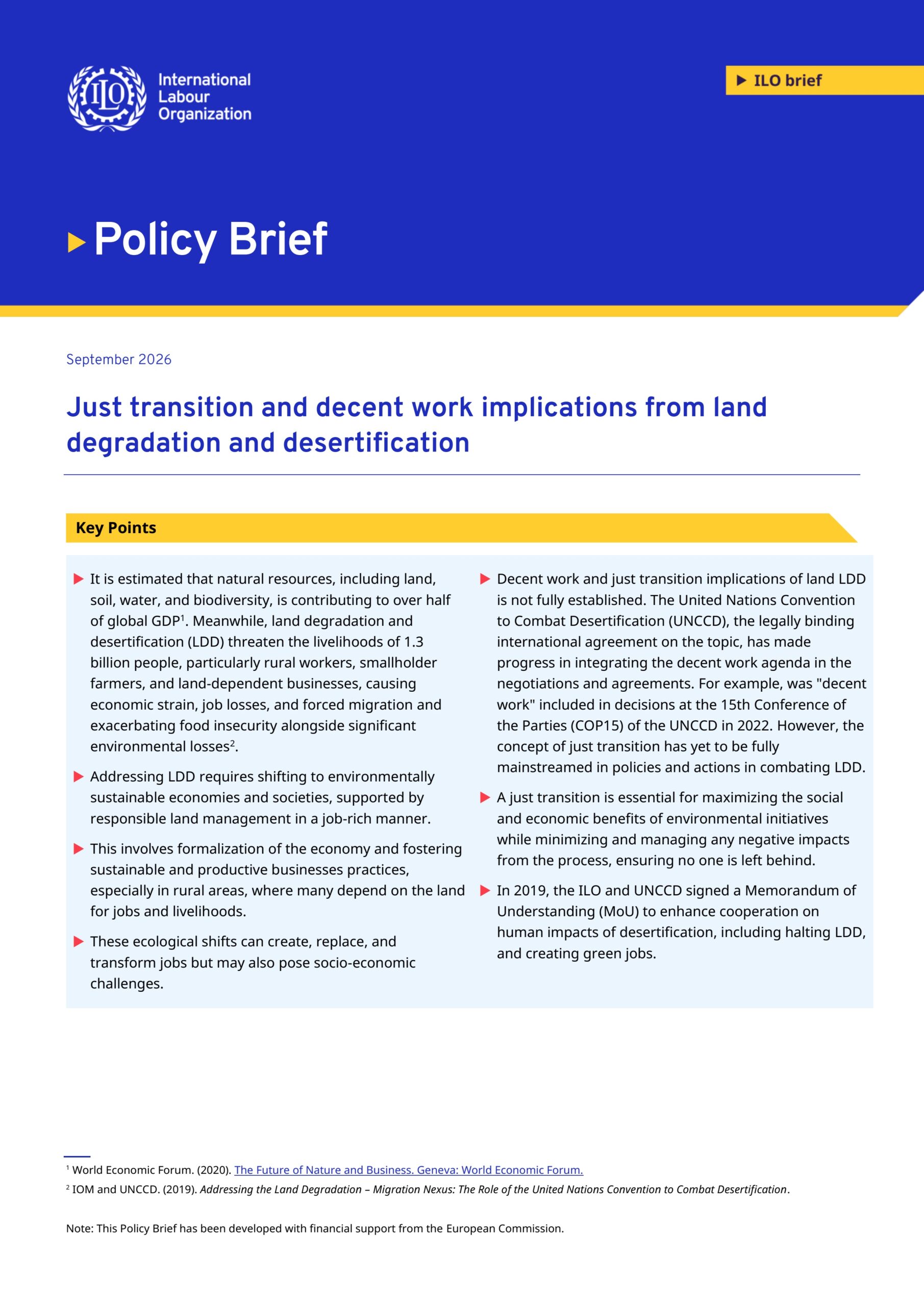
Just transition and decent work implications from land degradation and desertification
This report examines the impact of land degradation and desertification on global employment and livelihoods. It advocates for integrating just transition principles into environmental policies to ensure decent work, social justice, and economic resilience, particularly for vulnerable groups such as women, youth, and indigenous populations.
Please login or join for free to read more.

OVERVIEW
Background
The International Labour Organization (ILO) Guidelines for a Just Transition towards environmentally sustainable economies and societies for all provide a policy framework and operational tool to address environmental change while advancing social justice and promoting decent work creation. This policy brief explores the link between just transition and land degradation and desertification (LDD), providing insights into how LDD impacts decent work and positioning the just transition agenda within the framework of the United Nations Convention to Combat Desertification (UNCCD). It synthesises findings on the employment effects of LDD, identifies challenges and opportunities, and illustrates approaches to address these issues to support job creation and socio-economic resilience.
Socio-economic impacts of LDD
Natural resources, including land, soil, water, and biodiversity, underpin global economic wealth and contribute to over half of global GDP. The ILO estimates that 1.2 billion jobs depend on healthy ecosystems, yet the Intergovernmental Panel on Climate Change (IPCC) reports that between 1.3 to 3.2 billion people are already affected by land degradation. LDD results in the loss of soil health, biodiversity, and productivity, intensifying poverty, hunger, inequality, and vulnerability to climate-related events like droughts and floods. These impacts disproportionately affect women and vulnerable populations, such as indigenous and tribal peoples, pastoralists, persons with disabilities, and those living in poverty.
Economic impacts of LDD
LDD triggers broad economic disruptions by impacting industries reliant on natural resources. The estimated global economic value of natural ecosystem services ranges from US$ 125 to US$ 140 trillion annually. These services, including pollination and water purification, support critical sectors such as agriculture, tourism, energy, and construction. Every dollar spent on land restoration yields between US$ 7 and US$ 30 in benefits; conversely, inaction could result in annual economic losses estimated between US$ 10 trillion and US$ 31 trillion. Human activity has already altered 70 per cent of Earth’s land, with agricultural expansion responsible for approximately 90 per cent of global deforestation.
Employment and livelihoods
Approximately 40 per cent of the global workforce is dependent on nature and ecosystem services. LDD exacerbates prevailing decent work deficits, as declining land productivity causes jobs to become unstable and lower in quality. Between 2000 and 2015, an estimated 23 million working-life years were lost annually due to environmental disasters, many of which were exacerbated by LDD. In regions like Sub-Saharan Africa, an estimated 60 million people may be forced to migrate due to LDD and the lack of viable livelihoods. The cotton sector in Uzbekistan illustrates these risks, where land degradation and the decline of the Aral Sea led to surged unemployment and the collapse of local fisheries.
Gendered dimension of LDD
Women and girls are disproportionately affected by environmental degradation, particularly in agriculture-dependent regions where one-third of the global female workforce is engaged. Rural women often work in low-skilled, informal employment with poor conditions and limited social protection. Structural barriers, including exclusion from land-use decision-making and insecure land tenure, push women further into precarious, seasonal labour and intensify food insecurity.
Impacts on indigenous and tribal peoples
LDD undermines the cultural identity of indigenous and tribal communities by disrupting traditional knowledge and management practices. Displacement from degraded lands threatens livelihoods and erodes traditions. In Burkina Faso, the Great Green Wall initiative demonstrated the value of integrating indigenous restoration techniques, creating approximately 300 jobs, 70 per cent of which were filled by women, and increasing crop yields.
Linking LDD and just transition
A just transition is essential for maximising the social and economic benefits of environmental initiatives while minimising negative impacts. While the just transition agenda has previously focused on climate change and decarbonisation, expanding this approach to sustainable land management is vital for safeguarding livelihoods. Policies must integrate decent work and labour rights, ensuring affected populations have access to alternative livelihoods, social protection, and educational opportunities.
Priority agendas of the global framework of UNCCD
The UNCCD, established in 1994, aims for land degradation neutrality (LDN) through land restoration. While decent work was not initially central to its focus, it has been integrated into the agenda, particularly at COP15 in 2022. This shift marked a commitment to creating sustainable jobs and green employment opportunities for vulnerable groups, including women, youth, and indigenous communities. Regional initiatives, such as Tanzania’s 2014 guidelines, have successfully mainstreamed actions to combat desertification into sectoral policies for forestry, tourism, and agriculture.
How labour markets may change with land degradation neutrality
Labour market effects from LDD responses fall into four categories: new jobs created, existing jobs substituted, jobs eliminated without replacement, and the transformation of existing roles. However, transitions may face misalignments, including temporal (job loss preceding green job creation), spatial (jobs located far from workers), skills-based (lack of qualifications), and sectoral. A just transition is required to accelerate the shift from jobs contributing to LDD toward those mitigating it while managing these risks.
Role of government and social partners
Governments, employers’ and business membership organisations (EBMOs), and workers’ organisations play essential roles in driving a just transition. EBMOs can mobilise businesses for land restoration and sustainable land use, while workers’ organisations advocate for fair wages, safe conditions, and social protection for workers in affected sectors. Social dialogue is key to ensuring that the voices of vulnerable communities are included in decision-making processes.
Combatting LDD across the nine just transition policy areas
Governments should use public investments to develop resilient infrastructure and rehabilitate natural resources. Enterprise policies must foster an enabling environment for micro, small, and medium-sized enterprises (MSMEs) and cooperatives. Skills development policies should address gaps through holistic training for green jobs, while occupational safety and health (OSH) policies must address emerging risks like heat stress and pesticide exposure. Social protection systems, active labour market policies, and the protection of core labour standards are vital for supporting workers through structural changes.
Conclusions and key recommendations
Addressing LDD is critical for safeguarding livelihoods and ensuring food security. Transitioning to sustainable land management offers potential for job creation and economic growth but requires careful planning to manage socio-economic risks. Governments must consider integrating just transition principles into their responses to LDN. Furthermore, context-specific research is required across all nine policy areas of the ILO Just Transition Framework, including mapping out risks and misalignments related to the transitions required to achieve LDN.




