

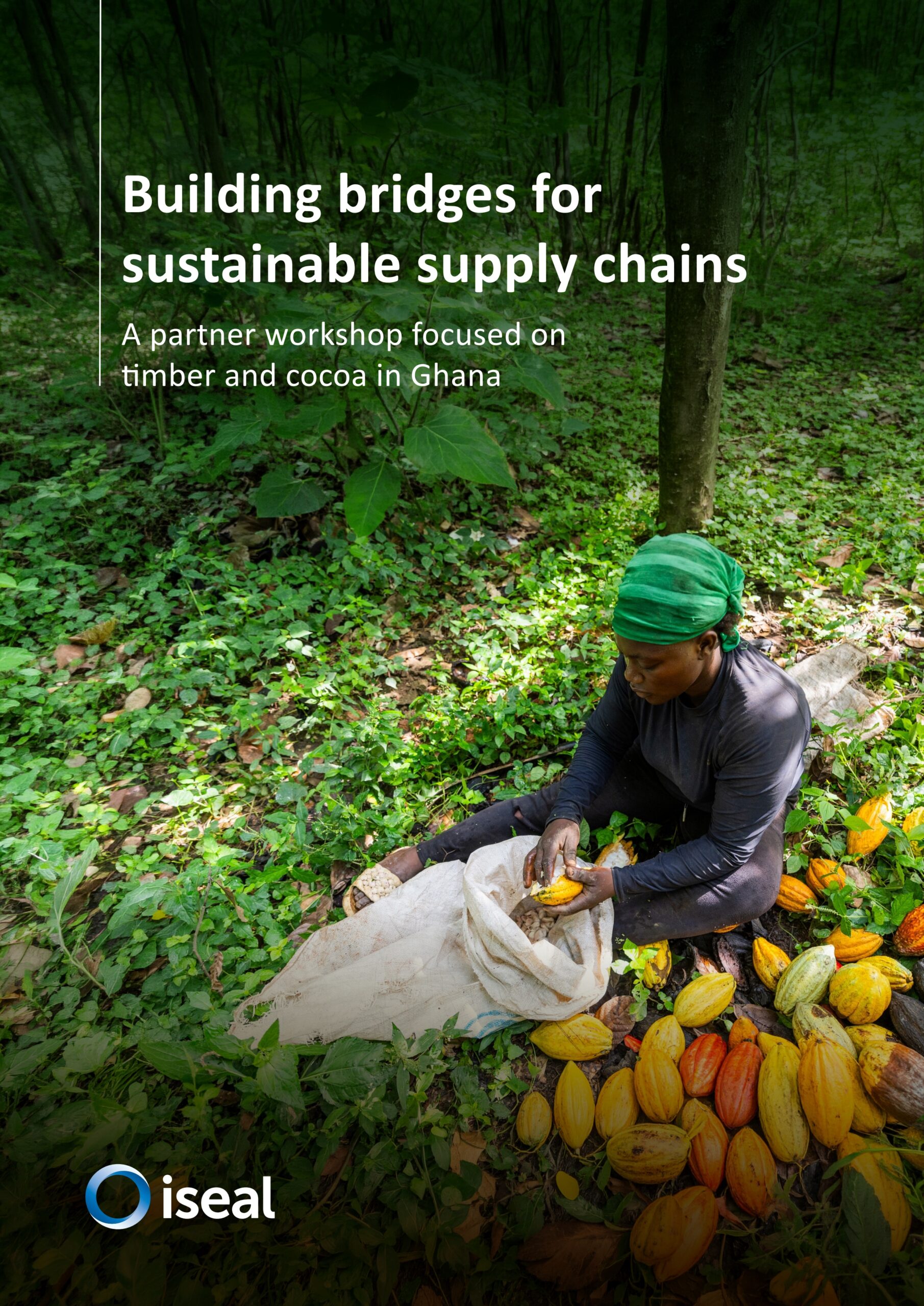
Building bridges for sustainable supply chains: A partner workshop focused on timber and cocoa in Ghana
This report summarises a June 2026 workshop regarding Ghana’s national timber and cocoa sustainability systems. It examines digital traceability, governance, and interoperability between national frameworks and voluntary standards. Key recommendations include strengthening data quality, ensuring sustainable financing, and aligning national systems with international climate standards to improve market recognition.
Please login or join for free to read more.

OVERVIEW
Executive summary
On 8 June 2026, ISEAL convened a partner workshop in Accra, bringing together 54 representatives from 29 organisations including government, civil society, and the private sector. This event launched a five-year project, supported by the UK government’s Forest Governance, Markets and Climate (FGMC) programme, focused on strengthening the credibility and market recognition of national sustainability systems. Key findings highlighted that national systems are interconnected arrangements of institutions and data, rather than standalone technologies. Digital traceability is improving information access but risks creating fragmentation if interoperability is not prioritised.
Background and introduction
The report notes growing demand for information regarding commodity origins and production conditions, driven by new due diligence requirements from demand-side governments and ambitious corporate sourcing commitments. For producer countries like Ghana, where smallholders play a significant role, meeting these expectations is challenging. National legality and sustainability systems align domestic policy with market needs, providing necessary standards, data collection, and assurance. ISEAL views these systems as complementary to existing voluntary efforts, offering a way to strengthen forest governance and support long-term economic development.
A framework for understanding national systems
National systems translate legal and sustainability requirements into operational controls and verifiable evidence of compliance. They consist of foundations, such as legal frameworks, supply-chain controls, and stakeholder engagement, as well as enablers like capacity building and finance. Data and traceability are identified as cornerstones, spanning six domains: producer and plot registration, geospatial monitoring, commodity traceability, certification and compliance, export reporting, and governance. The ISEAL Credibility Principles—including impartiality, reliability, and transparency—provide a lens for ensuring these systems remain effective and trustworthy over time.
Ghana’s experience
Ghana’s Timber Legality Assurance System (GhLAS) is a mature framework that supports Forest Law Enforcement, Governance and Trade (FLEGT) licensing. In August 2025, Ghana achieved a historic milestone as the first African nation to issue FLEGT licences for timber exported to the European Union. This system is underpinned by the Ghana Wood Tracking and Decision Support System (GWT-DSS), which tracks timber from stump to market, replacing manual processes with digital audits and management dashboards. Transparency is further supported by the Ghana Timber Transparency Portal, providing public access to harvesting information.
In the cocoa sector, the Ghana Cocoa Board (COCOBOD) established the Cocoa Management System (CMS) in 2019 as a national database for cocoa farmers. As of June 2026, over 1.3 million farms covering 1.46 million hectares have been mapped, with 793,000 farmers registered. The Ghana Cocoa Traceability System (GCTS) uses this infrastructure to trace cocoa from individual plots to ports using 13.6 million barcoded tags procured for the 2025/26 season. Ghana is also implementing the African Regional Standard (ARS) 1000 series to support compliance with regulations like the EU Deforestation Regulation (EUDR).
Discussion and dialogue from the workshop
Digitalisation offers significant opportunities for efficient data management and accountability but introduces complexities such as data ownership concerns and the potential exclusion of actors with limited digital capacity. Participants emphasised the need for interoperability to ensure information is reused across processes rather than repeatedly collected. Five enabling conditions for effective traceability were identified: interoperability, high-quality data governance, political backing, sustainable financing, and meaningful stakeholder participation. Furthermore, trust in national systems depends on independent verification and oversight, with systems needing to balance transparency against producer privacy and data sovereignty.
From learning to practice: guidance and recommendations for next steps
The report outlines short-term recommendations including making system information more accessible, establishing structured feedback routes for smallholders, and prioritising interoperability between national and voluntary platforms. There is a specific need to review alignment with emerging climate standards, such as the GHG Protocol’s Land Sector Removals Standard (LSRS) and the Science Based Targets initiative (SBTi) Corporate Net Zero Standard v2.0, which include specific requirements for physical traceability.
Longer-term recommendations focus on establishing sustainable and equitable financing arrangements that do not burden smaller producers. Developing and publishing data standards for Key Data Elements (KDEs) and Critical Tracking Events (CTEs) is also advised to support data portability. National systems should be utilised as platforms for wider risk assessment and evidence-based policy, ensuring they deliver value beyond mere regulatory compliance while maintaining alignment with evolving international market expectations.




