

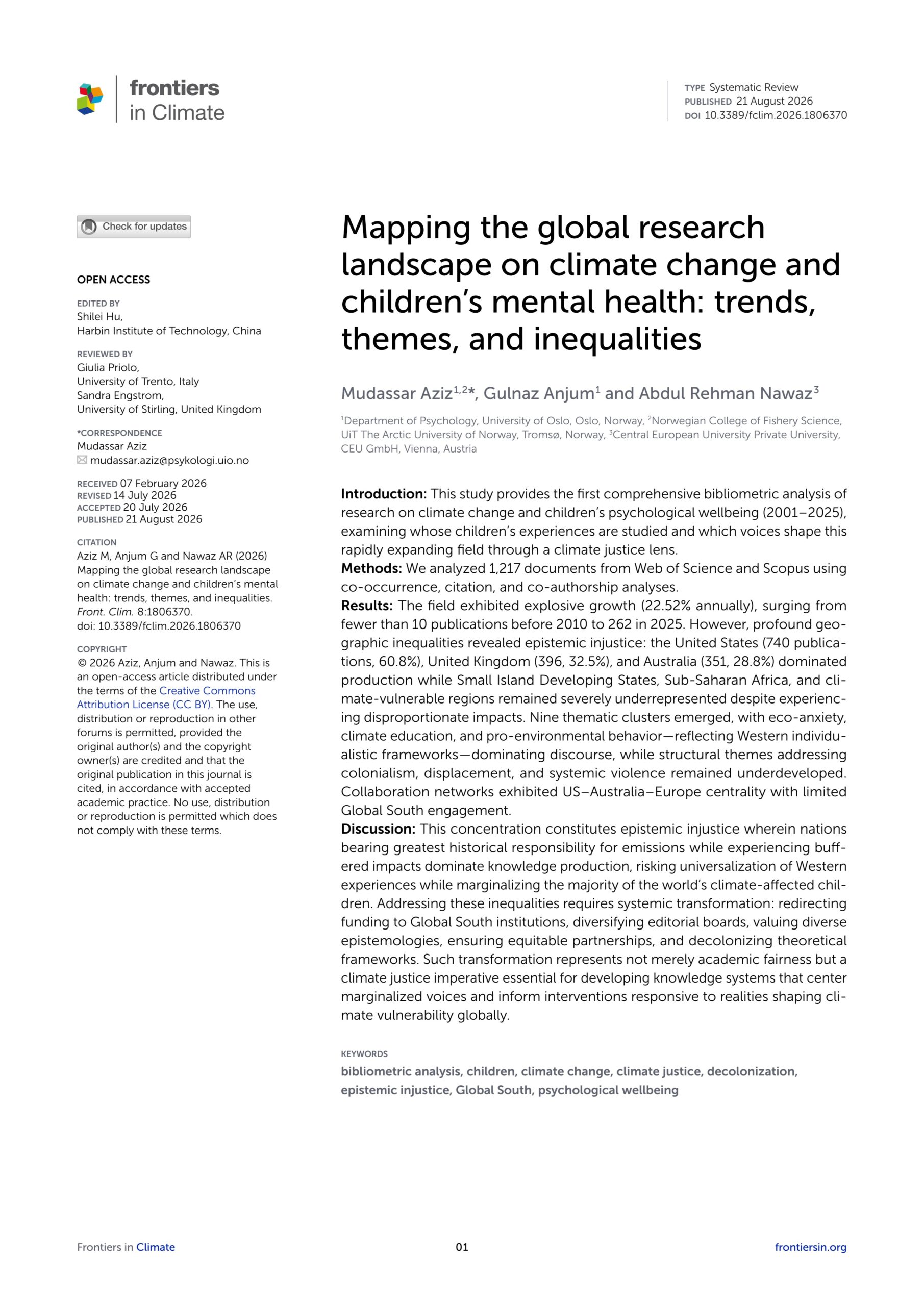
Mapping the global research landscape on climate change and children’s mental health: trends, themes, and inequalities
This systematic review provides a bibliometric analysis of climate change and children’s psychological wellbeing research (2001–2025). It reveals explosive growth but significant geographic inequality, with Global North institutions dominating production. The study advocates for decolonising frameworks and redirecting resources to ensure epistemic justice for climate-vulnerable populations.
Please login or join for free to read more.

OVERVIEW
Introduction
Climate change is one of the most pressing global challenges, with profound implications for human health and wellbeing. Children and adolescents are among the populations most vulnerable to these impacts, facing both immediate health risks from climate-related disasters and long-term psychological consequences. Approximately one billion children—nearly half the world’s youth population—live in countries classified by UNICEF as at extremely high risk from climate impacts, with the overwhelming majority located in the Global South. Despite this, the burden of climate impacts is not distributed equally, and research production often fails to reflect the experiences of those most affected. This study provides the first comprehensive bibliometric analysis of research on climate change and children’s psychological wellbeing from 2001 to 2025, examining the field through a climate justice lens.
Methods and materials
Researchers conducted a systematic mapping of scientific literature using 1,217 documents retrieved from the Web of Science Core Collection and Scopus databases on 12 November 2025. The analysis focused specifically on psychological, social-psychological, and psychiatric literature to ensure a shared disciplinary frame for comparing keywords, sources, and citation practices. Bibliometric techniques including co-occurrence, co-authorship, and citation analysis were employed using software such as Biblioshiny and VOSviewer. The selection process followed PRISMA guidelines, filtering documents by subject category, language, and document type to produce a final corpus for analysis.
Results
The field has exhibited explosive growth, with an annual growth rate of 22.52%. Scientific production surged from fewer than 10 publications annually before 2010 to 262 in 2025. However, the results revealed profound geographic inequalities. The United States dominates production with 740 publications (60.8%), followed by the United Kingdom (396, 32.5%), Australia (351, 28.8%), and Canada (308, 25.3%). In contrast, climate-vulnerable regions in the Global South remain severely underrepresented. For example, Pakistan accounts for only 41 documents (3.4%) despite being one of the countries most severely affected by recent climate disasters. Most leading research institutions are located in high-income nations, with North Carolina State University leading (41 publications), followed by Deakin University (38) and the University of Melbourne (37).
Thematic analysis identified nine distinct clusters. Dominant themes include eco-anxiety, climate education, and pro-environmental behaviour, which often reflect Western individualistic frameworks. The largest cluster, Cluster 1, focuses on psychological responses to disasters, including terms such as anxiety, depression, stress, and PTSD. While youth activism and climate justice appear in the collaboration network, they remain less developed than individualised psychological constructs. Highly influential works include studies on hope and coping strategies, with the most cited article receiving 88 local citations. Collaboration networks exhibit a strong US–Australia–Europe centrality with limited engagement from Global South institutions.
Discussion
The findings indicate a state of epistemic injustice where nations bearing the greatest historical responsibility for emissions dominate the discourse on children’s mental health while experiencing buffered impacts. This concentration risks the universalisation of Western experiences while marginalised children in the Global South experience climate change as immediate threats to survival, such as food insecurity and displacement. Structural barriers, including language requirements and funding imbalances, perpetuate these disparities. Notably, the majority of funding for climate research on Africa flows to institutions in Europe and North America rather than African organisations. The practice of ‘parachute science’—where Global North researchers extract data without meaningful local collaboration—further entrenches these inequities.
Conclusion
Addressing these inequalities requires a systemic transformation across the research landscape. Recommended actions include redirecting funding to Global South institutions, diversifying editorial boards, and valuing diverse epistemologies. Decolonising theoretical frameworks is essential to move beyond individualistic Western paradigms and centre marginalized voices. Such transformation is a climate justice imperative necessary to develop knowledge systems responsive to the structural realities shaping climate vulnerability globally. Only by dismantling epistemic injustices can climate psychology effectively support all children facing an uncertain climate future.




