

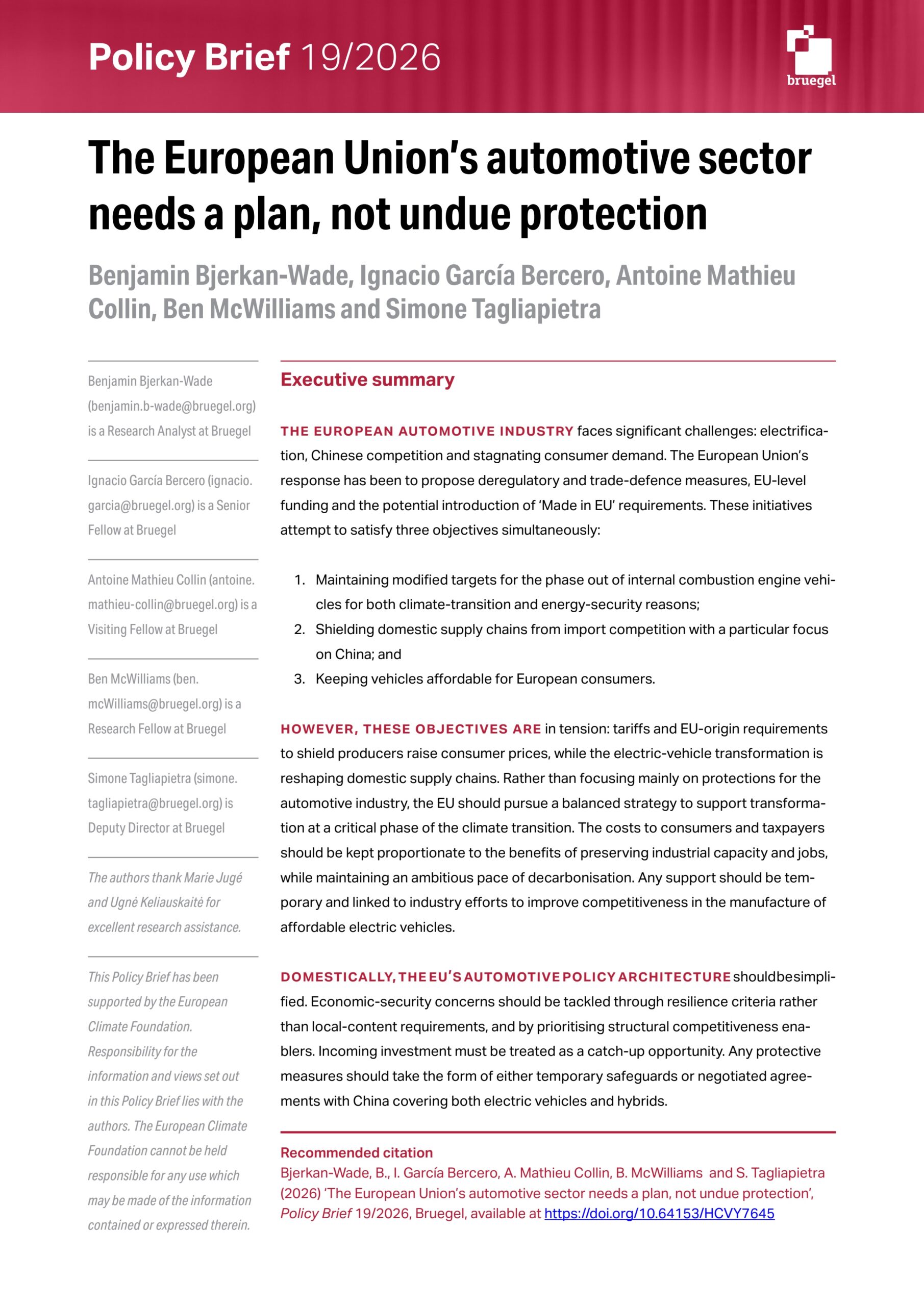
The European Union's automotive sector needs a plan, not undue protection
This report analyses the EU automotive sector’s challenges from electrification and Chinese competition. It argues against protectionist local-content requirements, recommending structural reforms, a negotiated trade agreement with China, and leveraging foreign investment to facilitate industry adjustment, ensuring long-term competitiveness while maintaining an ambitious pace of decarbonisation.
Please login or join for free to read more.

OVERVIEW
Introduction
The European automotive sector is undergoing a profound transformation driven by electrification, increasing competition from China, and declining domestic demand. This sector is vital to Europe’s prosperity, yet fears regarding its disruption have led to political discussions focused on protecting incumbent industries rather than facilitating adaptation. Current policy proposals from the European Commission include delaying the transition to electric vehicles (EVs), introducing local-content requirements for subsidies, and imposing tariffs on Chinese imports. However, these measures often conflict with objectives to maintain decarbonisation targets and keep vehicles affordable for consumers. A balanced strategy is required to support industry transformation while ensuring costs to taxpayers and consumers remain proportionate to the benefits of preserving industrial capacity.
The state of the European automotive industry
EU passenger car production has declined significantly, falling by approximately 2.6 million units since 2019, representing a 19 per cent drop. This decline is partly attributed to a drop in demand, with Europeans purchasing 2.2 million fewer new cars in 2025 than in 2019. Despite lower output, European carmakers recorded their highest profit margins in 2023 by focusing on higher-priced vehicles. The sector remains a critical employer, with 14 million Europeans employed across the value chain, representing 6 per cent of total employment. Geographically, this employment is concentrated in regions such as Lower Saxony and Bavaria in Germany, and northern Italy. The transition to EVs is accelerating, with EVs accounting for 28 per cent of new car sales in the EU in 2025, up from just 3 per cent in 2019. More than €76 billion has been invested in European battery and EV manufacturing since 2017, providing a production capacity of 4.6 million EVs per year.
Automotive trade trends
The EU remains a net exporter of vehicles, with 2025 exports valued at €157 billion and imports at €75 billion, resulting in an €82 billion surplus. However, internal combustion engine (ICE) exports to China fell from an average of €18 billion between 2017 and 2024 to €8 billion in 2025. In the EV segment, the EU maintained a €14 billion trade surplus in 2025. Chinese-built EVs are rapidly gaining market share, surpassing 20 per cent of total EV sales in 2026. While the EU introduced duties ranging from 7.8 per cent to 35.3 per cent on Chinese-produced automobiles in 2024, these apply only to battery electric vehicles (BEVs) and not plug-in hybrids (PHEVs). Consequently, PHEV imports from China have grown substantially, potentially undermining climate targets and the effectiveness of trade-defence measures.
European automotive policy
EU industrial policy for EVs consists of several overlapping initiatives. The 2025 ‘Industrial Action Plan’ introduced a ‘Battery Booster’ package of grants, a review of carbon emissions targets, and funding for charging infrastructure. The proposed ‘Industrial Accelerator Act’ (IAA) seeks to introduce EU-origin content requirements for public support schemes and imposes conditions on foreign investment exceeding €100 million. The Commission has also proposed amending CO2 emission standards so that, after 2035, carmakers could comply with a 90 per cent exhaust-emissions reduction target, with the remaining 10 per cent offset via low-carbon fuels. National consumer-subsidy schemes vary, with France and Spain applying ‘Made in Europe’ criteria, which have been shown to reduce total EV penetration and slow fleet decarbonisation.
Lessons in dealing with cheap car (and other) imports
Historical precedents offer lessons for managing disruptive competition. In the 1990s, trade tensions with Japan were managed through voluntary export restraints, which encouraged Japanese firms to invest in European manufacturing facilities, modernising local supply chains. Similarly, Canada implemented a tariff-rate quota system in 2026 for Chinese-made EVs, allowing 49,000 units to enter at a reduced 6.1 per cent tariff to boost affordability while managing domestic impact. In contrast, the Swiss quartz crisis showed that adjustment can occur through repositioning into luxury markets without tariffs, while the unmanaged ‘China shock’ in the United States led to persistent local economic scarring and political backlash. These examples suggest that predictable, temporary trade restrictions can provide necessary time for local industry adjustment when combined with clear policy signals.
An implicit pact financed by consumers and taxpayers
The current EU automotive policy represents an implicit pact to shield producers in exchange for localising value chains. This pact involves significant trade-offs, particularly between the speed of the clean transition and economic security. Local-content requirements for batteries and green steel could raise the price of a new BEV by approximately €2,100, falling disproportionately on entry-level segments. Furthermore, regulatory unpredictability caused by repeated revisions to targets erodes the stability required for long-term investment. The benefits of these protections are concentrated among established carmakers, while the costs are borne by consumers and taxpayers through higher prices and subsidies.
Industrial and trade policy recommendations for the EU automotive sector
To ensure long-term competitiveness, EU policymakers should simplify and consolidate the complex regulatory architecture impacting the sector. The use of local-content requirements should be avoided as they lack transparent cost-benefit analyses and risk inflating vehicle costs. Instead, policy should focus on improving structural conditions, such as energy costs, skills, and charging infrastructure. Externally, the EU should treat inward foreign direct investment (FDI) as an opportunity for technology transfer and catch-up. A negotiated sectoral arrangement with China is recommended, potentially involving time-limited export quotas for both BEVs and hybrids, and commitments regarding the supply of critical inputs. Such an agreement would provide a predictable window for adjustment while maintaining incentives for EU producers to close the competitiveness gap.




