

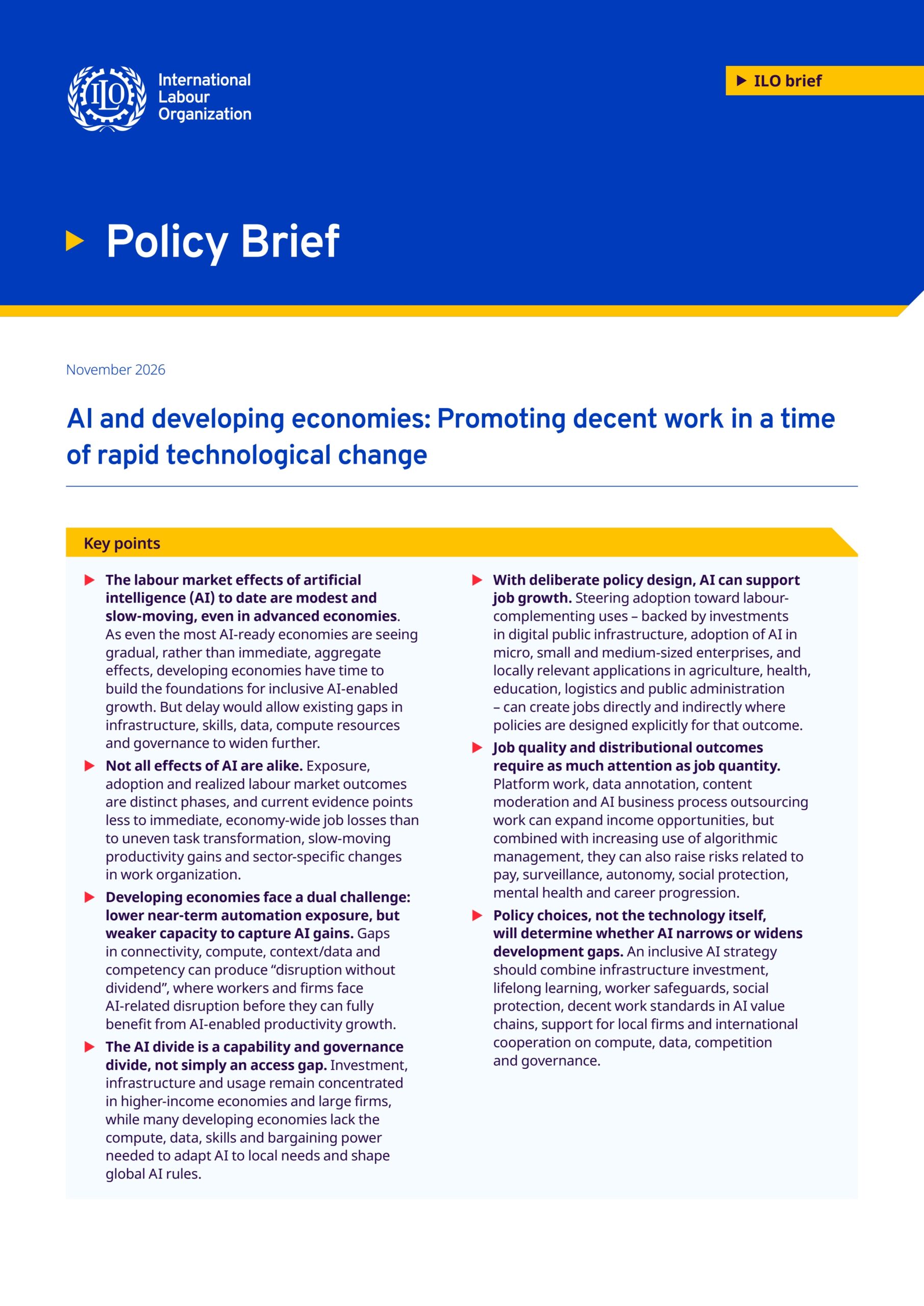
AI and developing economies: Promoting decent work in a time of rapid technological change
This policy brief examines AI’s impact on developing economies, highlighting a multidimensional divide in infrastructure and skills. It warns of “disruption without dividend”, where workers face automation before capturing productivity gains. It advocates for deliberate policy design, prioritising digital public infrastructure and decent work standards to ensure inclusive growth.
Please login or join for free to read more.

OVERVIEW
Introduction
The digital transformation of economies and labour markets has accelerated in recent years, building on decades of technological change from the twentieth century emergence of computers and the internet to recent advances in machine learning. This process has been further propelled by the deployment of artificial intelligence (AI) technologies, particularly generative AI (GenAI). These technologies are reshaping how work is organised, the tasks workers perform, and the skills demanded by employers. While AI creates opportunities for productivity growth and economic development, it also raises concerns regarding job displacement, job quality, and unequal access to technologies. Much existing research has focused on advanced economies, but this brief examines these transformations through the lens of developing economies, which differ significantly in labour market structures and institutional capacities.
Unequal starting conditions: the digital and AI divide
The effects of digital technologies depend on enabling conditions such as access to infrastructure, connectivity, devices, and skills. These conditions vary considerably, with disparities referred to as the digital and AI divide. In 2025, an estimated 6 billion people were online, leaving 2.2 billion without internet access. Regional differences are stark, with internet access reaching only 36 per cent of the population in Africa compared to 92 per cent in Europe. Meaningful AI use requires reliable electricity, high-speed connections, and compute resources. The World Bank uses a “4Cs” framework—connectivity, compute, context, and competency—to highlight that these gaps are widening. Developing economies often lack the local-language resources and compute capacity to adapt AI to their specific needs, risking a capability and governance gap where they become passive users of systems designed elsewhere.
AI adoption and productivity potential: large promise, uneven diffusion
The AI divide remains a significant barrier to adoption. In 2026, usage of frontier models like Claude remained concentrated in high-income economies, with the top 20 countries accounting for 48 per cent of all population-adjusted usage. Enterprise-level adoption also reflects a divide; in the European Union in 2025, 55.0 per cent of large enterprises used AI tools compared to only 17.0 per cent of small enterprises. A survey of more than 7,000 firms in the Middle East and North Africa region found only 27 were AI adopters. While micro-level evidence suggests substantial gains—such as a 40 per cent reduction in writing completion time and a 55.8 per cent speed increase in programming tasks—macroeconomic productivity effects remain modest, ranging from 0.1 to 1 percentage point annually. Developing economies may face “disruption without dividend”, where automation exposure arrives before the capacity to convert AI into broad productivity gains.
Digitalization, AI and job quantity
Research into 40 emerging digital technologies shows that the largest employment-to-population gains occurred in low-income countries, with an average increase of 1.39 percentage points. High-income and upper-middle-income countries followed with gains of 0.76 and 0.65 percentage points, respectively. Overall, women have experienced larger employment gains than men (0.70 vs 0.46 percentage points). However, GenAI exposure is positively correlated with income levels; 34 per cent of employment in high-income countries is exposed to GenAI to varying degrees, compared to only 11 per cent in low-income countries. While GenAI is more likely to augment rather than automate tasks, there are risks that it could narrow entry points into skilled occupations for young workers. In the United States, employment among workers aged 22 to 25 declined by 6 per cent in AI-exposed roles between 2022 and 2025.
Implications of digitalization and AI for job quality
Digitalisation and AI influence job quality through changes in work organisation and management. Algorithmic management tools are increasingly used for recruitment, task allocation, and performance evaluation. Without safeguards, these systems can reduce worker autonomy, intensify workloads, and increase stress. Evidence of these risks is strongest in urban platform work in emerging economies like India and South Africa. AI’s impact on wages is mixed; while it may enhance productivity for high-skilled workers, it could place downward pressure on wages for others. Online labour market evidence indicates that demand for substitutable freelance tasks, such as writing and translation, declined by 20 to 50 per cent following the release of ChatGPT.
New forms of work in the digital and AI economy
The expansion of digital connectivity has facilitated the growth of the platform economy. As of October 2025, at least 653 active digital labour platforms were identified globally. This has created a global AI workforce performing both high-skilled roles (data scientists) and lower-skilled tasks like data annotation and content moderation. These lower-skilled tasks are often performed by workers in developing economies and can be repetitive or involve exposure to harmful content. The adoption of the Decent Work in the Platform Economy Convention, 2026 (No. 193) provides an international benchmark for regulating these forms of work as labour market policy rather than mere technology issues.
Leapfrogging potential and its limits
AI offers opportunities for developing economies to bypass intermediate technological stages. In healthcare, AI-assisted diagnostics can extend expertise to rural areas. In agriculture, lightweight tools support pest detection and yield prediction. However, these benefits depend on investments in local infrastructure and “small AI” tools adapted to local languages and data needs. Realising this potential requires broad access to the infrastructure and skills needed for an inclusive digital transition.
Policy implications
The brief recommends that developing economies treat AI foundations as public infrastructure, prioritising reliable electricity, broadband, and shared compute access. Policy should make decent job growth an explicit objective by steering AI adoption toward labour-complementing uses in sectors like agriculture and health. Support for MSMEs through innovation vouchers and technical assistance is essential to prevent dependence on a few proprietary providers. Governments should integrate AI modules into labour force surveys to monitor actual adoption impacts. A comprehensive skills policy is required to help workers move from exposure to augmentation. Furthermore, workplace AI must be governed with requirements for human oversight, transparency, and data protection. Finally, regional and international cooperation is needed to help developing economies access shared compute, datasets, and representation in global AI rule-setting.




