

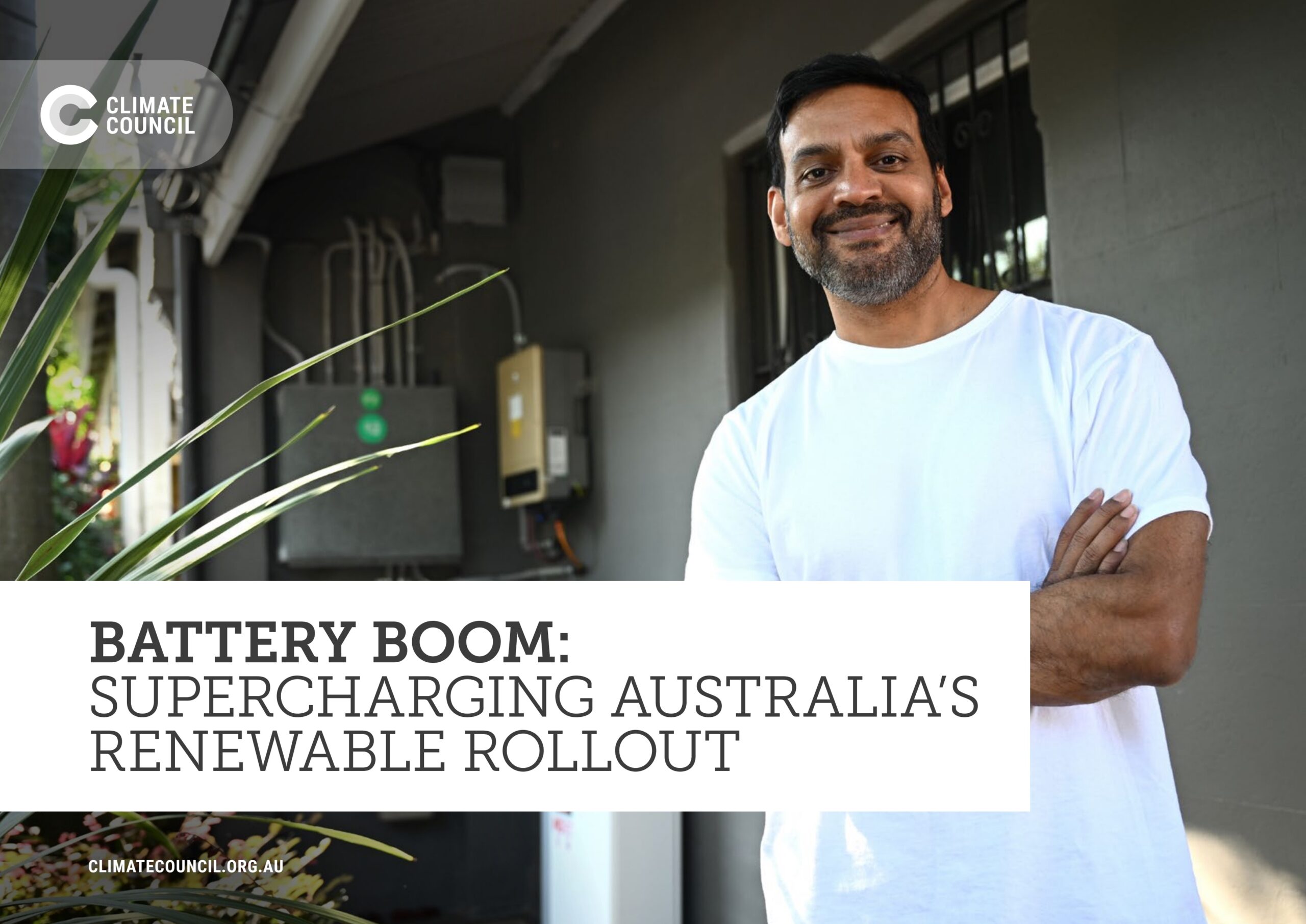
Battery boom: Supercharging Australia’s renewable rollout
This report examines Australia’s battery storage boom, detailing how two million household batteries by 2030 could save $4 billion annually. It analyses falling costs, state-level progress, and vehicle-to-grid technology, providing policy recommendations to integrate storage across the grid to accelerate the transition to a reliable, renewable energy system.
Please login or join for free to read more.

OVERVIEW
Key findings
Australians have the potential to collectively save more than $4 billion on their power bills every year if two million additional batteries are installed in homes and businesses by 2030. Currently, while four million households have solar, only 8 per cent have a battery. Pairing a battery with rooftop solar can nearly double a household’s annual savings, providing up to $2,300 in relief compared to $1,500 with solar alone. Nationally, Australia will require 49 GW of battery and pumped hydro storage by 2050 to maintain a reliable grid. Globally, battery prices have fallen 86 per cent since 2013, with the upfront cost of big batteries dropping by 20 per cent in 2024-25. The average payback period for an Australian household to recover the cost of a battery is now 8.3 years, down from 19 years in 2016.
Introduction
Australia is a global leader in renewable energy, with approximately 40 per cent of its power currently sourced from wind, solar, and hydro. Batteries represent the next frontier in reducing energy costs and climate pollution. Since the installation of the first grid-scale battery in 2017, Australia has added another 33, with more than 20 GW of large-scale storage currently in the pipeline. In addition to grid-scale projects, hundreds of community-scale batteries are being installed, and approximately 300,000 households have already integrated batteries into their rooftop solar systems.
Batteries will unlock Australia’s renewable potential as our energy system transforms
The Australian energy system is transitioning away from coal-fired power stations, which are expected to retire by 2038. These ageing stations are increasingly unreliable, frequently breaking down as they reach their end of life. To back new renewable generation, storage is essential. Analysis by the CSIRO confirms that a grid powered by 90 per cent wind and solar, supported by storage and upgraded transmission, is the most cost-effective way forward. Different types of storage play specific roles: shallow storage (batteries) manages peak demand and grid stability for less than four hours, while deep storage (pumped hydro) provides backup for weeks or months during periods of low wind and sun. Emerging technologies like green hydrogen and flow batteries are also being explored to provide longer-term dispatchable power.
Batteries are becoming cheaper and better, fast
While the cost of gas generation increased by 11 per cent in 2024-25, the upfront cost of big batteries fell by 20 per cent. Modern batteries are more powerful and efficient than earlier models; for example, the 560 MW Collie battery in Western Australia can power approximately 785,000 homes. Vehicle-to-grid (V2G) technology is another major opportunity, as electric vehicle (EV) batteries can store five to ten times more power than standard home batteries. If connected to the grid, EVs could become one of Australia’s largest forms of flexible storage. Households switching to an EV and using V2G can save around $2,000 per year on fuel costs, with some early adopters already earning $1,000 annually by selling energy back to the grid.
Australians are already embracing battery storage, but we’re just getting started
Australia’s battery storage capacity has more than doubled in the last three years. In 2024, more than 72,000 home batteries were installed, marking a 27 per cent increase from 2023. Batteries are also providing critical resilience during climate-fuelled disasters. During Cyclone Alfred in 2025, EV owners used vehicle-to-load (V2L) capabilities to power essential appliances like fridges and medical equipment during blackouts. To support further growth, Australia is developing a home-grown battery industry, leveraging its position as the producer of half of the world’s lithium. The Australian Government has committed $523 million to the Battery Breakthrough Initiative to promote local manufacturing.
Who’s leading the charge?
South Australia leads the nation in household battery proportion, with over 7 per cent of homes equipped with storage. Western Australia has the highest number of big batteries, while the Northern Territory has the highest proportion of solar-equipped homes that also have a battery (15.9 per cent). Victoria leads in community-scale storage through its Neighbourhood Battery Initiative. Nationally, the suburbs with the highest potential for additional home battery rollout include Tarneit in Victoria, alongside Bundaberg and Hervey Bay in Queensland.
How Australia can supercharge the battery boom
The Climate Council identifies five key policy opportunities to accelerate the rollout. First, solar and storage should be rolled out for 450,000 social housing properties to support the 800,000 residents facing high cost-of-living challenges. Second, the National Construction Code should be updated to ensure all new and substantially renovated buildings include solar and the capacity for storage. Third, the government should accelerate the rollout of ‘solar soaker’ community batteries, aiming for 5,000 units by 2030 to benefit renters and apartment dwellers. Fourth, a national V2G strategy should be developed to unlock the storage potential of the growing EV fleet. Finally, battery safety and recycling standards must be harmonised. Although 95 per cent of materials in lithium-ion batteries are recyclable, currently only 10 per cent are recycled in Australia.
Conclusion
Australia is well-positioned to reach its goal of a 94 per cent renewable grid this decade. By scaling up storage at all levels—from households and businesses to grid-scale batteries and pumped hydro—Australia can ensure reliable access to cheap, clean power around the clock. Adopting the Climate Council’s policy recommendations will allow for the installation of two million household batteries and 5,000 community batteries by 2030, securing a safer climate future for the next generation.




