

Buybacks playbook
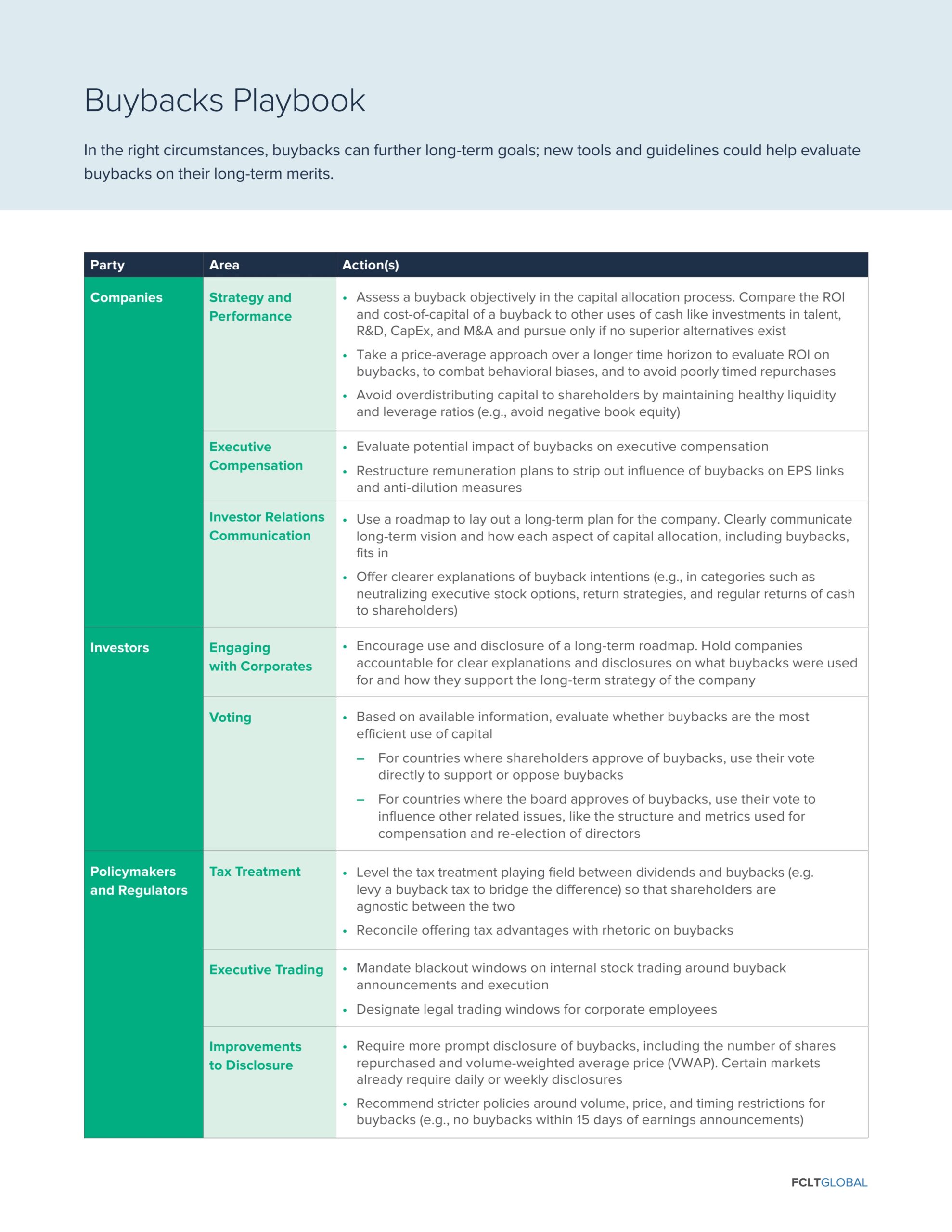
This playbook provides a framework for companies, investors, and policymakers to evaluate share buybacks based on long-term merits. It recommends objective capital allocation, decoupling executive pay from buyback-influenced metrics, and enhancing regulatory disclosures and trading restrictions to ensure repurchases support sustainable corporate strategy rather than short-term gains.
Please login or join for free to read more.

OVERVIEW
The “Buybacks Playbook” suggests that in the right circumstances, buybacks can further long-term goals. It notes that new tools and guidelines could help evaluate buybacks on their long-term merits. The report provides specific actions for three primary parties: companies, investors, and policymakers and regulators.
Strategy and performance
Companies are encouraged to assess a buyback objectively within the capital allocation process. This involves comparing the return on investment (ROI) and cost-of-capital of a buyback to other uses of cash. These alternative uses include investments in talent, research and development (R&D), capital expenditure (CapEx), and mergers and acquisitions (M&A). The playbook recommends that a company should pursue a buyback only if no superior alternatives exist for the capital. Additionally, companies should take a price-average approach over a longer time horizon to evaluate the ROI on buybacks. This strategy is intended to combat behavioural biases and to avoid poorly timed repurchases. Organisations should also avoid overdistributing capital to shareholders by maintaining healthy liquidity and leverage ratios, such as avoiding negative book equity.
Executive compensation
Regarding executive compensation, the report advises companies to evaluate the potential impact of buybacks on remuneration structures. It recommends restructuring remuneration plans to strip out the influence of buybacks on earnings per share (EPS) links and anti-dilution measures. This ensures that buyback decisions are not driven by performance metrics that might be artificially influenced by a reduction in the number of outstanding shares.
Investor relations communication
For investor relations communication, companies should use a roadmap to lay out a long-term plan. They should clearly communicate their long-term vision and explain how each aspect of capital allocation, including buybacks, fits into that vision. The playbook suggests offering clearer explanations of buyback intentions by using specific categories. These categories might include neutralising executive stock options, return strategies, and the regular return of cash to shareholders.
Engaging with corporates
Investors have a role in engaging with corporates to encourage the use and disclosure of a long-term roadmap. They should hold companies accountable for providing clear explanations and disclosures on what buybacks were used for. Furthermore, investors should ensure that these buybacks support the long-term strategy of the company.
Voting
Based on available information, investors should evaluate whether buybacks are the most efficient use of capital. In countries where shareholders approve of buybacks, they are encouraged to use their vote directly to support or oppose these measures. In countries where the board approves of buybacks, investors should use their vote to influence other related issues. These issues include the structure and metrics used for compensation and the re-election of directors.
Tax treatment
Policymakers and regulators are advised to level the tax treatment playing field between dividends and buybacks. One suggested method is to levy a buyback tax to bridge the difference so that shareholders are agnostic between the two. The report also suggests that regulators should reconcile the practice of offering tax advantages with the public rhetoric on buybacks.
Executive trading
In terms of executive trading, the playbook recommends that regulators mandate blackout windows on internal stock trading around the time of buyback announcements and execution. It also suggests designating legal trading windows for corporate employees to ensure transparency and prevent the misuse of non-public information during buyback programmes.
Improvements to disclosure
Finally, the report calls for improvements to disclosure by requiring more prompt reporting of buybacks. This should include the number of shares repurchased and the volume-weighted average price (VWAP). The playbook notes that certain markets already require daily or weekly disclosures. It also recommends stricter policies around the volume, price, and timing restrictions for buybacks, such as prohibiting buybacks within 15 days of earnings announcements.




