

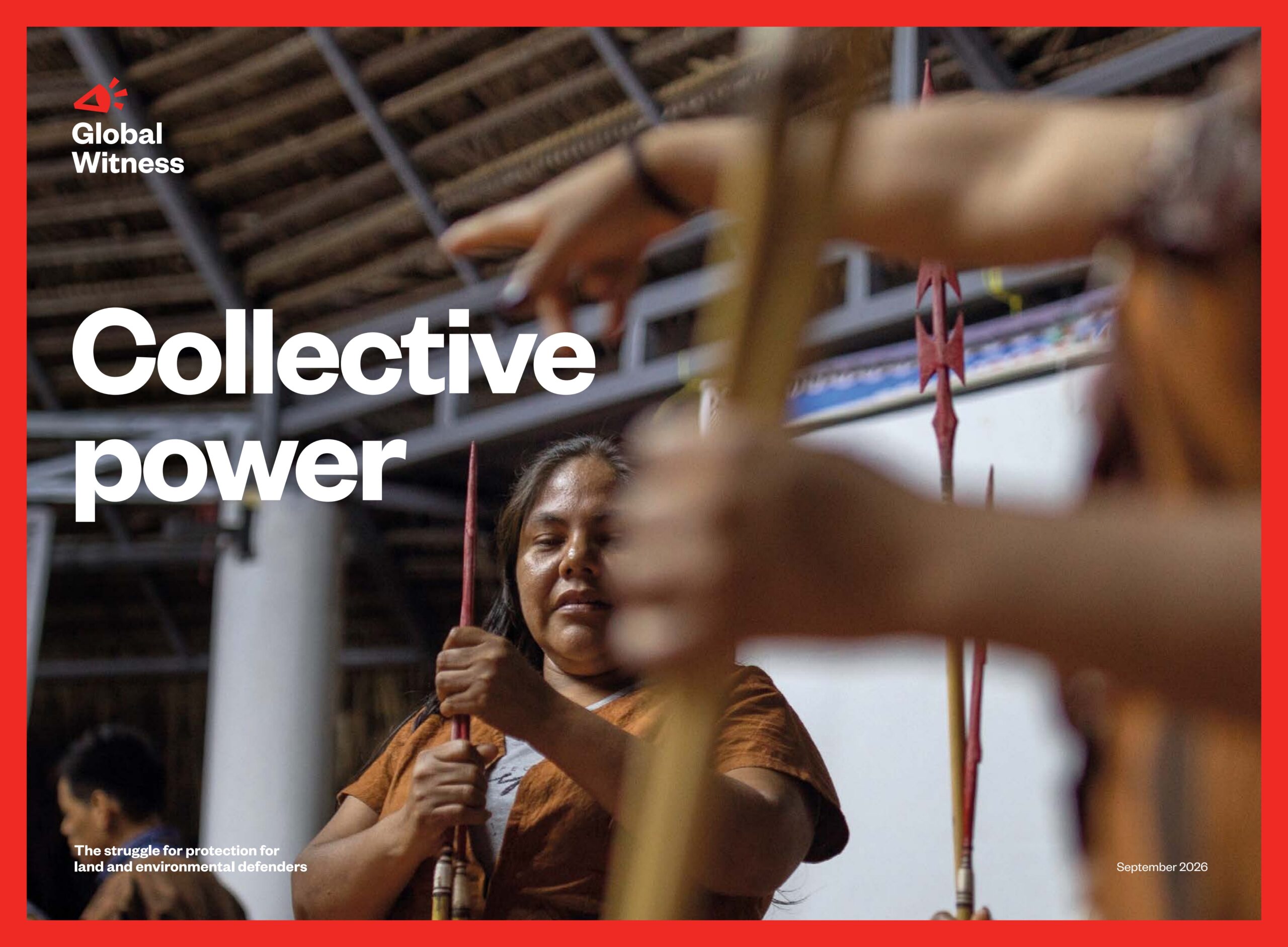
Collective power: The struggle for protection for land and environmental defenders
Global Witness reports that 124 land and environmental defenders were killed in 2025, bringing the total since 2012 to 2,375. Colombia remains the deadliest country. The report advocates for collective protection mechanisms and highlights the criminalisation of Indigenous communities resisting land grabs in Peru and Indonesia.
Please login or join for free to read more.

OVERVIEW
Foreword
Joan Carling, Executive Director of Indigenous Peoples’ Rights International, highlights that Indigenous communities are frequently excluded from decision-making, resulting in “green colonialism” where renewable energy and mineral projects drive land grabs and violence. In 2025, at least 124 defenders were killed worldwide. In the Philippines, 12 defenders were killed, with Global Witness linking five of those deaths to the armed forces. Carling argues that ancestral knowledge offers effective climate solutions and must be central to global policy efforts.
Global findings
Global Witness verified the killings of 124 land and environmental defenders in 2025. This brings the total number of documented killings and disappearances since 2012 to 2,375. Although the 2025 figure represents a decrease from 142 in 2024, the report warns that these figures are likely significant underestimates. Ten of the 15 countries where killings occurred were categorised as repressed by the CIVICUS Monitor. Latin America accounted for 85% of cases, reflecting pervasive state failures to protect defenders.
Colombia remains the deadliest country, with 39 killings documented in 2025. In Brazil, cases doubled from the previous year to 26, primarily driven by land conflicts involving small-scale farmers and Indigenous communities. Other countries with significant lethal attacks include the Philippines (12), Honduras (12), Mexico (10), and Guatemala (8). Beyond killings, defenders face a “hidden iceberg” of non-lethal attacks, including criminalisation, smear campaigns, and the weaponisation of social media.
Guarding the forest
In Peru, the Kakataibo people are resisting the encroachment of organised crime and illegal coca cultivation. Since 2020, six Kakataibo leaders have been killed. Between 2000 and 2023, ancestral Kakataibo territory lost roughly a fifth of its tree cover. In response, they established the Indigenous Guard of the Kakataibo People of Peru (GIPKAP) in 2022, which now includes over 150 members across 10 bases. The Guard asserts their constitutional right to administer justice and protect their territory independently of an often indifferent state.
Collective protection
Collective protection recognises that defenders are rarely targeted as isolated individuals but as members of communities. This approach shifts focus from reactive individual security to reducing the structural conditions that enable violence. It relies on community leadership, territorial monitoring initiatives like Indigenous Guards, and the establishment of safe spaces. The report recommends that states formally recognise, fund, and integrate these community-led strategies into national protection mechanisms.
Resisting corporate land grabs
In Indonesia, Dayak communities in West Kalimantan are resisting PT Mayawana Persada, which holds a 136,710-hectare concession. Since 2016, the company has cleared 35,000 hectares, including 19,000 hectares of orangutan habitat and 30,000 hectares of carbon-rich peatland. Dayak leaders, such as Tarsisius Fendy Sesupi, have faced criminalisation and extortion charges for using traditional justice systems to impose customary sanctions on the company. Global Witness has documented 26 killings of defenders in Indonesia since 2012, with agribusiness remaining the single biggest driver.
Case updates
The report provides updates on several high-profile cases. In Mexico, the disappearance of Ricardo Lagunes Gasca and Antonio Díaz Valencia in January 2023 remains unresolved despite international pressure. In the Philippines, youth defenders Jhed Tamano and Jonila Castro were abducted in 2023 and continue to face legal harassment. In Chile, the family of Mapuche defender Julia Chuñil, who disappeared in 2024, has been targeted with criminalisation by authorities.
Recommendations
The report outlines five pillars for action. Firstly, states must address structural drivers by securing collective land rights and ensuring Free, Prior and Informed Consent (FPIC). Secondly, they should strengthen collective protection by documenting attacks and creating early warning mechanisms. Thirdly, states must combat impunity by establishing specialised investigative units. Fourthly, they should protect civic space by repealing laws that criminalise activism. Finally, defenders must be put at the centre of climate and biodiversity policy, ensuring that regulations like the EU Deforestation Regulation (EUDR) and the Corporate Sustainability Due Diligence Directive (CSDDD) provide robust protections throughout corporate supply chains.




