

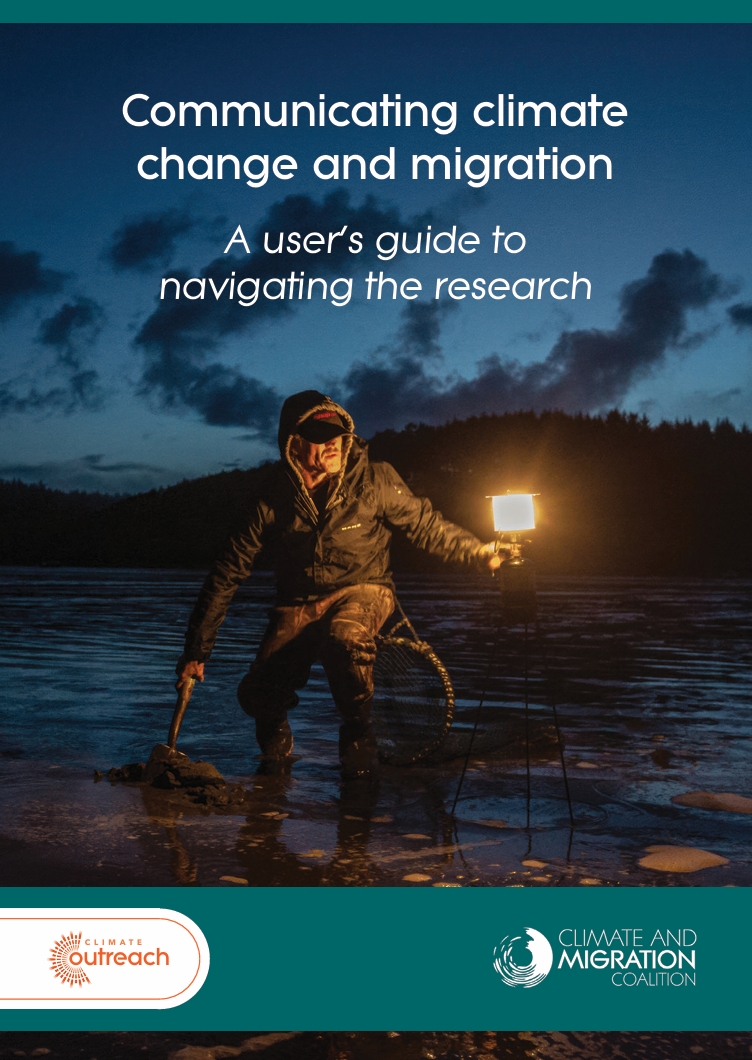
Communicating climate change and migration: A user’s guide to navigating the research
This report guides practitioners on communicating climate-linked migration, highlighting research gaps, biases and limited diversity. It emphasises critical engagement with academic literature, improved representation of affected communities, and the need for nuanced, interdisciplinary approaches to inform effective, ethical communication strategies.
Please login or join for free to read more.

OVERVIEW
A quick guide for communicators and practitioners
The report advises practitioners to engage critically with academic research on climate-linked migration. Key considerations include clarifying communication objectives, ensuring contextual relevance of studies, incorporating perspectives of affected communities, identifying knowledge gaps, and checking for bias. These steps help avoid misrepresentation and improve the effectiveness and fairness of communication strategies.
Why this report
The report addresses growing interest in climate-linked migration and the lack of clear definitions or consistent communication approaches. It highlights that climate change influences diverse mobility patterns, including displacement and planned relocation, yet uncertainty and fear of causing harm deter organisations from engaging. The report aims to help practitioners navigate academic research to inform clearer, more consistent communication.
Section I – Five need-to-knows about the current academic literature on communicating about climate-linked (im)mobilities
The literature is diverse but uneven. Five research categories are identified, with most studies focusing on public attitudes and discourse analysis rather than lived experiences. Research is skewed towards quantitative methods and underrepresents migrants’ perspectives and communities of origin.
There has been a notable rise in research since 2020, reflecting increasing policy and academic interest. However, studies disproportionately focus on WEIRD populations (Western, educated, industrialised, rich, democratic), limiting global applicability despite most climate-linked mobility occurring within regions.
The literature lacks interdisciplinary collaboration, with most studies published in climate or policy journals rather than migration-focused ones. This leads to fragmented approaches and inconsistent definitions of effective communication.
Additionally, research often excludes practitioners and individuals with lived experience in developing narratives. This limits practical relevance and reinforces narrow or repetitive framings.
Section II – Critical questions and reflections for research on communicating about climate-linked (im)mobilities
Studies testing narratives typically use experimental methods such as surveys and randomised controlled trials. They assess impacts on public attitudes, policy support, and perceptions of migrants, often using simplified scenarios or vignettes.
Findings show inconsistencies in how climate-linked mobility is defined, making comparisons difficult. Although research acknowledges complexity, tested narratives often oversimplify issues, prioritising measurable outcomes over nuance.
Many studies assume climate change will increase migration, sometimes citing unsupported large-scale projections. This can reinforce alarmist narratives and overlook regional variations or decreasing mobility in some contexts.
Migration is frequently framed as a risk or threat rather than a potential adaptation strategy. Positive outcomes of migration and the role of enabling policy environments are largely absent. This framing can bias public perception and obscure opportunities for constructive policy responses.
Section III – Five guiding questions for consulting peer-reviewed papers to inform your communications
The report provides five guiding questions to assess research applicability. Practitioners should align research with communication goals, assess contextual fit, and prioritise insights from affected communities.
They should also evaluate internal knowledge gaps and build connections with relevant organisations. Finally, they must identify and mitigate biases in research to avoid reinforcing harmful stereotypes or narratives.
These questions support more informed, context-sensitive communication strategies.
Conclusions and future directions for the research
The report concludes that while research on communicating climate-linked migration is expanding, it remains insufficiently nuanced. It recommends shifting from WEIRD to more diverse, globally representative research and strengthening interdisciplinary collaboration between climate, migration and communications fields.
Future research should prioritise perspectives of affected communities, explore migration as adaptation, and involve practitioners and policymakers in study design. It should also examine narratives that reflect agency and diverse experiences.
Greater engagement with influential actors such as governments and media is encouraged to improve real-world impact and public discourse on climate-linked mobility.




