

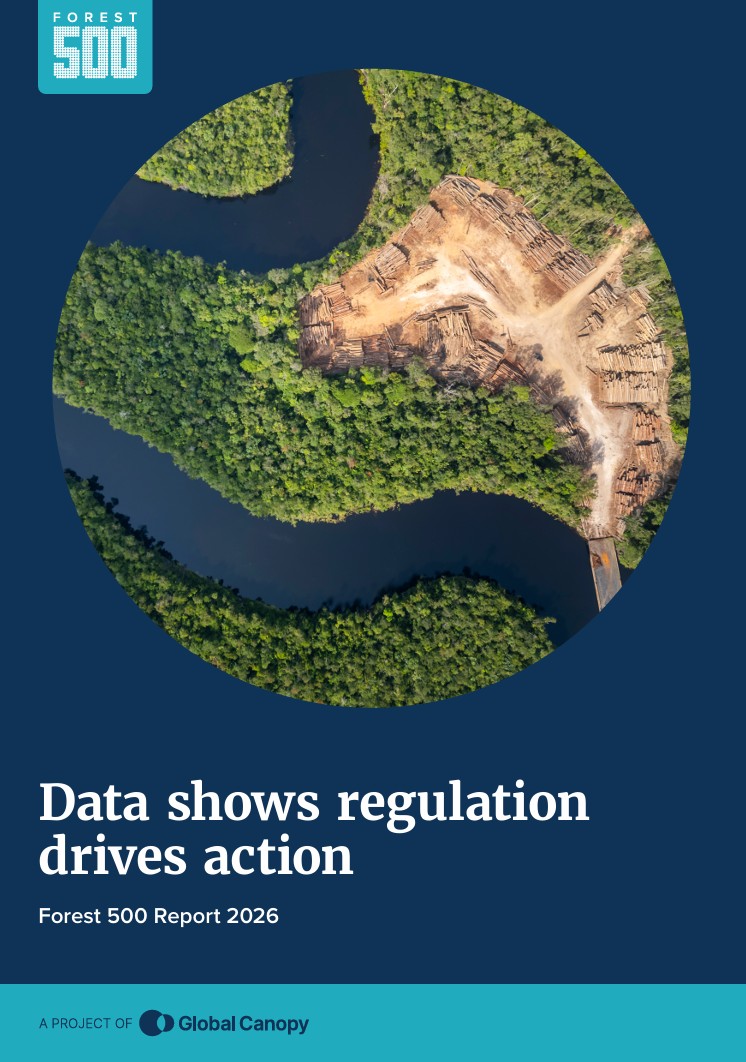
Data shows regulation drives action: Forest 500 report 2026
Forest 500 finds that anticipated EUDR regulation is already driving corporate traceability and deforestation action, though progress remains uneven: only 4% of assessed companies are leaders, 63% show partial action and 33% remain laggards.
Please login or join for free to read more.

OVERVIEW
Forest 500 assesses 500 companies with the greatest influence on deforestation across beef, cocoa, coffee, leather, palm oil, pulp and paper, rubber, soy and timber. The assessment uses more than 270,000 publicly available data points and aligns with the Accountability Framework. These commodities were linked to 68% of global deforestation from 2013 to 2023.
The leaders, late majority and laggards
Only 19 companies (4%) were classified as leaders in 2025, up from 16 in 2024. Leaders demonstrated strong commitments and implementation across all exposed commodities. Examples included Nestlé, Mondi Group and Flora Food Group.
The late majority represented 313 companies (63%). These firms had partial commitments or weak implementation, although 132 disclosed new implementation actions in 2025, including risk assessments, supplier monitoring and traceability improvements.
Laggards accounted for 168 companies (33%) and had no public deforestation commitments. Twenty-four companies have never published commitments since assessments began in 2014. Fourteen companies weakened commitments or withdrew from certification schemes in 2025, including Nike and Thang Loi Coffee Joint Stock Company.
Key findings: What the data tells us
The report found that regulation is influencing corporate behaviour. Sixty-eight companies (14%) publicly referenced the EU Deforestation Regulation (EUDR) in relation to commitments, traceability systems, risk assessments or collaborative initiatives.
In 2025, more than one-quarter of companies disclosed implementation actions not previously reported. Public evidence of traceability mechanisms increased across eight of nine commodities. However, 53% of companies still failed to disclose any traceability mechanism, although this improved from 58% in 2024.
Only 29% of companies had commitments covering all forest-risk commodities they produced or sourced, up from 27% in 2024. Palm oil and timber recorded the highest rates of deforestation-free commitments at 76% and 75% respectively, while leather remained lowest at 29%.
Corporate disclosure on deforestation action
Companies increasingly reported commodity-specific risk assessments, supplier compliance requirements, traceability systems and participation in landscape initiatives. Examples included IKEA strengthening supply chain monitoring and Reckitt Benckiser extending farm-level palm oil traceability.
The report found that relatively few companies followed best practice. While many had commitments, fewer monitored compliance, publicly reported progress or maintained remediation measures.
Traceability and reporting
Traceability remains central to compliance with the EUDR. In 2025, 51 upstream companies had traceability systems covering operations and suppliers, while 62 downstream companies had traceability mechanisms across all sourced commodities.
The report also highlighted progress in leather supply chains, with companies including BMW Group, Inditex and VW Group introducing new traceability systems.
Deforestation and conversion-free volumes
Only 24% of companies reported that more than half of commodity volumes were deforestation and conversion-free (DCF) for at least one commodity. Palm oil performed strongest at 40%, while rubber recorded no companies exceeding 50% DCF volumes.
Recommendations
The report recommends that laggard companies conduct deforestation risk assessments and establish comprehensive commitments. Late majority companies are encouraged to strengthen implementation, monitoring and public reporting. Leaders are advised to support regulation publicly and maintain transparent third-party verification. Governments are urged to implement and enforce forest-risk regulations, while financial institutions should strengthen portfolio risk assessments and stewardship.




