Excessive executive compensation: Investor guidance
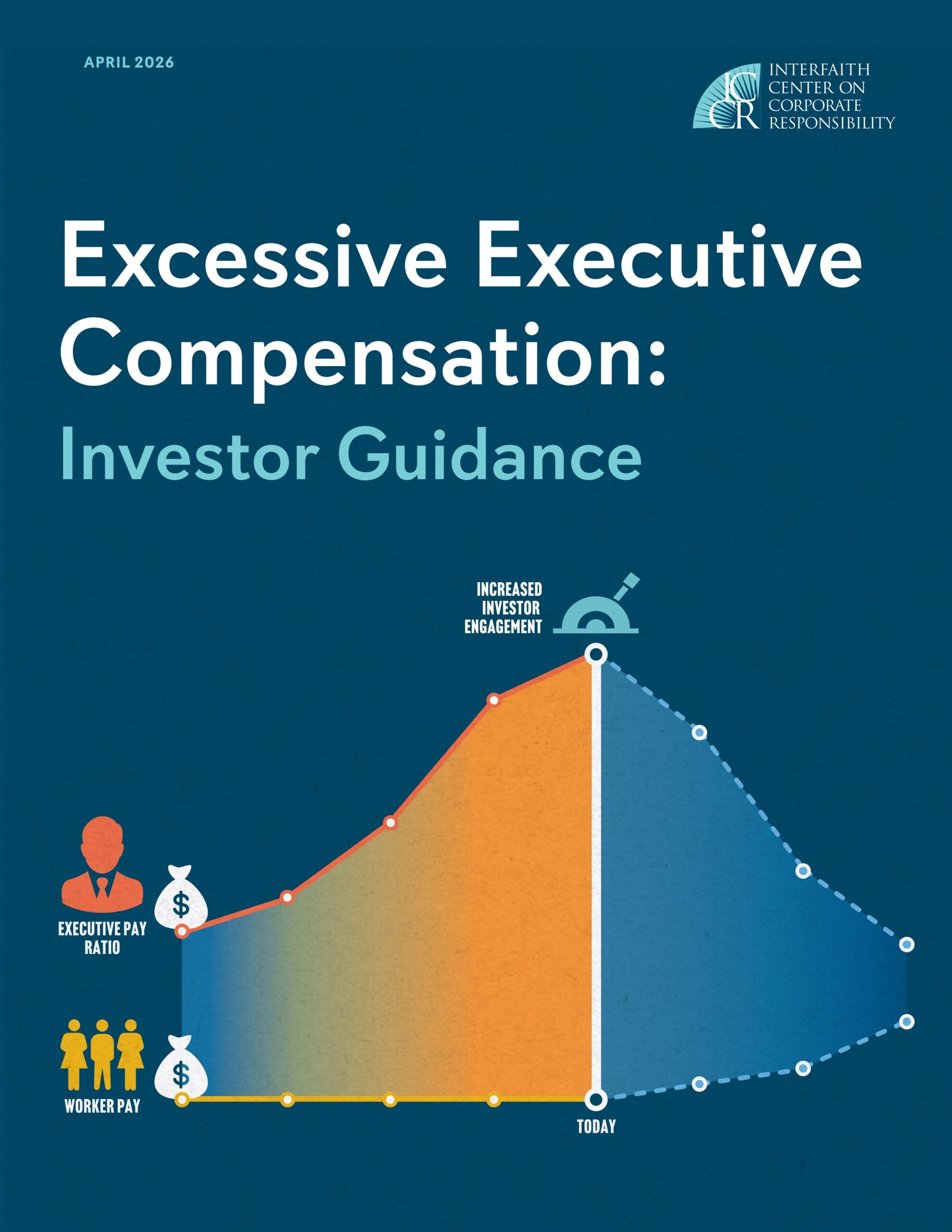
Published by ICCR in April 2026, this report provides investor guidance on addressing excessive executive compensation. It outlines proxy voting guidelines, pay thresholds, and stewardship frameworks to help investors challenge the growing gap between CEO and worker pay, and promote greater accountability and long-term value creation.
Please login or join for free to read more.

OVERVIEW
Introduction
In recent decades, the average CEO of the largest U.S. company has made around 300 times as much as the median worker (p.5). In 1965, CEOs were paid just 21 times as much as a typical worker (p.5). Overall shareholder support for management’s Say-on-Pay proposals averaged over 90% among Russell 3000 companies in 2025 (p.5). This report provides updated fiduciary tools for investors to address excessive executive compensation and income inequality, and empowers investors to strengthen proxy voting guidelines and hold asset managers accountable.
ICCR’s history of engagement on executive compensation, living wages, and inequality
ICCR has actively engaged hundreds of companies on executive compensation since SEC amendments in 1992 facilitated greater shareholder engagement (p.7). Shareholder proposals calling for Say-on-Pay votes grew from 49 in 2007, to 72 in 2008, to 102 in 2009, contributing to Say-on-Pay being mandated under the Dodd-Frank Act, signed into law on 21 July 2010 (p.8). A 2023 investor statement representing $4.5 trillion in assets under management and advisement called on U.S. companies to take steps towards paying a living wage to direct and contract workers (p.9–10). Research indicates that high CEO-to-median-employee pay ratios can hurt employee loyalty and motivation, decreasing workforce productivity and increasing employee turnover (p.10).
Addressing executive compensation and income inequality in stewardship frameworks
Several ICCR members and peers treat excessive executive compensation as a systems-level risk that cannot be reduced by portfolio diversification (p.13). Examples include Adasina Social Capital, Azzad Asset Management, Domini Impact Investments, L&G Asset Management, NEI, NorthStar, Schroders, United Church Funds, and University Pension Plan Ontario. L&G, for instance, votes against the Say-on-Pay resolution of any S&P 500 company whose CEO-to-median-employee pay ratio exceeds 300 and whose total shareholder return underperformed the S&P 500 over a three-year period (p.15).
Proxy voting guidelines
Proxy voting guidelines translate broad investment policy commitments into specific voting policies. The report focuses on those elements that have contributed most significantly to sustained increases in overall pay levels, including quantum of pay, peer benchmarking, compensation design, one-time awards, compensation committee oversight, and equity plans.
Say-on-pay
Investors apply various quantitative thresholds to assess excessive pay. NorthStar votes against packages where the CEO-to-median-employee pay ratio exceeds 100:1 (p.20). SHARE recommends voting against total compensation exceeding 200 times the average annual pay of workers in the country of incorporation (p.21). NEI defines “extremely excessive” pay as above 375 times median household income in the U.S. and above 190 times in Canada (p.21). Domini, Friends Fiduciary, and Everence vote against Say-on-Pay where total CEO compensation exceeds $10 million (p.22).
Peer comparison
Peer benchmarking has been a key driver of pay inflation. Adasina Social Capital and As You Sow vote against CEO pay when it exceeds the 75th percentile of peers (p.24). L&G and Schroders both call for clear disclosure of peer selection rationale and discourage pay increases driven solely by benchmarking (p.25).
Compensation design & incentive metrics
NEI’s guidelines expect at least two-thirds of short-term awards to rely on quantitative metrics and long-term awards to be predominantly performance-based (p.26). L&G expects performance periods of at least three years (p.27). SHARE recommends that annual bonuses should not exceed two times base salary (p.28). Some investors, including Trillium, vote against compensation where incentives are not tied to science-based climate or diversity-related targets (p.28).
Evaluations of one-time awards
Sign-on bonuses and retention awards are scrutinised because they may inflate peer comparisons in subsequent years. Guidelines generally require such awards to be aligned with performance and not structured in a way that weakens accountability or creates conflicts of interest (p.30–31).
Guidelines that address the compensation committee
Voting against compensation committee members serves as an escalation tool when pay concerns remain unresolved. Several investors, including Trillium and Domini, identify approximately 70% support on a Say-on-Pay vote as a threshold warranting closer examination of board responsiveness (p.32).
Equity awards
Equity awards have been a key driver of excessive CEO pay. Investors prefer performance-based grants with the longest vesting schedules and rigorous holding requirements. Both Domini and Friends Fiduciary vote against CEO equity plans where compensation exceeds $10 million per year (p.36). Castlefield requires executives to hold shares for at least five years to align their interests with shareholders (p.36).
Conclusion
CEO pay has risen over 1,000% in the last fifty years while many workers face stagnant wages and precarious working conditions (p.41). The report urges investors to take a more disciplined approach to proxy voting by scrutinising peer benchmarks, compensation plan design, performance metrics, and one-time awards, to better reflect accountability, fairness, and long-term value creation.