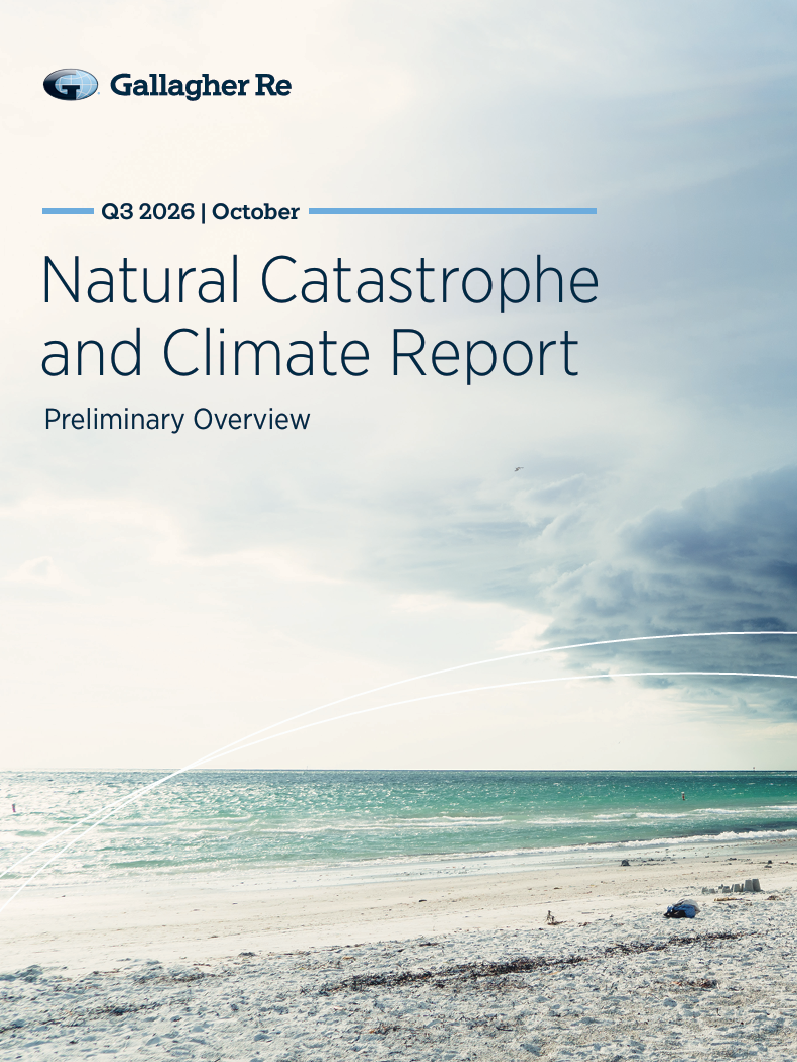
Natural catastrophe and climate report series
Gallagher Re’s Natural Catastrophe and Climate Report series examines global and regional natural disasters, economic and insured losses, insurance protection gaps and emerging risk trends. It explores the influence of climate change and socioeconomic factors on catastrophe risks, supporting risk assessment, climate resilience and insurance and reinsurance decision-making.
Please login or join for free to read more.

OVERVIEW
The Natural Catastrophe and Climate Report is a research series published by Gallagher Re that examines global and regional natural catastrophe events, economic and insured losses, and emerging climate-related risks. The series comprises annual reports and periodic updates throughout the year.
Its purpose is to enhance understanding of natural catastrophe risks, insurance protection gaps and the influence of climate change, socioeconomic factors and exposure growth on disaster-related losses. It also examines the implications of these risks for insurance and reinsurance markets, businesses and governments.
Methodology
The series draws on Gallagher Re’s catastrophe loss data, scientific research, meteorological observations and insights from academic and industry partners.
It categorises natural catastrophe events by geographical region and hazard type, including tropical cyclones, flooding, earthquakes, droughts, wildfires and severe storms. Economic and insured losses are compared with historical trends, with adjustments for inflation, construction costs and labour costs.
The reports also examine climate patterns, extreme weather events, insurance market conditions and emerging risk assessment methodologies.
Relevance for finance professionals
Finance professionals can use the series to assess physical climate risks, evaluate financial exposure to natural catastrophes and incorporate environmental risks into financial decision-making.
Insurers and reinsurers can use the research to inform underwriting, risk modelling, pricing and capital allocation. Investors and lenders can use the analysis to assess geographical and sectoral risk exposure, understand insurance protection gaps and identify climate adaptation and resilience financing opportunities.
LINKS & ATTACHMENTS
-
Go to source

-
4431 - 2026 - Natural catastrophe and climate report Q3 2026
-
4431 - 2026 - Natural catastrophe and climate report H1 2026
-
4431 - 2026 - Natural catastrophe and climate report Q1 2026
-
4431 - 2026 - Natural catastrophe and climate report 2026
-
4431 - 2024 - Natural catastrophe and climate report Q3 2024
-
4431 - 2023 - Natural catastrophe and climate report 2023
-
4431 - 2022 - Natural catastrophe report of 2022