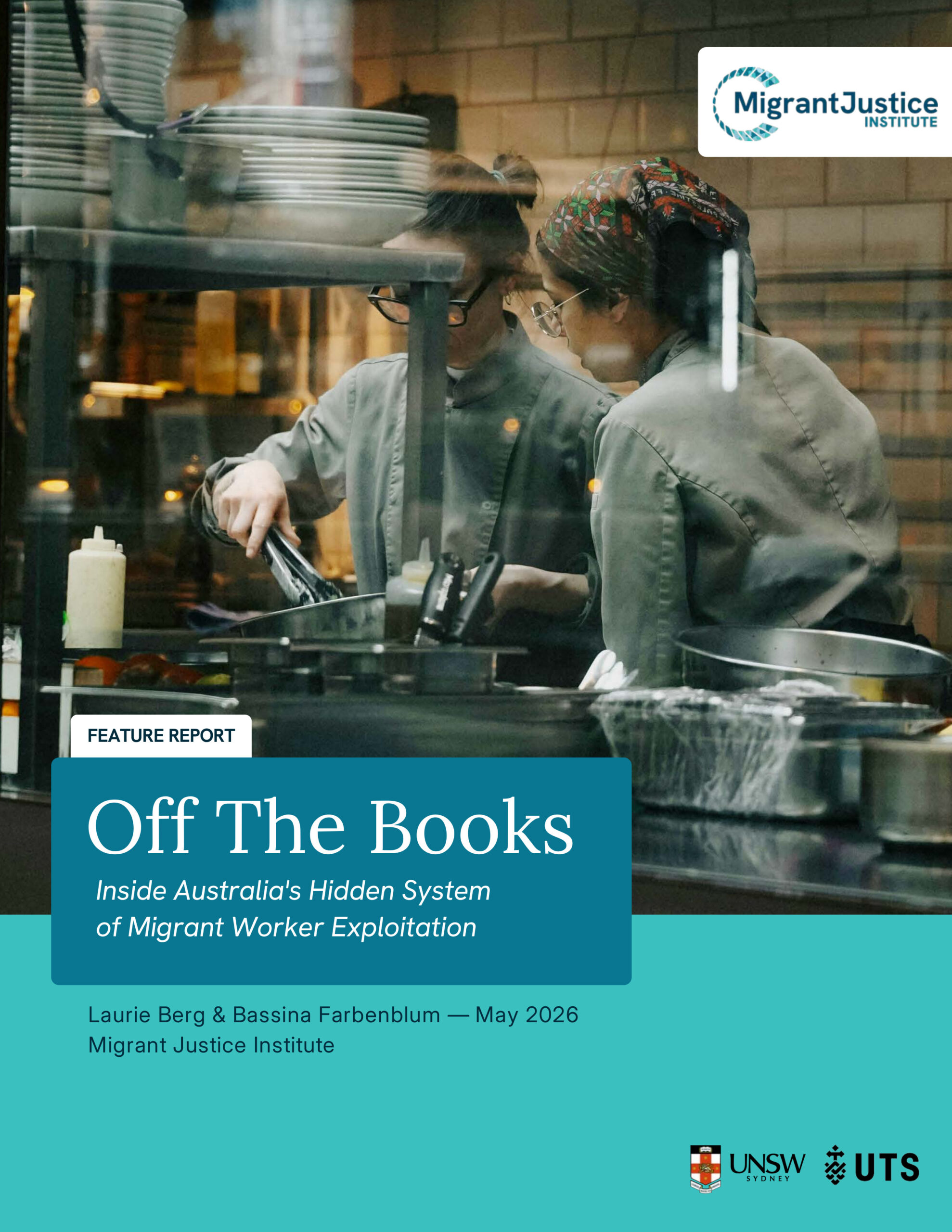
Off the books: Inside Australia's hidden system of migrant worker exploitation
This report analyses the systemic underpayment of temporary migrant workers in Australia. Surveying almost 10,000 individuals, it reveals two-thirds receive less than their legal entitlements. Employers frequently utilise insecure structures, such as misclassified independent contracting and casual work, to evade their responsibilities under the Fair Work Act.
Please login or join for free to read more.

OVERVIEW
Introduction
The 2024 National Temporary Migrant Work Survey examines the working conditions of almost 10,000 migrants on temporary visas in Australia. Our data suggests international students alone may be short-changed by around $61 million every week – $3.18 billion per year.
Part 1 – About the survey
The survey focuses on these workers’ lowest paid job in 2023-24, acting as a unique migrant information and empowerment tool.
Part 2 – Participant demographics and lowest paid job in 2023-24
Participants include international students, backpackers, graduate visa holders, employer-sponsored workers and other migrants who worked in Australia on a temporary visa.
Part 3 – Wages
Underpayment of migrant workers remains rampant. Employers paid two-thirds of migrant employees less than they were owed under the Fair Work Act. Almost a quarter were short-changed by at least $10 per hour, and 36% were paid below the floor of the National Minimum Wage.
Part 4 – Employment structure
Employers systematically use insecure employment structures to disempower and exploit workers. Over a third (35%) of migrants worked on an ABN, more than four times the rate in the general workforce. The majority of those on ABNs (61%) were in industries where this was probably misclassification. A further 38% of migrants were engaged as a casual employee.
Part 5 – Wages and employment structure
Insecure work drives underpayment. 37% of casual employees and 43% of ABN workers were paid below the National Minimum Wage – double the rate of permanent employees. The vast majority of all migrants (83%) reported working nights and weekends. These migrants were almost 50% more likely to be paid below National Minimum Wage.
Part 6 – Impact of temporary migrant status
Casual and ABN work drive underpayment because they give businesses significant leverage over workers. The 48-hour per fortnight work restriction on the student visa pushes international students into unlawful and exploitative jobs, and many migrant workers feel confined to the cash jobs labour market.
Part 7 – Noncompliance beyond underpayment
Employers that underpay migrants engage in multiple simultaneous noncompliant and obfuscatory practices: violations cluster together. A quarter (23%) of participants were paid at least some of their wages in cash. Furthermore, 16% still do not receive payslips, 8% received a payslip that disguised underpayment by omitting hours worked, and 40% received payslips reflecting underpaid wages. Non-payment of mandatory superannuation and deductions from workers’ pay also occur.
Part 8 – Other factors affecting risk of underpayment
Underpayment risk is greatest for new arrivals but remains substantial regardless of length of stay. Geographic location does not significantly affect likelihood of underpayment, and gender has little impact on migrants’ risk of underpayment. Union members have a reduced likelihood of underpayment, insecure work and noncompliance.
Part 9 – Industry data
Underpayment extends to all corners of the Australian economy, and businesses that exploit migrants gain unfair advantages over businesses that comply.
Part 10 – Forced labour and underpayment
Underpayment is part of a system of exploitation, not an isolated practice. Violations cluster together, including practices that are indicators of modern slavery.
Part 11 – Conclusion
First-term reforms were a necessary start, but addressing migrant exploitation is unfinished business.
Part 12 – Recommendations
Stronger interventions are required to prevent employers from using insecure work arrangements and immigration settings to systematically avoid their responsibilities under the Fair Work Act. The government should also invest in reducing the hurdles migrants face to recovering the unpaid billions in wages they are owed.