The total portfolio approach (TPA): A practical guide for navigating the transition to TPA
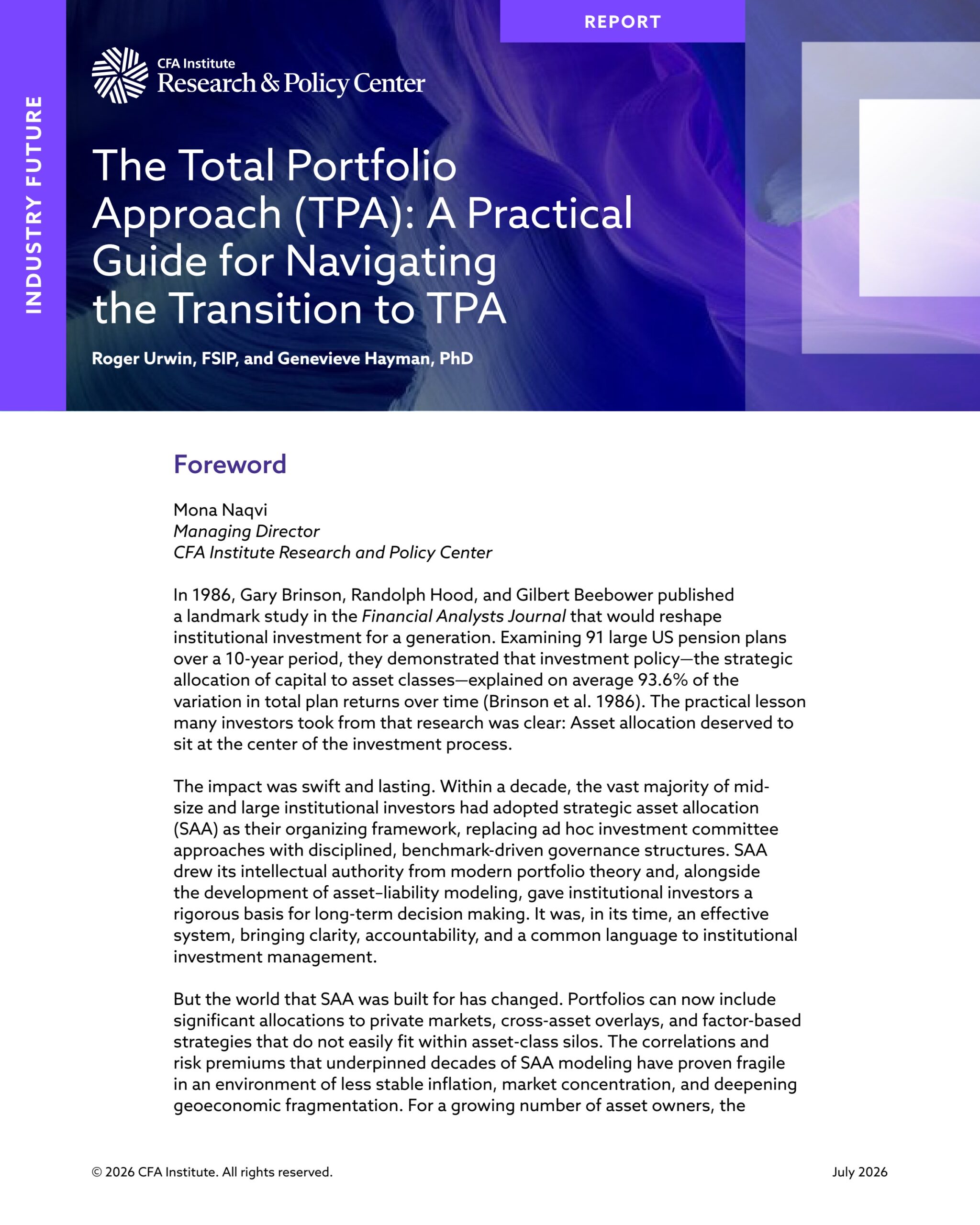
The report examines the Total Portfolio Approach as an alternative to traditional strategic asset allocation. Drawing on interviews and survey evidence, it explains TPA’s investment, governance, risk, sustainability and organisational foundations, outlines a five-level transition pathway, and provides practical guidance for asset owners assessing readiness and implementation.
Please login or join for free to read more.

OVERVIEW
Introduction
Strategic asset allocation (SAA) remains the dominant institutional investment framework, but its benchmark-driven, asset-class structure can fragment decision-making and respond slowly to changing market conditions. The Total Portfolio Approach (TPA) instead evaluates investments according to their contribution to whole-fund objectives, risks and constraints. The report draws on interviews with 14 senior executives across 11 organisations, covering asset owners representing approximately US$1.4 trillion and asset managers with more than US$1.48 trillion in assets under management.
TPA is not universally appropriate. Among the 100 largest global asset owners assessed, eight use TPA, 66 use SAA and 26 use hybrid approaches. Suitability depends particularly on investment beliefs, governance, collaborative culture, team capability, organisational resources and data infrastructure.
Foundational pillars of TPA
TPA rests on five interconnected pillars: investment, governance, risk, sustainability and intelligence. Investment decisions are goal-driven and consider public and private assets, factors, liquidity and changing market regimes together rather than through isolated asset-class allocations.
Governance shifts towards distributed ownership with stronger oversight. Boards establish risk appetite and policy parameters, while investment committees, CIOs and potentially chief total portfolio officers receive greater decision-making authority within defined guardrails. Dashboards and multiple comparators support oversight.
Risk management expands beyond volatility, correlations and tracking error to incorporate drawdowns, mission impairment, systemic risks, regime changes and intertemporal risks. Scenario analysis supports portfolio resilience. Sustainability is treated as a system-level investment consideration, incorporating financially material risks including climate change, biodiversity loss and social instability alongside real-world outcomes.
Technology, data and people provide the intelligence infrastructure required for integrated portfolio management. AI applications include factor decomposition, scenario generation, liquidity forecasting and real-time aggregation of portfolio risk exposures.
The practical side of transitioning to TPA
TPA is presented as a five-level continuum: enhanced SAA, mindset TPA, top-down TPA, joined-up TPA and one-fund TPA. Organisations can transition incrementally rather than undertaking complete restructuring.
Early stages include establishing shared investment beliefs, prioritising total-fund goals, resetting governance responsibilities and potentially introducing a reference portfolio. More advanced stages strengthen top-of-house investment capabilities, dashboards, scenario analysis, external-manager integration and system-level investing.
Transition costs include technology, data, training and project-management investment. Risks include poor implementation, inconsistent data, liquidity challenges, cultural resistance and adverse market conditions.
Survey insights into TPA transitions
Ten respondents assessing their investment methodology reported an average current position of approximately 3.5 on a five-point SAA-to-TPA scale, increasing to an expected 4.3 within three to five years.
Key motivations included portfolio management quality, risk-adjusted returns and governance. Cultural change, investment-team coordination and governance were the most frequently identified implementation barriers. More than half estimated risk-adjusted return benefits exceeding 50 basis points relative to an SAA counterfactual, although the report cautions that available performance evidence is not definitive.
The people factor
Successful TPA implementation depends on mindset, leadership, culture and organisational design. It requires systems thinking, collaboration, shared accountability and adaptable teams alongside technical investment expertise.
Organisations are encouraged to preserve institutional knowledge through incremental role changes rather than wholesale restructuring. Remuneration and incentives should support total-fund performance and broader organisational objectives rather than reinforce asset-class silos.
Conclusion
TPA offers a flexible framework rather than a single prescribed model. SAA remains appropriate for many funds, particularly where organisational resources or governance capabilities cannot support TPA.
Asset owners considering transition should assess whether SAA benchmarks reflect genuine fund objectives, evaluate governance, culture, skills and data readiness, select an appropriate TPA integration level, and begin with practical measures such as investment-belief setting, governance review or reference-portfolio design.