

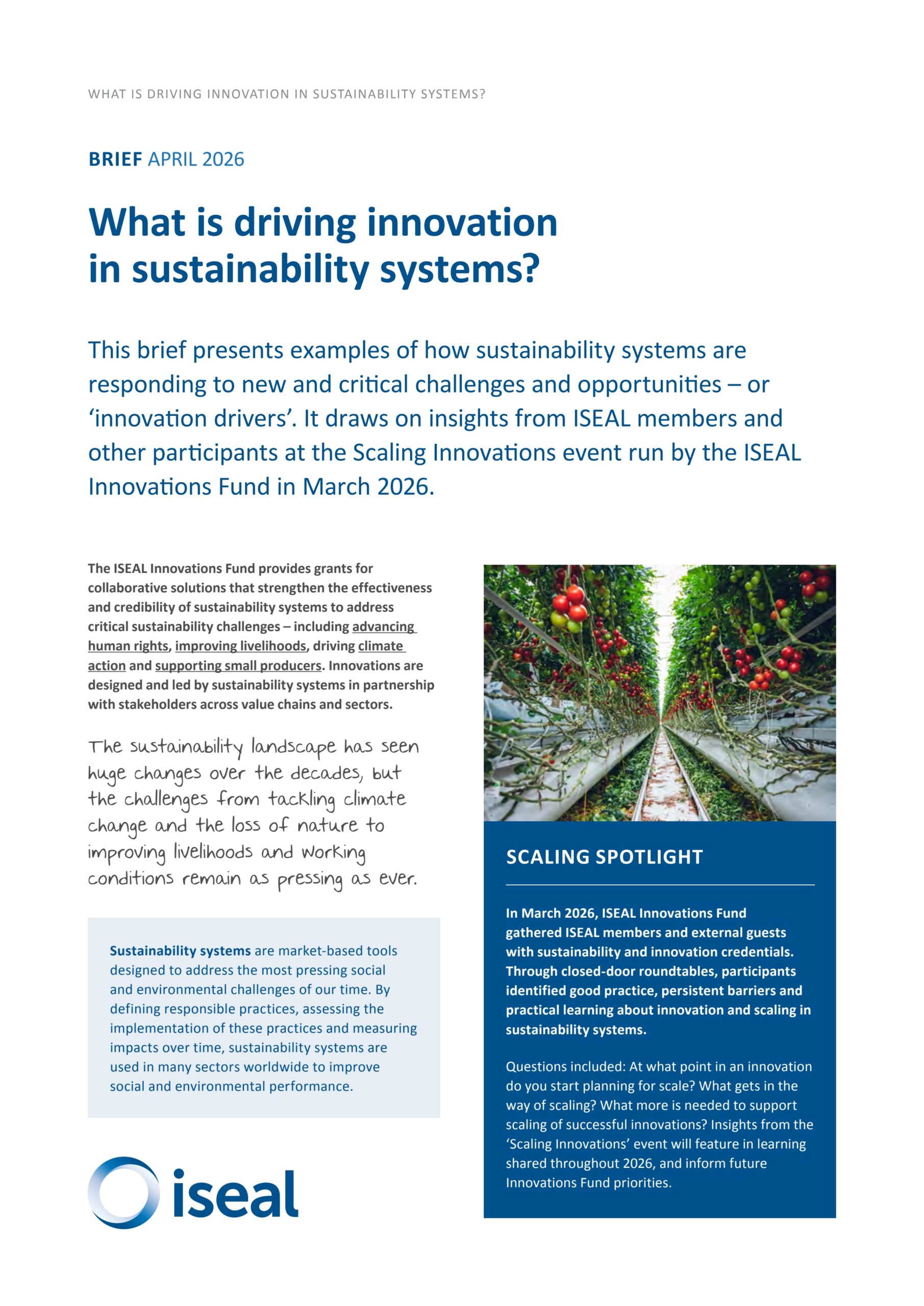
What is driving innovation in sustainability systems?
This report examines the key drivers of innovation in sustainability systems, including evolving legislation, data accessibility, and the need for inclusive value creation. It highlights case studies in palm oil, aquaculture, and cocoa, while providing strategic insights for scaling successful innovations through collaboration and robust business cases.
Please login or join for free to read more.

OVERVIEW
What is driving innovation in sustainability systems?
This research brief provides an analysis of how sustainability systems are responding to critical challenges through various ‘innovation drivers’. It draws on insights gathered during the ISEAL Innovations Fund ‘Scaling Innovations’ event in March 2026. Sustainability systems are market-based tools designed to address social and environmental issues by defining responsible practices and measuring long-term impacts. The ISEAL Innovations Fund supports these systems through grants for collaborative solutions in areas such as human rights, livelihoods, and climate action.
Innovation driver 1: evolving legislation and raising standards
The evolution of legislative requirements, particularly the European Union’s corporate sustainability due diligence regulation and the forthcoming Deforestation Regulation (EUDR), is a significant driver of innovation. Sustainability systems are developing tools to enable companies to carry out due diligence, trace products to their origin, and make credible claims. These innovations provide a competitive advantage, helping companies stay ahead of mandatory requirements, such as nature-related risk disclosures which are currently voluntary but likely to become mandatory in the future.
Innovations also address the risk of smallholders being excluded from supply chains due to complex reporting requirements. For example, a project involving the Roundtable on Sustainable Palm Oil (RSPO) and Proforest focuses on palm oil supply chains, where approximately 7 million smallholders depend on the crop for income. The project identifies traceability bottlenecks and incentivises downstream actors to support inclusion. Additionally, the Preferred by Nature Digital Tools Platform assesses digital traceability tools to promote alignment and reduce duplication of effort in a fragmented market.
Innovation driver 2: creating value and inclusion
Sustainability systems face increasing competition from commercial service providers and in-house corporate systems. Innovation is therefore focused on providing greater value for companies, such as simplifying reporting on sustainability outcomes. Equally important is creating value for producers by simplifying data collection and sharing reporting burdens more equitably.
A notable spotlight is the low-carbon assurance module (L-CAM) led by the Sustainable Rice Platform (SRP). For major rice buyers, methane and nitrous oxide can account for up to 80–90% of greenhouse gas emissions in their rice value chains (Scope 3). The L-CAM enables companies to report quantified emission outcomes while incentivising climate-friendly production. Another initiative is the blended finance facility developed by the Aquaculture Stewardship Council (ASC) and Finance Earth, which uses philanthropic funding to de-risk and mobilise private capital for small-scale aquaculture producers.
Innovation driver 3: making data meaningful and accessible
Technological advances are enabling new methods of data collection and analysis, though systems must ensure that big data and artificial intelligence are used safely. Verified data offers greater credibility than business-collected data and provides producers with insights to benchmark performance. Collaborative efforts are underway to align indicators and strengthen interoperability between systems to prevent small producers from being overwhelmed by data demands.
Innovation spotlights in this area include a culturally inclusive environmental accounting approach in Queensland, Australia. This project, involving the Aluminium Stewardship Initiative, Angkamuthi Tribal Aboriginal Corporation, and Ecotec, documents ecological data alongside Indigenous Peoples and Local Communities (IPLC) knowledge. Furthermore, Fairtrade is piloting a data ownership model for cocoa cooperatives in Ghana, empowering smallholders with greater control over their information to improve bargaining power and production decisions.
Innovation driver 4: strengthening traceability and assurance
Sustainability systems are capitalising on tools such as satellite data analysis, AI remote-sensing algorithms, and drones to improve assurance efficiency and credibility. Innovations also focus on amplifying worker voices and building auditor capacity to detect human rights violations. Digital tools like mobile apps and QR codes are increasingly used to replace paper-based records to meet transparency demands.
A specific innovation spotlight is the ‘prescriptive assurance’ model being developed by Assurance Services International (ASI) in partnership with the Rainforest Alliance and ASC. Traditional assurance is often reactive, recognising issues only after they occur. This new model integrates external data and AI into a centralised alert system to predict risks and recommend targeted mitigation measures, enhancing the overall impact of sustainability standards.
From innovation drivers to scaling innovations
The Scaling Innovations event highlighted several requirements for supporting innovations as they scale. Sustainability systems must foster an innovation culture with senior-level buy-in and organisational support. Building a business case is essential for long-term financial viability beyond initial grant funding. Innovations should also be anchored in stakeholder priorities, involving producers and communities throughout the design process.
Collaboration with partners can help refine solutions and avoid duplication, while a ‘test, learn, adapt’ mindset is crucial. Ongoing testing and adaptation are necessary when replicating innovations in different contexts, and even failed objectives offer valuable learning opportunities to improve future performance.




