
Library | ESG issues
Governance
The governance pillar in ESG (environmental, social, and governance) refers to the systems, policies, and practices that ensure an organisation is managed responsibly and ethically. It includes issues such as board structure, reporting & disclosures, shareholders & voting, and risk management. Strong governance reduces risks, enhances trust, and supports long-term business sustainability.
Refine
1881 results
REFINE
SHOW: 16


Preventable Surprises
Preventable Surprises are a group of investment industry insiders working to persuade institutional investors to accept their fiduciary responsibility to mitigate systemic risks before the next preventable surprise. Activities include online dialogues, research reports, surveys and policy.

Relationship-to-profit: A theory of business, markets, and profit for social ecological economics
Supporting post-growth transformation, this doctoral thesis posits a new theory: relationship-to-profit theory. This explains the social and ecological implications of how businesses relate to profit, and argues that for economies to be sustainable businesses and markets should treat profit as a means rather than an end-in-itself.

Net zero investment framework: Implementation guide
This report provides a practical framework for investors seeking to implement net zero commitments. It builds on the draft Net Zero Investment Framework published in 2020 by the Institutional Investors Group on Climate Change, broadening to a global perspective.

Australian Institute of Company Directors
The Australian Institute of Company Directors is committed to strengthening society through world-class governance. The organisation's aim is to be the independent and trusted voice of governance, building the capability of a community of leaders for the benefit of society.

The Ethics Centre
The Ethics Centre is a not-for-profit organisation developing and delivering innovative programs, services and experiences, designed to bring ethics to the centre of personal and professional life. The Ethics Centre carries this out through consulting, thought leadership and volunteer-led programs to help build critical thinking through discussing ethics.

Institutional Investor Group on Climate Change (IIGCC)
The Institutional Investors Group on Climate Change (IIGCC) is the European membership body for investor collaboration on climate change and the voice of investors taking action for a prosperous, low carbon future. IIGCC has more than 300 members across 22 countries, with over €37 trillion in assets under management.

Investor Group on Climate Change
The Investor Group on Climate Change (IGCC) is a collaboration of Australian and New Zealand institutional investors focusing on the impact that climate change has on the financial value of investments. The IGCC aims to encourage government policies and investment practices that address the risks and opportunities of climate change.

Global investor study: The rise of the sustainable investor
The report highlights key findings from Schroder’s Global Investor Study. It provides an insight into global investor attitudes towards sustainable investing and the obstacles preventing widespread adoption of sustainable investing. The report emphasises the notion that sustainable investing is gaining momentum around the world.

Asia Investor Group on Climate Change (AIGCC)
Asia Investor Group on Climate Change (AIGCC) is an initiative to create awareness and encourage action among Asia’s asset owners and financial institutions about the risks and opportunities associated with climate change and low carbon investing.

International Service for Human Rights (ISHR)
International Service for Human Rights (ISHR) is an independent, non-governmental organisation dedicated to promoting and protecting human rights. They achieve this by supporting human rights defenders, strengthening human rights systems, and leading and participating in coalitions for human rights change.

Digital financial services
Discusses the potential of digital financial services (DFS) to reduce poverty and promote economic growth. Analyses DFS role in financial inclusion within households and emerging markets and developing economies. Examines constraints of regulations and frameworks and provides case studies from countries that have enabled DFS in their economy.

Banking on a low-carbon future II: A ranking of the 20 largest European banks’ responses to climate change
This report ranks the 20 largest European banks based on their response to climate change as of the 6th December 2019. The report highlights that while the European banking sector is making progress in reflecting climate-related risks, there is need for greater integration of these risks fully into strategies, processes, risk management tools and transparency.
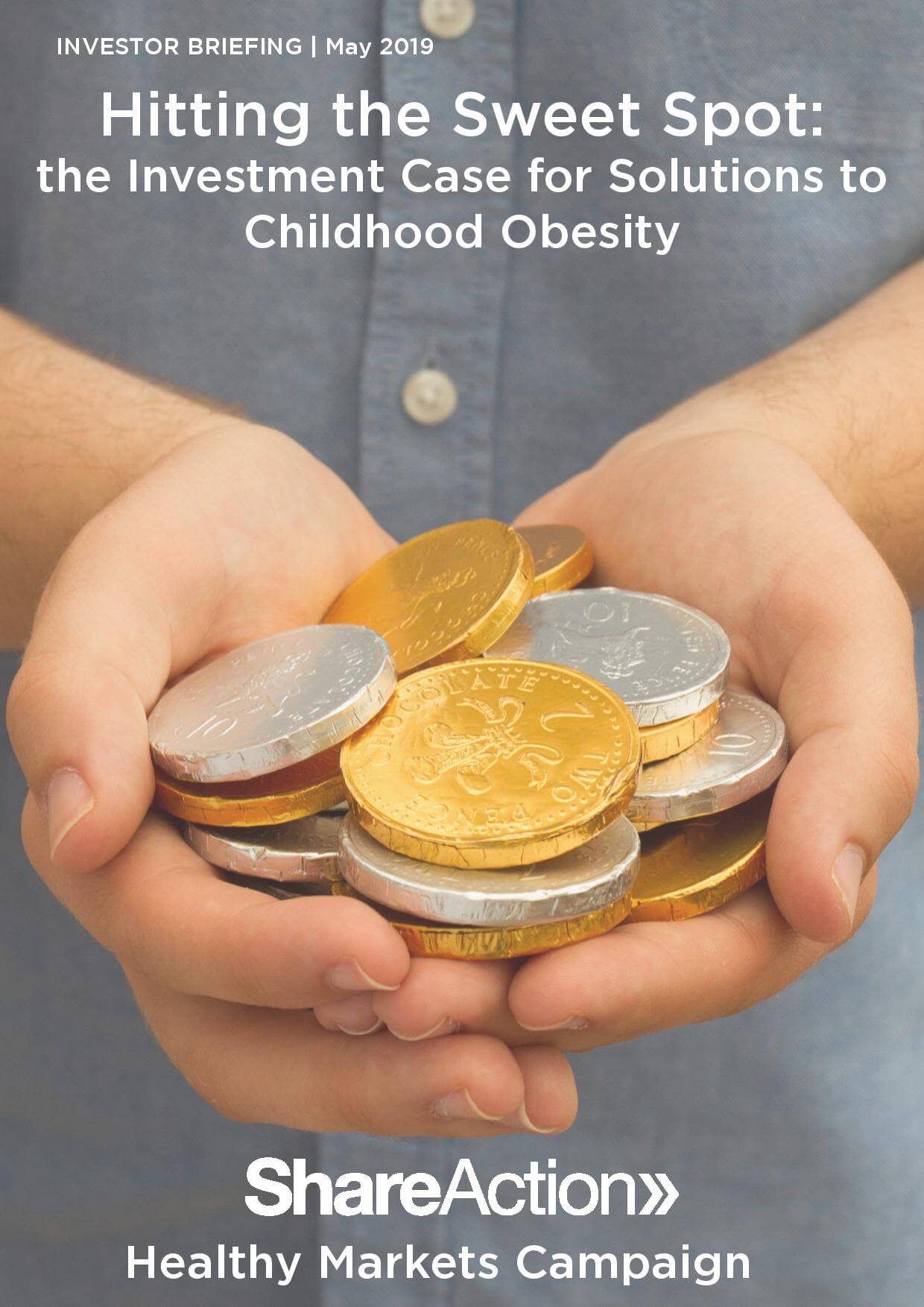
Hitting the sweet spot: The investment case for solutions to childhood obesity
This report discusses the growing cost to society posed by rising rates of obesity in children and adults. It identifies risks and opportunities for investors created by shifting trends in the food and beverage markets, driven by evolving consumer demands and regulatory changes.

The future of tobacco stocks: a scenario analysis
This report identifies drivers of change within the tobacco industry and the potential risk factors that may arise as a result. The report conducts a scenario analysis that maps out three potential outcomes for the industry and the relative impact on the share price of the world’s largest tobacco companies.

Internal carbon pricing for low-carbon finance: A briefing paper on linking climate-related opportunities and risks to financing decisions for investors and banks
This paper makes the business case for financial firms to use an internal carbon price in investment and lending practices. Drawing on stakeholder insights, this paper provides guidance on how to best implement an internal carbon price to decarbonise portfolios and increase resilience in a low-carbon transition.

Generation Foundation
Generation Foundation is the advocacy and grant-making initiative founded by Generation Investment Management. Generation Foundation works with various organisations to publish research addressing key global issues including climate change, carbon risk, gender inclusion and economic inequality.


