
Library | ESG issues
Just Transition
A just transition ensures that the shift to a low-carbon economy is fair, inclusive, and leaves no one behind. It prioritises workers, communities, and industries affected by the transition, ensuring they have access to new opportunities, reskilling programs, and social protections. Achieving a just transition is essential for securing public support, economic stability, and sustainable long-term growth.


Refine
156 results
REFINE
SHOW: 16


Beyond the illusion of innovative climate finance at scale in Africa: A market-informed blueprint for Kenya's just and resilient climate transition
This report examines why Kenya's climate finance gap persists despite strong institutions, renewable energy leadership and financial inclusion gains. It identifies seven flawed assumptions and recommends a nationally co-ordinated country investment platform to mobilise domestic capital, align incentives and deliver a just and resilient climate transition.
Pipe dreams: How oil and gas fail to deliver economic development in Africa
This 2026 report analyses the economic impact of oil and gas extraction across 13 African nations. Finding that fossil fuels exacerbate poverty, vulnerability, and corruption rather than delivering sustained growth, it advocates for a rapid, just transition to decentralised renewable energy to ensure future economic stability and development.
Energy security through freight electrification: A rapid response briefing note on policy options for responding to the global fuel crisis
This briefing note outlines policy options to enhance Australia's fuel security through freight electrification. It recommends a phased, five-year, $3 billion programme to deploy up to 50,000 battery electric trucks, displacing one billion litres of diesel annually while leveraging private capital and implementing structural reforms.

RIAA Conference Australia 2026 - Companion Resources
Responsible investment has moved well beyond principles and pledges. Today’s challenges require practical capability and informed judgement. The RIAA Conference is a must-attend event for finance, sustainability and industry practitioners who want to focus on the key themes for responsible investment in 2026 and what implementation really looks like. Designed as an immersive, hands-on experience, the program focuses on the systems that underpin strong financial performance, and will help you understand how climate, nature, technology, governance and regulation intersect.
These specially curated companion resources have been recommended by the conference speakers and Altiorem team.
These specially curated companion resources have been recommended by the conference speakers and Altiorem team.
Hedging ambiguity with pro-social preferences: An illustration from green finance
The paper argues that pro-social preferences can offset ambiguity aversion in green finance by acting as a behavioural hedge. Using ambiguity-based investment models, the authors show socially motivated investors may accept uncertain green assets, lowering effective hurdle rates and supporting private capital flows into sustainable projects.
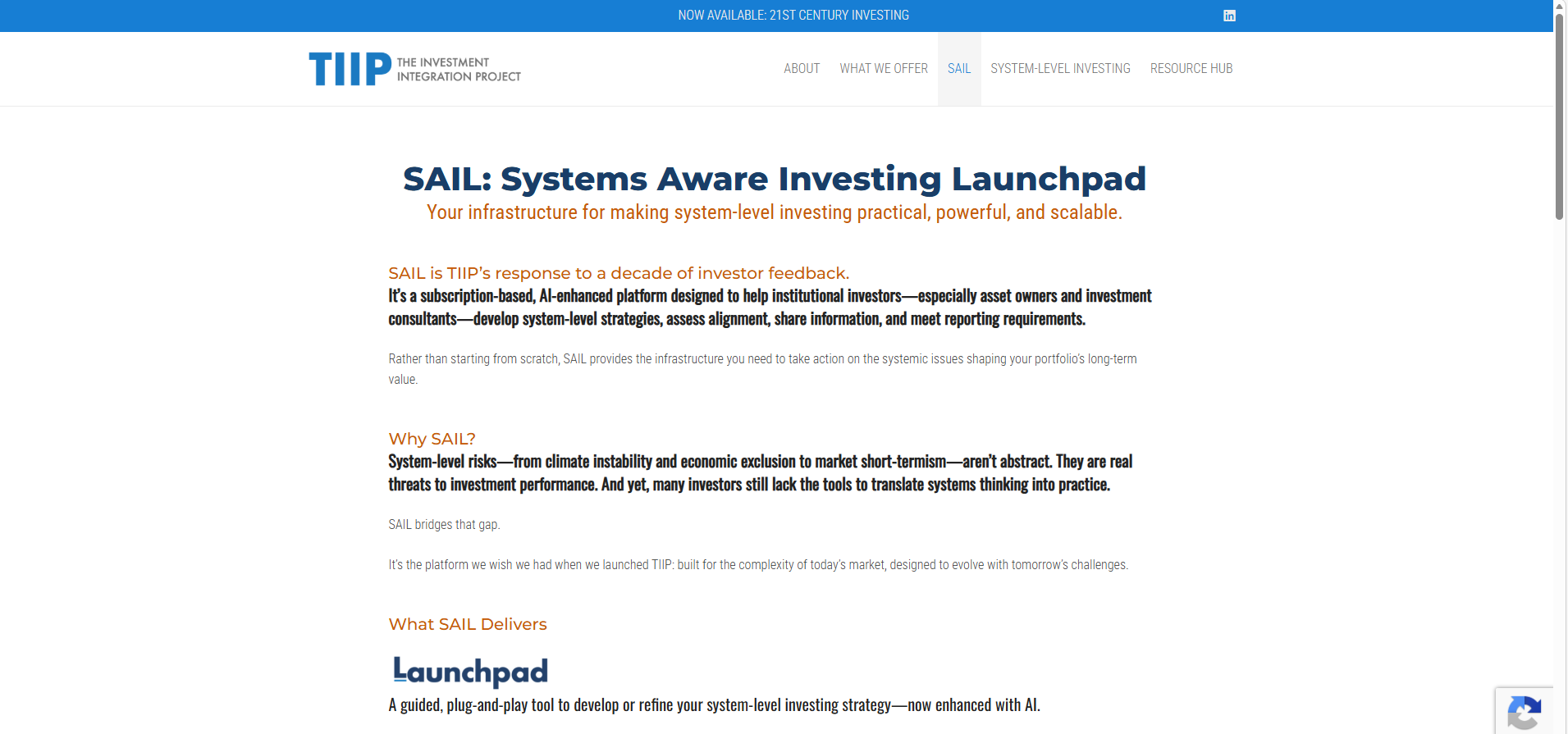
SAIL: Systems Aware Investing Launchpad
SAIL (Systems Aware Investing Launchpad) is an AI-enhanced platform developed by TIIP to support institutional investors in implementing system-level investing strategies. It provides tools for strategy development, benchmarking, reporting and collaboration, helping users assess and manage systemic environmental, social and financial risks.
Tackling governance and financing for sustainability transitions
The report argues current financial systems misallocate capital towards resource-intensive activities, hindering sustainability transitions. It recommends policy, governance and financial reforms to redirect investment towards resource efficiency, low-carbon development and equitable transition pathways, particularly in resource-dependent economies.
The production gap series
This benchmark series examines the gap between governments’ planned fossil fuel production and pathways consistent with international climate goals. It assesses alignment with temperature limits by reviewing national production plans and policy signals, providing a consistent framework to track progress and comparability across editions.
China sustainable investment review series
The China Sustainable Investment Review is a recurring research series that provides a structured overview of the development of China’s sustainable investment market. It examines policy evolution, market practices, product types, and ESG integration across financial institutions using publicly available information.
Too-big-to-strand? Bond versus bank financing in the transition to a low-carbon economy
The paper shows bond markets price fossil fuel stranding risk, while syndicated bank loans do not. Firms substitute bonds with bank loans as climate policy risk rises, concentrating exposure in large banks and raising “too-big-to-strand” regulatory concerns.
Energy and AI
The IEA’s Energy and AI report examines AI’s rising electricity demand and its capacity to improve energy efficiency, security and innovation. It assesses data centres, grids and end-uses, highlighting skills, infrastructure and policy needs to manage costs, emissions and resilience globally.

Systems-informed stewardship part II: Bringing a systems perspective to stewardship
This article applies a systems lens to stewardship, arguing that fragmented intermediation and entrenched short-term time horizons undermine sustainability outcomes. It calls for recognising these structural barriers as a critical step toward more effective, systems-informed stewardship.

State of the sovereign transition series
An assessment of 85 countries against the ASCOR framework, evaluating sovereign climate performance across emissions pathways, climate policies, and finance to inform investor decision-making and engagement.
Transition forecast series
This benchmark series presents forward-looking assessments of global energy, land use and nature transitions. It consolidates expert judgement with structured policy tracking to outline plausible transition pathways across major economies, supporting investors and financial institutions in scenario analysis, risk assessment and strategic planning.
Net Zero Asset Managers' target disclosures series
The Net Zero Asset Managers Target Disclosures is a reporting series that tracks how participating asset managers set, disclose, and update net zero targets over time. It provides a consistent, initiative-wide view of commitments, disclosure practices, governance arrangements, and methodological approaches across reporting years.

Sustainable Finance Roundup January 2026: Geopolitics, Energy Transitions, and Systemic Risk
This month’s sustainable finance article roundup examines a landscape increasingly shaped by geopolitics and climate risk, as near-term fragmentation, energy security, and affordability pressures collide with intensifying long-term threats from climate change, biodiversity loss, and water stress. The works featured analyse how these dynamics are reshaping capital allocation, disclosure, and resilience planning, demonstrating the growing need for sustainable finance to integrate geopolitical risk with real-economy transition.


