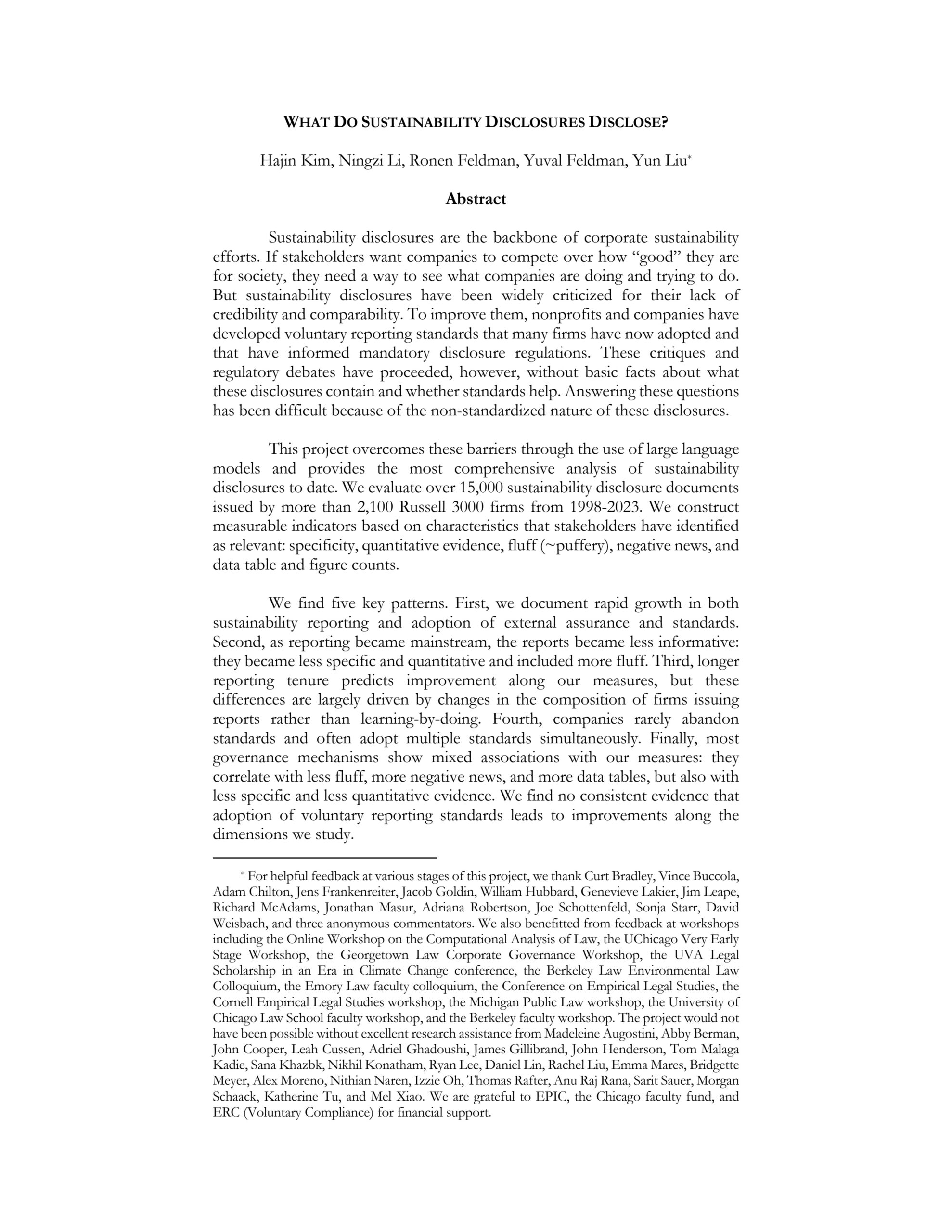
What do sustainability disclosures disclose?
This research analyses over 15,000 sustainability disclosures from Russell 3000 firms. It finds that while reporting has surged since 2015, informative quality has declined. Adoption of voluntary standards yields mixed results, correlating with reduced ‘fluff’ but lower narrative specificity. Improvements primarily reflect selection effects rather than organisational learning.
Please login or join for free to read more.

OVERVIEW
Introduction
Sustainability disclosures are considered the backbone of corporate sustainability efforts, yet they have faced significant criticism for a perceived lack of credibility and comparability. This research represents the most comprehensive analysis of such disclosures to date, evaluating over 15,000 sustainability disclosure documents issued by more than 2,100 Russell 3000 firms between 1998 and 2023. The authors utilise large language models to overcome previous barriers to analysis caused by the non-standardised nature of these reports. They focus on five key measurable indicators: specificity, quantitative evidence, “fluff” (or puffery), negative news, and counts of data tables and figures.
Setting the stage
There is a theoretical case for sustainability disclosures to further two goals: improving overall societal welfare by internalising externalities and improving financial markets by surfacing and pricing risks. Stakeholders, including sophisticated regulatory intermediaries and investment analysts, rely on these reports, with a 2017 survey indicating that over 60% of ESG-focused investors use them. However, the “alphabet soup” of voluntary standards—including the Global Reporting Initiative (GRI), Sustainability Accounting Standards Board (SASB), and Task Force on Climate-related Financial Disclosures (TCFD)—has created a complex reporting landscape. Costs are substantial; estimates suggest companies spend an average of over $600,000 on corporate climate disclosures alone, sometimes outspending their investments in sustainability innovation itself.
Empirical analysis
The study identifies five key patterns. Firstly, there has been a rapid “mainstreaming” of reporting and adoption of external assurance since 2015. However, as reporting became common, informativeness declined; reports became significantly less specific and quantitative while containing more fluff. Quantitative sentences make up approximately 13% of reports, and negative sentences only 7%, whereas fluff constitutes around 27% of the text. While longer reporting tenure initially appeared to predict higher quality, the researchers found this was largely driven by selection effects—where higher-quality firms chose to report earlier—rather than organisational learning. A “learning-by-doing” effect was only observed during the first three years of a firm’s reporting history, where quantitative sentence counts increased by roughly 4% and fluff decreased by 7%.
The association with voluntary governance mechanisms is mixed. Most mechanisms, including external assurance, GRI, and SASB, correlate with lower narrative specificity (between 3% and 11% lower) and fewer quantitative sentences (between 4% and 14% lower). On a positive note, these mechanisms are associated with a 4% to 7% reduction in fluff and a substantial increase in the use of data tables and figures, ranging from 13% for SASB to 79% for GRI. The TCFD and Science Based Targets initiative (SBTi) frameworks are notable outliers; TCFD is associated with reduced specificity and no increase in table usage, while SBTi is the only mechanism linked to increased specificity and quantitative evidence (with a 4.6% increase in the quantitative ratio).
Discussion and policy implications
The “participation paradox” highlights that while pressure can compel firms to issue reports, it does not necessarily ensure their quality. Companies demonstrate significant inertia once a standard is adopted, with year-on-year retention rates exceeding 90% for SASB and GRI. There is also substantial overlap, with many firms adopting multiple standards simultaneously; for example, 84% of GRI-aligned reports in 2022 were also SASB-aligned. The mixed quality patterns suggest that voluntary standards may function more as credibility signals or “club goods” rather than drivers of behavioural change. For policymakers, these findings complicate the debate over mandatory disclosures. While a mandate could address selection bias and standardise formats, the inherent difficulty in defining “quality” remains. The researchers suggest that standard-setters should facilitate the use of automated analysis tools by requiring standardised language and machine-readable data tables.