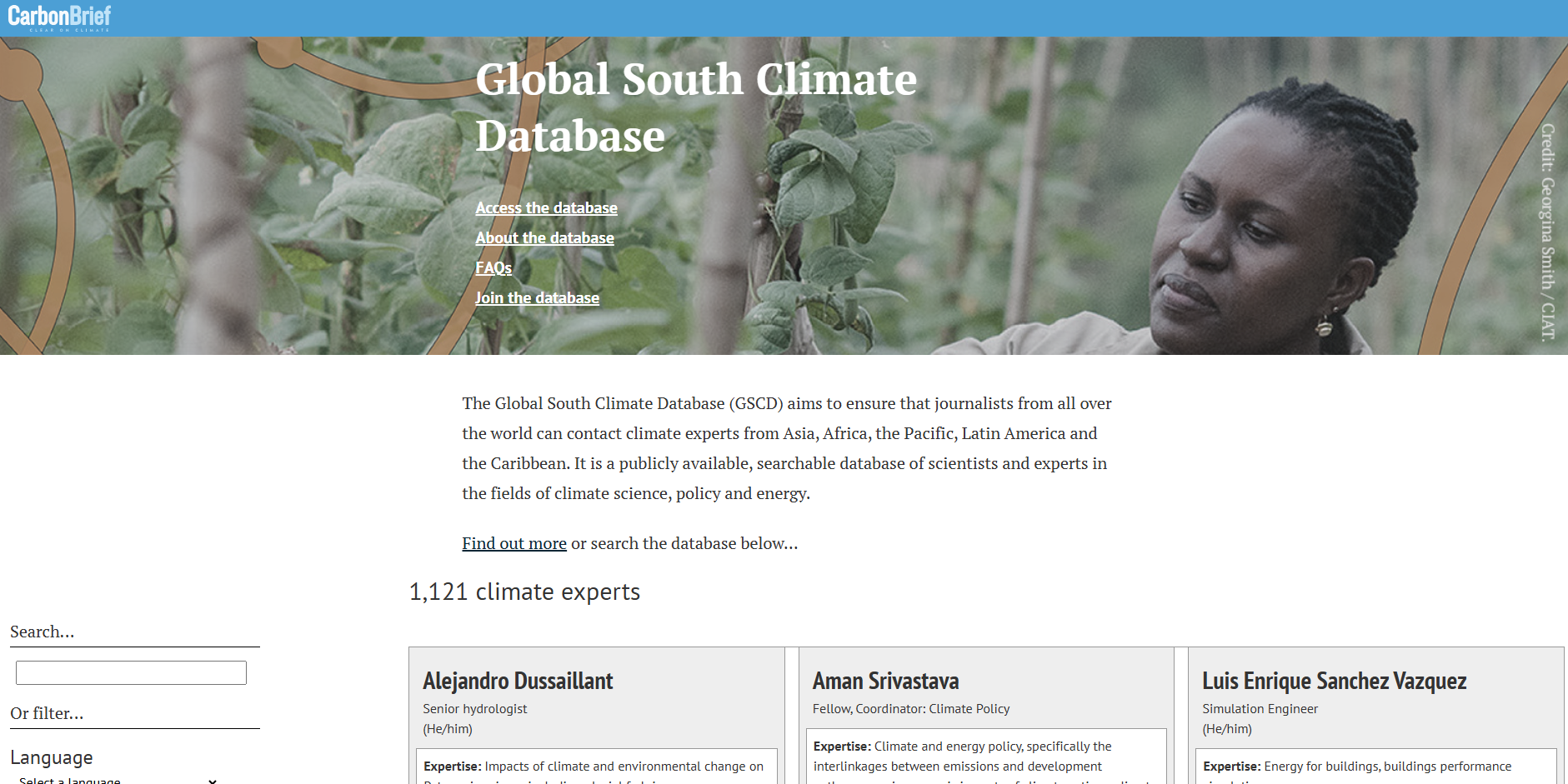
Global South Climate Database
A searchable database maintained by Carbon Brief providing access to over 1,100 climate experts from the Global South. It enables finance professionals to connect with specialists in carbon markets, climate policy, and regional environmental risks across Asia, Africa, and Latin America.
Please login or join for free to read more.

OVERVIEW
The Global South Climate Database is a publicly available, searchable directory of scientists and experts in the fields of climate science, policy, and energy. It was developed to ensure that journalists and other stakeholders globally can access climate expertise specifically from Asia, Africa, the Pacific, Latin America, and the Caribbean. For finance professionals, the tool serves as a bridge to regional specialists who provide localized insights into climate-related risks and opportunities.
Organisation behind the tool
The database is maintained by Carbon Brief, a UK-based website specialising in climate science and policy. It was developed in collaboration with the Oxford Climate Journalism Network at the Reuters Institute for the Study of Journalism.
What the tool does
The tool provides a searchable interface containing over 1,100 climate experts. Key functionalities include:
- Filtering by language (multiple options including Arabic, Spanish, Portuguese, and various regional dialects).
- Filtering by country and region within the Global South.
- Topic-specific searches covering carbon markets, climate finance, economics, energy transitions, and adaptation.
- Direct access to expert profiles, which list professional expertise, institutional affiliations, and contact details.
Target audience
The primary intended users are journalists seeking diverse expert voices for reporting. However, it is also designed for use by researchers, policymakers, and private sector professionals seeking technical and regional expertise.
Relevance to finance professionals
The database can be applied in finance for several purposes:
- Risk assessment – Engaging regional experts to understand localized climate extremes, hydrological impacts, and disaster projections.
- ESG analysis – Accessing specialists in climate justice, gender, and indigenous knowledge to inform social and environmental metrics.
- Market/commodity insights – Consulting experts on food systems, agriculture, carbon markets, and energy infrastructure developments in specific emerging markets.
- Investment context – Gaining insights into local climate policy, governance, and the socioeconomic impacts of decarbonisation pathways.