

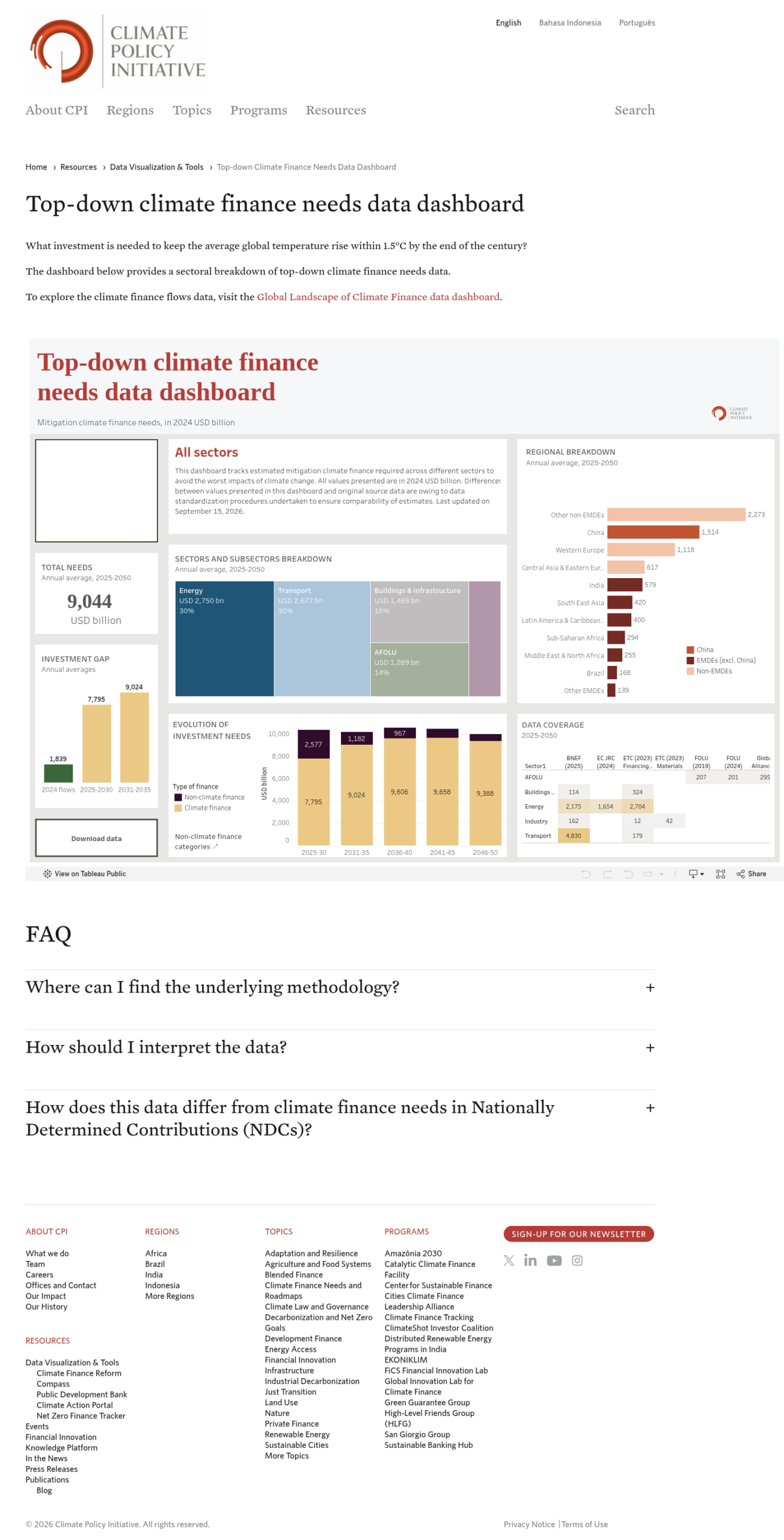
Top-down Climate Finance Needs Data Dashboard
Developed by the Climate Policy Initiative, this dashboard provides interactive visualisations of the global financial requirements for climate mitigation and adaptation, helping finance professionals quantify the investment gap.
Please login or join for free to read more.

OVERVIEW
Overview
The Top-down Climate Finance Needs Data Dashboard is a visualisation tool designed to track and present the scale of funding required to meet global climate objectives. It provides a comprehensive overview of estimated financial requirements for climate mitigation and adaptation based on a variety of top-down modelling sources. This resource is relevant to finance professionals as it helps quantify the investment gap and identify the capital deployment scales necessary for global climate alignment.
Organisation behind the tool
The dashboard is developed and maintained by the Climate Policy Initiative (CPI), an international advisory and research organisation focused on improving energy and land-use policies with a specific emphasis on finance.
What the tool does
The tool provides users with data visualisations that aggregate and compare various climate finance needs. Key features include:
- Interactive visualisations of financial needs across different regions and sectors.
- Aggregation of data from multiple reputable top-down modelling sources.
- Comparison of current finance flows against projected needs to highlight funding gaps.
- Functionality to view and analyse the data by specific climate themes such as energy systems, land use, and infrastructure.
Target audience
The dashboard is primarily intended for institutional investors, policymakers, climate finance researchers, and international development organisations looking to understand the scale of climate-related financial requirements.
Relevance to finance professionals
Finance professionals can apply the dashboard’s insights in the following ways:
- Risk assessment – Understanding the scale of underinvestment in specific regions or sectors to evaluate systemic transition risks.
- ESG analysis – Utilising macro-level data to support environmental reporting and benchmarking investment portfolios against global needs.
- Investment context – Informing long-term capital allocation strategies by identifying sectors requiring significant investment, such as energy and sustainable infrastructure.
- Market insights – Gaining a clearer perspective on global economic trends related to climate-aligned market shifts.





