

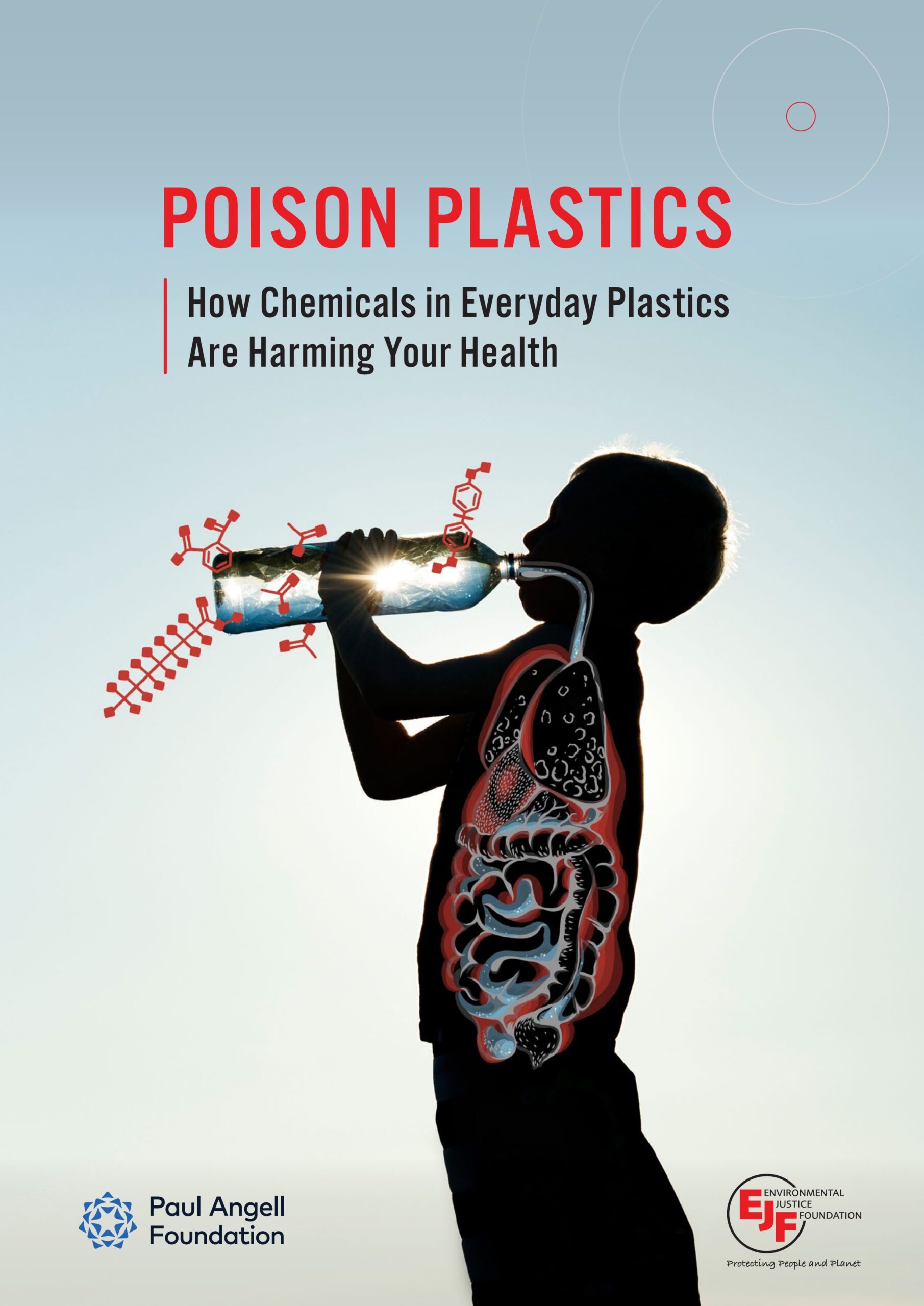
Poison plastics: How chemicals in everyday plastics are harming your health
This Environmental Justice Foundation report examines the health risks associated with chemicals in everyday plastics. It reveals that 92.8% of assessed chemicals pose high risks, including cancer and hormone disruption. The document calls for a Global Plastics Treaty to reduce production and eliminate hazardous substances through a precautionary approach.
Please login or join for free to read more.

OVERVIEW
Introduction
Plastics and their constituent chemicals are deeply embedded in modern life, but their rapid proliferation has come at a significant cost to both the environment and human health. Global plastic production, which was under two million tonnes in 1950, now exceeds 430 million tonnes annually and is projected to more than double by 2050. Approximately three-quarters of all plastic produced between 1950 and 2017 has become plastic waste, with only 9% recycled. The plastics industry is the fastest-growing source of industrial greenhouse gas (GHG) emissions, currently accounting for 4-5% of global emissions. If the global plastic system were a country, it would be the third-largest GHG emitter in the world by 2040, behind only China and the United States.
The toxic chemistry of plastics
Plastics carry both intentionally added and non-intentionally added chemicals (NIAS). Research synthesised in the PlastChem project identifies over 16,000 chemicals present or marketed for use in plastics. More than 4,200 of these are identified as hazardous for human health or the environment. Concerningly, hazard information is lacking for over 10,000 plastic chemicals. These substances, including plasticisers, stabilisers, and flame retardants, are often not chemically bonded to the plastic polymer. Consequently, they can leach directly from plastic products into food, water, soil, air, and the human body.
Human exposure to plastic chemicals
Human exposure occurs primarily through ingestion, inhalation, and skin contact. Ingestion is a major pathway, with chemicals leaching from food-contact plastics such as bottles, takeaway containers, and kitchen utensils. Inhalation is also significant; indoor air contains higher concentrations of plastic chemicals than outdoor environments due to sources like synthetic furniture, detergents, and airborne microplastics. Car cabins are notable sources of exposure, where styrene levels have been found to be 1.5 times the tolerable daily intake recommended by the World Health Organisation (WHO). Dermal uptake occurs via synthetic textiles, cosmetics, and hygiene products, such as menstrual pads and tampons, which involve prolonged contact with highly permeable tissue.
Thousands of plastic chemicals are harming our health
Exposure to plastic-associated chemicals is linked to a range of chronic conditions, including infertility, neurodevelopmental disorders, cardiovascular disease, obesity, and cancer. Vulnerable groups, particularly infants, children, and pregnant people, face heightened risks due to extreme sensitivity during developmental windows. Exposure to just three chemicals—BPA, PBDE, and DEHP—led to an estimated US$1.5 trillion in economic losses across 38 countries in 2015. Many plastic chemicals are endocrine disruptors that interfere with hormonal systems, lowering sperm quality and increasing risks of conditions like endometriosis. Studies have identified links between these chemicals and increased risks of miscarriage, premature birth, low birth weight, and impaired lung growth in children.
Everyday plastics: convenient or contaminating?
Analysis of five everyday use categories revealed a systematic failure in regulation and data transparency. Across these categories, the majority of chemicals (79.2%) lacked sufficient data to assess human health toxicity or exposure risk. Alarmingly, 92.8% of the chemicals that were assessed were identified as presenting a high risk to human health. Furthermore, 82.9% of these high-risk chemicals are not subject to regulation under any relevant multilateral environmental agreement (MEA).
In food-contact plastics, 91.6% of chemicals with available data present a high risk to human health, yet 90.6% remain unregulated internationally. Textiles showed a similar pattern, with a 92.8% high-risk rate and 81.5% unregulated. In the toys category, 88.9% were high risk, which is particularly concerning given children’s vulnerability to chemical ingestion through mouthing behaviours. Household items and hygiene/medical items presented high-risk proportions of 92.4% and 92.6% respectively. Menstrual products were highlighted as a neglected source of phthalate exposure, with concentrations found to be significantly higher than in other plastic consumer products.
Conclusion
Plastics have become ubiquitous at an immense hidden cost. Scientific evidence confirms that thousands of toxic chemicals remain unregulated and unmonitored. These findings expose a public health crisis and a profound failure of governance and corporate accountability. Individual efforts to reduce consumption are insufficient to entirely avoid exposure; governments must act decisively to reduce production and eliminate hazardous substances across the plastics life cycle.
Recommendations
To mitigate these health impacts, the report recommends that governments push for a strong Global Plastics Treaty with binding targets. This includes the 40×40 target proposed by Rwanda and Peru to reduce global primary plastic production by 40% by 2040. Regulations must adopt a precautionary approach, prohibiting hazardous chemicals based on their hazards rather than concentration levels. Strong provisions on transparency and traceability are required to hold producers accountable. Additionally, the report calls for the replacement of single-use plastics with toxic-free reuse, refill, and repair systems to protect both human health and the environment.





