

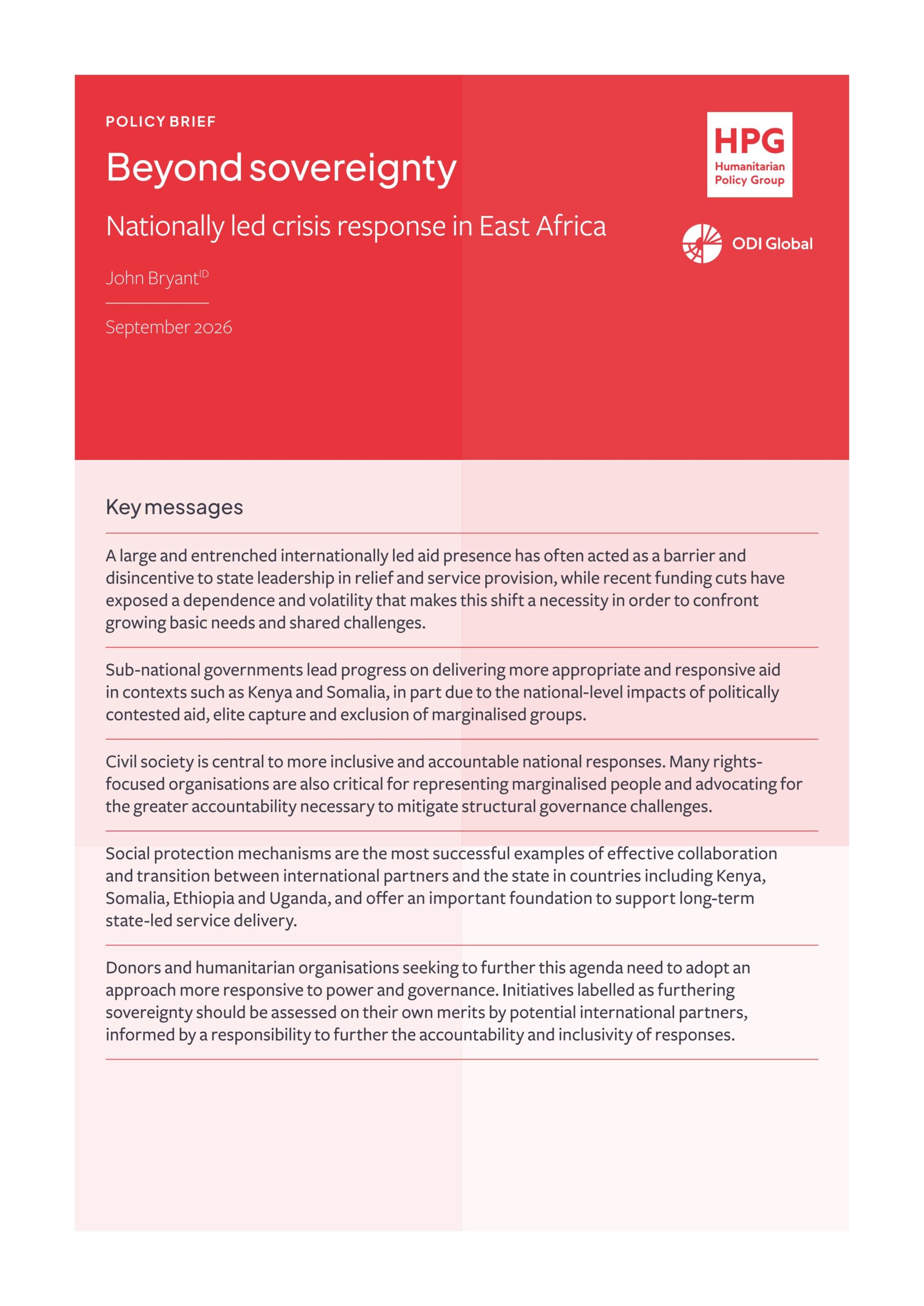
Beyond sovereignty: Nationally led crisis response in East Africa
This report examines the transition towards nationally led crisis response in East Africa. It identifies barriers within international aid structures while highlighting progress in sub-national governance, social protection, and civil society. Recommendations focus on strengthening state accountability and equitable partnerships across Kenya, Somalia, Uganda, South Sudan, and Ethiopia.
Please login or join for free to read more.

OVERVIEW
Introduction
The humanitarian sector has contracted by almost one-third over the past two years due to large falls in funding from public and private donors. This contraction has increased the gap between needs and responses, raising questions about how countries affected by crises will step into these gaps. This study defines state-led or nationally led crisis response as the coordination and strategy of a response being led by affected states, regardless of underlying funding. While consensus exists that affected states have the primary role in managing humanitarian assistance, the presence of the international humanitarian sector can sometimes prove detrimental to state leadership. Lessons from middle-income countries like Indonesia and the Philippines show that a transition to collaborative models under state management is possible.
Common findings
Research indicates that an outsized international humanitarian presence acts as a barrier and disincentive to state leadership in relief and service provision. Funding cuts have exposed a dependence and volatility that makes shifting towards national leadership a necessity. While progress has been made, it is often hindered by the political economy of aid, which can incentivise the status quo through entrenched international structures and short-term planning.
Entrenched international aid agencies are key barriers to state-led ownership and response
In East Africa, large amounts of international aid are often dominated by the World Food Programme (WFP). In Kenya, WFP receives nine times more resources than the state spends on its flagship social protection scheme, the Hunger Safety Net Programme. In Somalia, WFP receives over three and a half times the revenue of the entire federal government. This discrepancy creates an “aid-infused, geopolitical co-dependency” between states and donors. Dominant international presences lack the incentives to facilitate a transition to nationally led responses, and aid is frequently used as a tool for domestic actors and donors to exert influence.
For state actors, sub-national authorities lead progress despite aid politicisation
Sub-national authorities in Kenya and Somalia have demonstrated leadership despite structural barriers. Devolution in Kenya has allowed counties to lead many localised early-warning systems and responses using participatory vulnerability assessments. Somalia is comprised of sub-national entities like Puntland and Somaliland that have their own humanitarian ministries. However, these local authorities face funding gaps as international donors continue to focus on the highly politicised national level. Relations between sub-national and central governments are often fraught, leading to poor coordination and the marginalisation of groups such as women and non-dominant clans.
Civil society is a key channel for change but is under pressure
National non-governmental organisations (NGOs) and civil society networks are critical local service providers and drivers of change. However, they are under pressure from “NGO-isation,” where institutional funding compromises their independence and advocacy. Civic space is under threat due to active suppression and a lack of critical media. There is a notable division between rights-based civil society and humanitarian providers; the latter are more readily funded by donors but may avoid challenging domestic political issues.
Social protection mechanisms are a foundation for state-led responses
Social protection mechanisms offer a relatively effective means of transferring service provision from international to national control. In Kenya, the Humanitarian Safety Net Programme reaches over 137,000 households and has been successfully transferred to the government. Somalia’s Baxnaano (now BOOST-You) is the country’s largest social safety net, reaching four million participants since its inception. The World Bank has supported these systems through longer timeframes and an increased risk appetite compared to typical humanitarian donors.
Insights from elsewhere in East Africa
Countries including Uganda, South Sudan, and Ethiopia possess embattled civil societies and sub-national authorities that offer pragmatic entry points for improving state capacity. However, calls for greater sovereignty at the national level are sometimes used to mask authoritarian practices that weaken civil society and restrict rights.
Uganda
Uganda has shown regional leadership in refugee response through the Settlement Transformation Agenda and the Comprehensive Refugee Response Framework. While sub-national governance is active, recent “Protection of Sovereignty” legislation is claimed to deter foreign interference but is often seen as a way to weaken civil society. Funding agreements have also been used to pressure healthcare workers into refusing services for marginalised groups.
South Sudan
In 2026, over half the population (7.8 million people) requires urgent food assistance. High dependence on external donors, primarily the US, makes the population vulnerable to aid cuts. While collaborative relationships exist between local and traditional authorities in states like Lakes and Eastern Equatoria, the prospect for a shift to state-led services is remote due to intensifying civil war and political deterioration.
Ethiopia
The Ethiopian government has sought greater control over relief through the Disaster Risk Management Proclamation of late 2025. This includes “statistical sovereignty,” where humanitarian data is treated as a national asset and sharing is restricted. However, the “Makatet” (inclusion) initiative for refugees offers a more enabling route to national ownership by providing education and work opportunities.
The prospects for inclusive nationally led responses
A permanent international aid presence can act as a stifling cover for political failures in conflict governance. State capacities are hampered by corruption and debt repayments that far exceed donor funding. Trust in state actors is low across the region, with Somalia ranking 181st and South Sudan 182nd on the Corruption Perceptions Index. Shifting to nationally led responses requires addressing these broader political and economic issues.
Recommendations
National and sub-national state actors should prioritise transparency, tackle corruption, and build on social protection mechanisms to create shock-responsive service delivery. Civil society actors should use their local legitimacy to advocate for state-run services that serve marginalised groups. Donors must stop perpetuating the outsized international humanitarian system and instead support clear transition plans with “sunset clauses.” UN agencies and INGOs should focus on governance and support state service provision while seeking equitable partnerships with civil society.




