

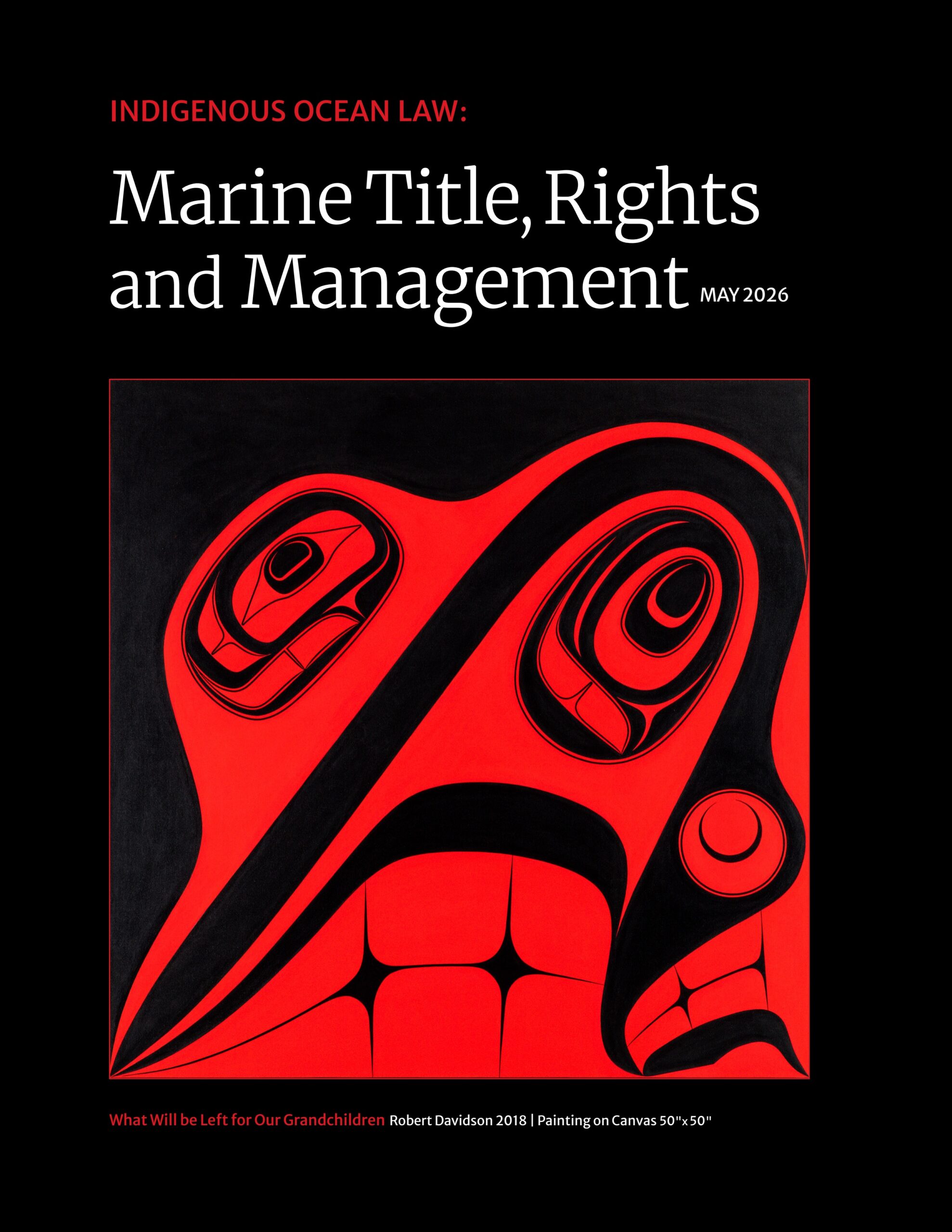
Indigenous ocean law: Marine title, rights and management
This report explores Indigenous ocean law, critiquing Western legal frameworks while advocating for Indigenous-led marine management. It highlights the Haida Nation’s success in securing marine title through negotiation and litigation, and presents conceptual tools like keystone theory and the rights of nature to support sustainable ocean governance.
Please login or join for free to read more.

OVERVIEW
The context of oceans
Indigenous Peoples of the Pacific Northwest Coast maintain powerful, symbiotic connections with their marine territories that have endured despite colonial and federal legislation. Historically, Western cartography has been used as a technology for empire-building and the dispossession of Indigenous lands. This report critiques the Western legal construct of mare nullius (empty ocean), which mirrors terra nullius by recasting marine spaces as empty and wild to legitimate colonial control. In contrast, the report foregrounds Indigenous marine territory as a spectrum ranging from generalized ocean space to historically situated social places defined by unique histories and names. It notes that while Earth’s world ocean covers 71% of the surface and contains 97% of its water, most human activity occurs on the continental shelf and coasts.
The current legal landscape
The Canadian legal landscape is shifting as courts begin to grapple with the legacy of colonialism. Under section 35(1) of the Constitution Act, 1982, existing Aboriginal and treaty rights are recognized and affirmed. However, litigation has predominantly focused on land title, leaving Indigenous communities largely excluded from marine decision-making. Recent developments, such as the United Nations Declaration on the Rights of Indigenous Peoples Act (UNDRIPA), offer new tools for asserting rights. Notable cases like Cowichan Tribes v Canada (2025) have resulted in declarations of Aboriginal Title to submerged lands, specifically involving 142 acres of the south Fraser River. Climate change litigation is also emerging as a significant force, with cases such as Mathur v Ontario (2025) and Misdzi Yikh v Canada (2024) challenging government failures to address environmental threats as breaches of Charter rights.
Toward an Indigenous ocean law
Developing an Indigenous ocean law requires a holistic approach that integrates Western science with traditional knowledge. This report proposes three conceptual frameworks: Indigenous law, keystone theory, and respect for all relations. Keystone theory focuses on essential features to reduce scientific and legal complexity, identifying six specific theories including biological and cultural keystone species. Marine keystones like the sea otter (Ku|Kuu) are vital; by preying on sea urchins, they allow kelp forests to thrive, which helps sequester carbon and reduce ocean warming. Cultural keystone species, such as the red cedar tree, shape cultural identity and serve as metaphors for Indigenous legal traditions. Furthermore, the ‘rights of nature’ movement advocates for the legal personhood of ecosystems, citing global precedents like the Whanganui River in New Zealand and the Magpie River in Québec.
Implementing Indigenous law: the Haida example
The Council of the Haida Nation (CHN), established in 1974, provides a practical template for asserting marine jurisdiction. Through a dual strategy of negotiation and litigation, the Haida have secured unprecedented recognition of their title. The 2024 ‘Rising Tide’ Haida Title Lands Agreement with British Columbia recognized Haida Title to all lands of Haida Gwaii, including the foreshore and some submerged lands. This was supplemented by the ‘Big Tide’ Agreement with Canada later that year. The Haida have also pioneered the use of Marine Protected Areas (MPAs), such as Gwaii Haanas and SGaan Kinghlas (Bowie Seamount), to protect biodiversity. These agreements are built on fundamental Haida laws including Yahguudang (Respect for all beings) and Giid tlljuus (Balance).
Conclusion
Indigenous law provides a robust legal and theoretical basis for understanding Aboriginal Title to marine territories. While initial forays into oceans governance have focused on discrete areas, the next step is the implementation of integrated marine plans across entire territories. This journey involves addressing the challenges of transnational regulatory governance and shipping corridors for hydrocarbon projects. Ultimately, the work of legal pluralism is not defined by fixed states but by ongoing, responsible relationships between multiple legal orders, each carrying its own authorities and systems of governance.
Epilogue
Despite progress, Indigenous communities face ongoing threats from oil tankers and industrial trawling. In 2025, Pacific Wild documented that nine vessels trawled 89,700 km² of the British Columbia coast, an area larger than Ireland. However, success stories like the establishment of Mia-yaltwa Ha’lidzogm hoon—an area covering over 6,700 square kilometres protected under Indigenous law—offer hope. The report concludes with practical strategies for corporations, including obtaining free, prior, and informed consent (FPIC), and for NGOs, such as ensuring Indigenous representation in leadership positions to support reconciliation efforts.




