

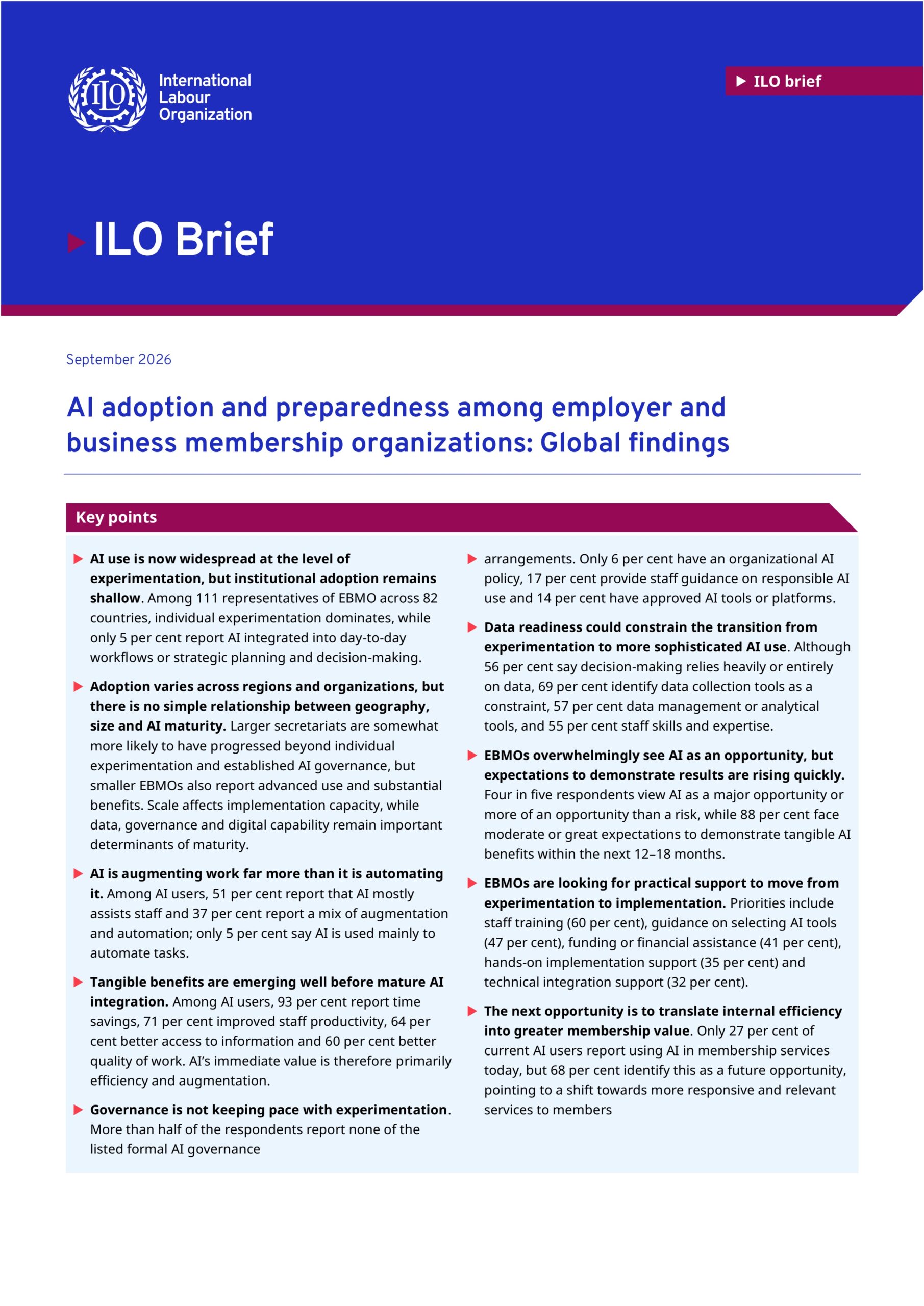
AI adoption and preparedness among employer and business membership organisations: Global findings
This ILO report examines AI adoption within employer organisations. While experimentation is widespread, institutional integration remains low. Despite significant efficiency gains, gaps in data readiness and governance persist. The findings suggest a shift from internal efficiency towards using AI to create greater membership value and responsive services.
Please login or join for free to read more.

OVERVIEW
Executive summary
Artificial intelligence (AI) is rapidly transitioning from a general-purpose technology to a practical set of operational tools used within employer and business membership organisations (EBMOs). Research by the International Labour Organisation (ILO) identifies a significant gap between experimentation and institutional adoption. While 44 per cent of organisations report individual staff experimentation, only 5 per cent have integrated AI into day-to-day workflows or strategic planning. AI is currently delivering tangible benefits, with 93 per cent of users reporting time savings and 71 per cent noting improved staff productivity. However, organisational preparedness, particularly regarding formal governance and data readiness, is not keeping pace with this experimental use. Direct comparisons with earlier studies suggest AI use remains concentrated in accessible applications with limited systematic integration.
Evidence base
The findings are based on a 2026 global survey that recorded 111 responses across all five ILO regions: Asia and the Pacific (29), the Americas (27), Africa (23), Europe and Central Asia (25), and the Arab States (7). The sample spans 82 countries and territories. Responding EBMOs vary in scale, with 33 per cent representing fewer than 500 members and 23 per cent representing more than 5,000. Secretariat capacity also varies; 39 per cent employ more than 25 permanent full-time staff, while 37 per cent have ten or fewer. The majority of respondents were senior decision-makers, including CEOs and Secretaries General.
Data readiness: a foundation for AI adoption
Data readiness is a critical component of EBMO preparedness. While 56 per cent of organisations report that decision-making relies heavily or entirely on data, significant constraints remain. Sixty-nine per cent identify data collection tools as a constraint, 57 per cent cite data-management or analytical tools, 55 per cent point to staff skills, and 53 per cent mention financial resources. Furthermore, 51 per cent report challenges related to the willingness of members to share data. Successful adoption depends less on the specific technology chosen and more on whether an EBMO has the organizational foundations to use it effectively, including reliable data and appropriate systems.
Experimentation is widespread, integration is not
AI use is concentrated at the experimentation stage, with 44 per cent reporting individual staff use and 21 per cent reporting use across multiple functions. In contrast, only 3 per cent have integrated AI into day-to-day workflows and just 2 per cent have embedded it in strategic planning. Nine per cent of EBMOs report no AI use at all. This suggests that while access to AI tools translates quickly into experimentation, systematic organisational adoption is a much slower process requiring broader capabilities in areas such as governance and process redesign.
Governance is not keeping pace with use
A clear preparedness gap exists in formal governance. More than half of EBMOs (51 per cent) report having none of the listed formal AI governance arrangements, while 23 per cent are currently developing them. Existing measures are limited: only 20 per cent provide AI training for staff, 17 per cent offer guidance on responsible use, and 14 per cent have approved specific AI tools. Only 6 per cent have an established organisational AI policy. This gap indicates that experimentation is spreading among staff faster than the rules and safeguards needed to manage that use can be developed.
Communications and research lead the way
Among EBMOs currently using AI, communications is the most frequent application area (80 per cent), followed by research and analysis (71 per cent), advocacy (55 per cent), and administration (53 per cent). AI is being adopted first in areas where it can support existing knowledge and administrative work without requiring major changes to organisational systems. Other areas, such as membership services (27 per cent) and training (26 per cent), show lower levels of current integration.
AI is augmenting work – and already delivering benefits
AI is primarily perceived as a tool for augmentation rather than automation. Fifty-one per cent of respondents report that AI mainly assists staff, while only 5 per cent say it is used mainly to automate tasks. Tangible benefits are emerging early; 93 per cent report time savings, 71 per cent improved productivity, 64 per cent better access to information, and 60 per cent better quality of work. Around half of the organisations report faster service to members and cost savings.
Future opportunity: moving from internal efficiency to member value
EBMOs see significant potential to expand AI use. While only 27 per cent currently use AI in membership services, 68 per cent identify this as a major future opportunity. The challenge lies in converting internal efficiency gains into more responsive services, stronger research, and better advice for member enterprises. Four in five respondents view AI as either a major opportunity or more of an opportunity than a risk.
A practical pathway for EBMOs
To move towards purposeful adoption, the report recommends treating AI as an organisational change process. EBMOs should start with specific organisational needs and use cases rather than focusing solely on tools. Building foundations for responsible use involves assessing data quality and defining approved tools. Organisations should invest in people by combining foundational literacy with hands-on learning. Building partnerships with technology providers or peer organisations can complement internal capacity. Finally, EBMOs must measure outcomes by tracking whether AI produces measurable improvements in service responsiveness and membership engagement, and match their support strategies to their specific level of AI maturity.




