

Indonesia’s 2026 fires: mapping exposure to bond issuers
This report maps the exposure of bond issuers to Indonesia’s 2026 fires and subsequent regulatory actions in Indonesia and Singapore. It categorises companies by operational or commercial exposure, highlighting potential financial risks from production losses, certification disputes, and tightening credit conditions for entities linked to transboundary haze.
Please login or join for free to read more.

OVERVIEW
Summary
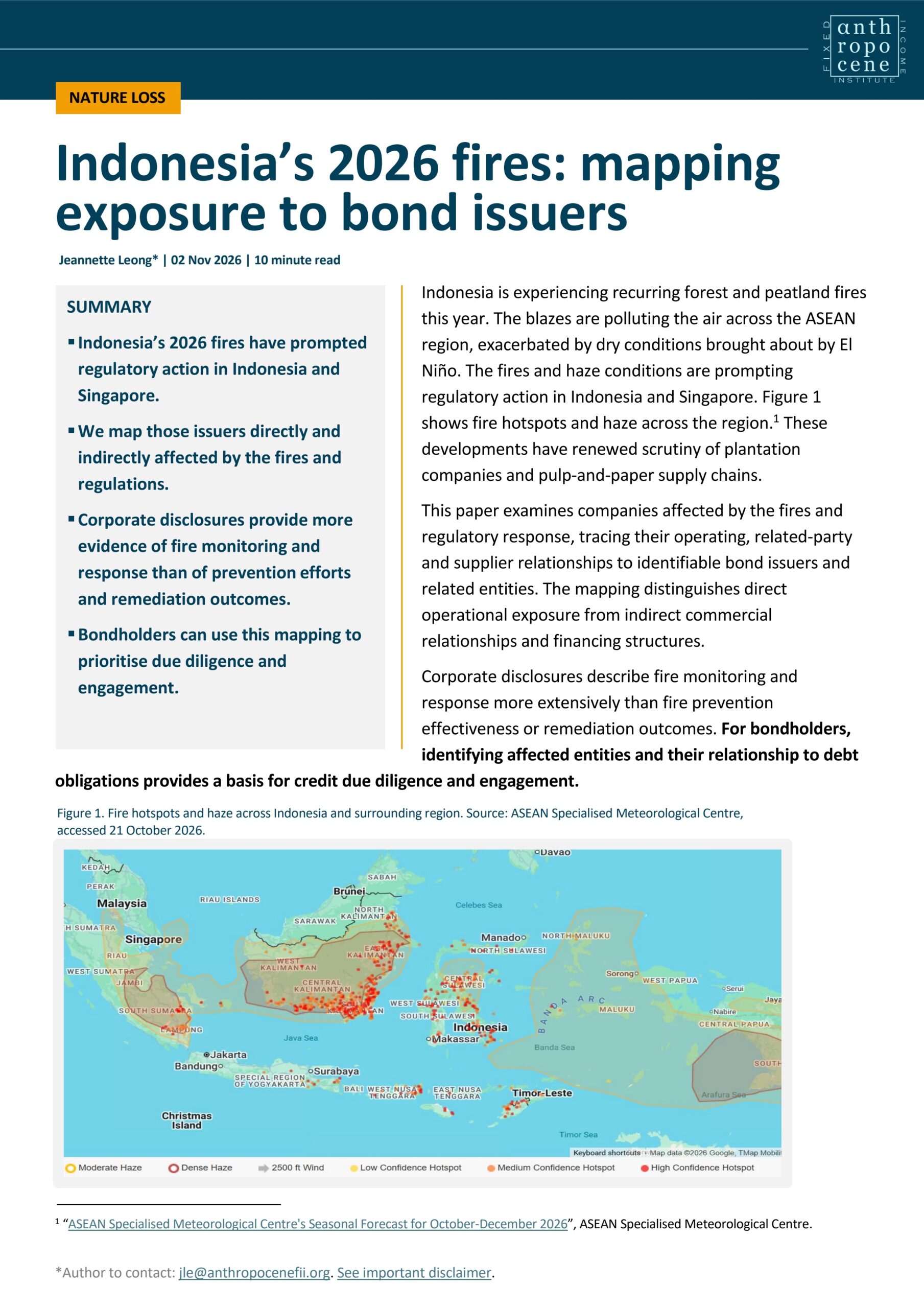
Indonesia is currently facing recurring forest and peatland fires, exacerbated by severe dry conditions brought about by the El Niño cycle. These blazes are polluting the air across the ASEAN region, prompting significant regulatory responses in both Indonesia and Singapore. This research examines companies affected by the fires and maps their operational, related-party, and supplier relationships to identifiable bond issuers. While corporate disclosures provide extensive information on fire monitoring and response, they offer less evidence regarding the effectiveness of prevention efforts or remediation outcomes. For bondholders, identifying affected entities and their relationship to debt obligations provides a necessary basis for credit due diligence and prioritising engagement.
Fire context, regulatory action, and links to debt issuers
The 2015 fires in Indonesia serve as a historical benchmark for the current crisis. Between January and September 2026, satellite mapping estimated that 1.92 million hectares were affected by fire. The Landscape Group estimates that fire-related emissions reached 673 MtCO2e by 15 October 2026, with approximately two-thirds originating from peat fires. Despite Indonesia introducing fire-prevention measures since 2015, including a peatland restoration agency and a permanent moratorium on primary forest permits, the risk remains high. Previous episodes demonstrate the scale of potential economy-wide losses; the 2015 fires caused an estimated USD 16.1 billion in economic losses, equivalent to 1.9% of GDP.
Regulatory pressure has intensified. On 19 October 2026, Indonesia’s Ministry of Forestry announced administrative sanctions against 32 companies covering 12,927 hectares, including 19 permit suspensions and five revocations. Singapore’s National Environment Agency (NEA) has also issued Preventive Measure Notices to ten Indonesian concession holders. Furthermore, Singapore has established a specialist panel of law, audit, and investigative firms to examine company operations and supply chains, with identified companies required to fund these assessments.
Exposure to debt issuers
This report identifies companies named in connection with the fires and maps them to debt obligors across three categories: direct operational exposure, related-party/commercial exposure, and group-level supplier exposure. Indofood CBP has the largest outstanding bond balance at USD 2.75 billion, included due to its procurement relationship with Indofood Agri Resources. Other identified issuers with bonds primarily in MYR and IDR include Kuala Lumpur Kepong, SD Guthrie, Genting Plantations, and Indah Kiat Pulp & Paper. These companies face varying levels of scrutiny based on their direct concessions or indirect commercial links.
Corporate disclosures emphasise monitoring and response
Major plantation companies have disclosed zero-burning policies and satellite monitoring programmes, yet fires continue to be reported within or around their concessions. Disclosures typically focus on fire locations and response activities rather than the effectiveness of containment or remediation. For example, Genting and Wilmar distinguish between fires within their estates and those on surrounding land, providing visibility on operational exposure, though location data alone does not establish where fires originated. Consistent reporting on affected areas and containment times is required for a fuller assessment of fire-management performance.
Potential operational, commercial, and financing effects
Fires can directly damage plantation infrastructure and palms, interrupting production and requiring costly rehabilitation. Historical disclosures reveal that drought and haze can impair fruit development and reduce yields for years. For instance, Golden Agri-Resources saw total palm product output fall by 15% in 2016 following the 2015 El Niño. First Resources reported that net profit fell by 36.2% to USD 31.5 million in 1H2016, citing the prolonged effects of dry weather.
Regulatory enforcement creates operational and remediation obligations
Permit suspensions and revocations restrict operating rights, while restoration orders create significant compliance obligations. Past Indonesian court rulings highlight the potential for financial liability; in 2016, an APP supplier was ordered to pay IDR 78.5 billion (approximately USD 5.9 million) in damages for fires on its concession. Singapore’s response extends to supply chains, with the government considering further legal and economic measures that could affect access to financing and grants for linked issuers.
Certifications and customer relationships: APP and IOI
Environmental concerns involving suppliers can lead to certification suspensions and the withdrawal of products by retailers. In 2015, major retailers removed APP-linked products during the haze crisis, and IOI Corporation reported a 5% decline in refinery volume following its RSPO certification suspension in 2016. The upcoming EU Deforestation Regulation (EUDR) will add further regulatory dimensions to these commercial risks, making supplier traceability and land-use history critical for maintaining market access.
Environmental considerations in financing relationships
Singaporean banks, including DBS, OCBC, and UOB, have reiterated strict lending requirements regarding open burning and deforestation. OCBC stated that evidence of non-compliance could lead to reduced financing or termination of relationships. The Monetary Authority of Singapore has reinforced expectations for banks to consider NEA information and take proportionate action where breaches of environmental laws occur.
Bondholder due diligence and environmental accountability
Bondholders can use engagement routes to encourage greater corporate accountability. Identifying affected operations and disclosing associated costs or regulatory obligations is a critical starting point. Tools like Forest IQ compare companies’ deforestation commitments, with scores for examined companies ranging from 1.5/10 for Indofood Agri to 9/10 for SD Guthrie. These scores help identify which companies require stronger commitments and improved reporting.
Conclusions
Corporate fire management and supplier oversight are material considerations for fixed income investors in the plantation and pulp-and-paper sectors. While current corporate disclosures are limited, the materiality of fire-related links may increase as regulatory enforcement tightens and market requirements expand. Bondholders are encouraged to incorporate these environmental considerations into their ongoing credit monitoring and engagement strategies through 2027.




