

Business Model Red Flags
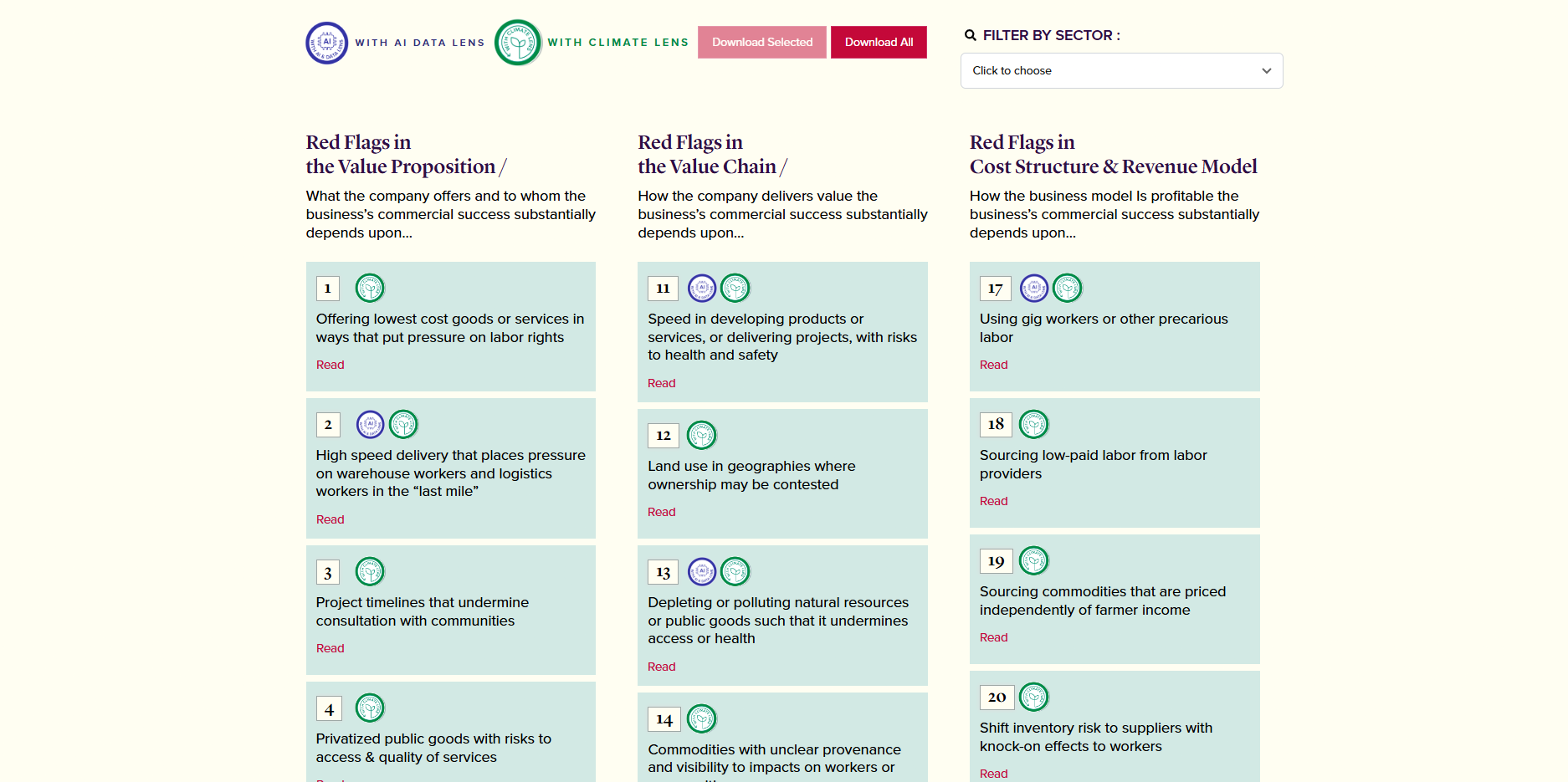
Business Model Red Flags is a framework by Shift that identifies 25 indicators of how corporate structures and commercial strategies can create human rights and environmental risks. It helps investors and companies perform deeper due diligence on profit-generating models.
Please login or join for free to read more.

OVERVIEW
Business Model Red Flags is a diagnostic tool developed to help organisations identify how specific business models, design choices, and commercial strategies may inadvertently create risks to human rights and the environment. By highlighting 25 distinct “red flags”, the tool assists finance professionals and corporate leaders in moving beyond surface-level policy commitments to examine the underlying drivers of harm within a company’s operations and value chain.
Organisation behind the tool
The tool is developed and maintained by Shift, a non-profit centre of expertise on the UN Guiding Principles on Business and Human Rights. Shift works with businesses, financial institutions, and governments to embed respect for people and the planet into corporate practices.
What the tool does
The tool provides a structured framework to assess risks through a “menu of red flags” categorised by business drivers. Key functions include:
- Providing a set of indicators for dominant or emerging business models across various sectors.
- Offering detailed explanations of how specific profit-seeking strategies—such as hyper-fast delivery models or aggressive tax planning—can incentivise human rights abuses.
- Supplying a “climate lens” to identify business models that are incompatible with a just transition or environmental goals.
- Categorising flags into themes such as labour rights, land-related rights, and the right to life and health.
Target audience
The primary users include institutional investors, asset managers, and ESG analysts seeking to perform deeper due diligence. It is also intended for corporate sustainability teams, risk managers, and civil society organisations monitoring corporate impacts.
Relevance to finance professionals
Finance professionals can apply the tool in the following areas:
- Risk assessment – identifying structural risks in investee companies that traditional ESG ratings might overlook, specifically regarding how a firm generates profit.
- ESG analysis – providing qualitative metrics and themes for reporting and internal sustainability benchmarking.
- Investment context – evaluating the long-term viability of business models in the face of increasing regulatory focus on human rights and environmental due diligence.
- Engagement and Stewardship – equipping asset managers with specific questions and indicators to use during dialogues with board members and executive teams.




