

Renewable energy financing landscape in India: The journey so far and the need of the hour
This report examines India’s renewable energy financing landscape, detailing the transition from non-banking financial companies to commercial banks and international bond markets. It analyses falling solar tariffs, historical funding barriers, and emerging opportunities in energy storage and rooftop solar necessary to achieve India’s 2070 net-zero mandate.
Please login or join for free to read more.

OVERVIEW
Executive summary
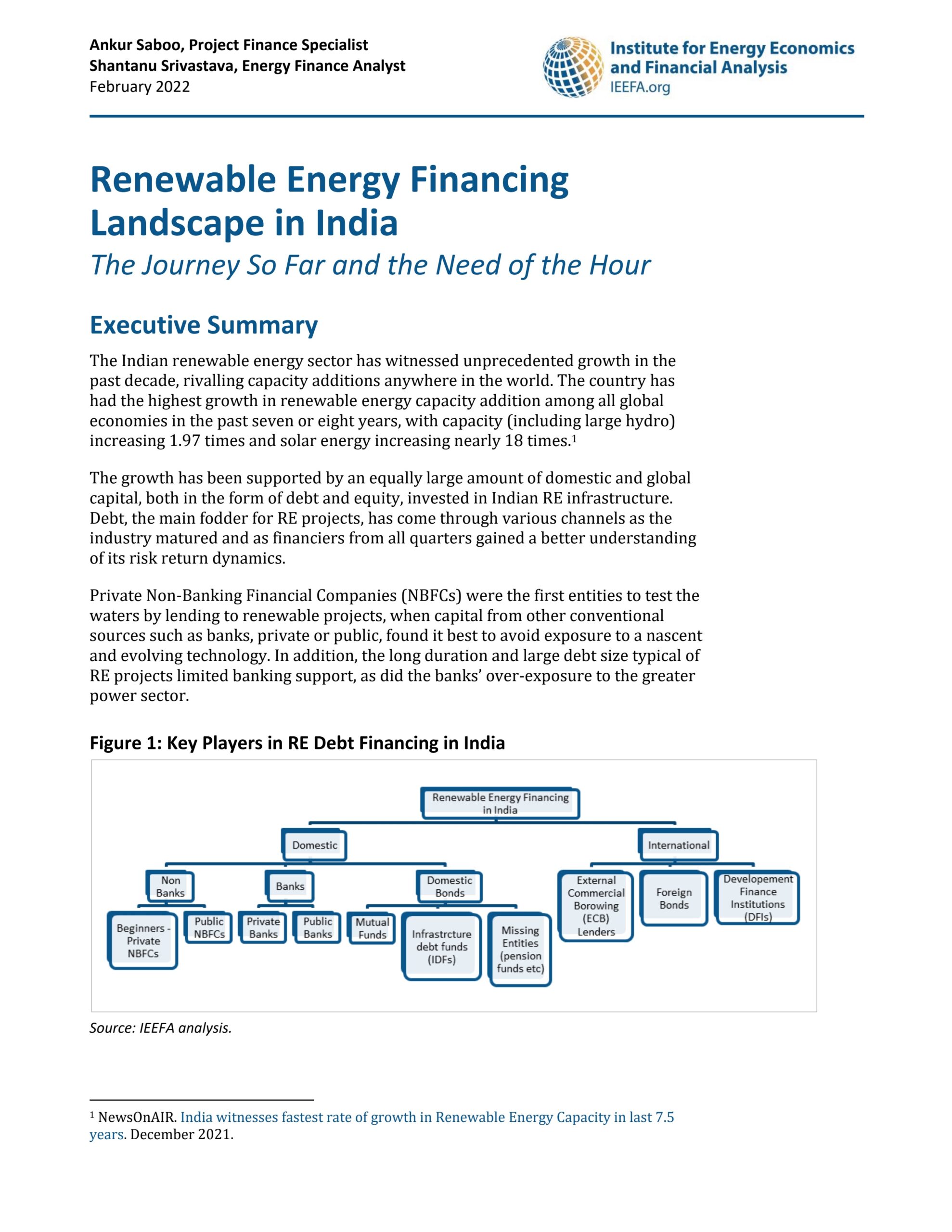
The Indian renewable energy (RE) sector has experienced unprecedented growth over the last decade, with capacity additions rivalling any other global market. India has recorded the highest growth in RE capacity additions among major global economies over the past seven to eight years. During this period, total capacity (including large hydro) increased 1.97 times, while solar energy capacity grew nearly 18 times. This expansion has been supported by significant domestic and global capital in the form of debt and equity. While private non-banking financial companies (NBFCs) were the first to lend to these nascent technologies, the market has since matured to include large commercial banks and international bond markets.
Renewable financing solutions – a retrospective view
The growth of solar power in India is noted as a significant success, with performance frequently surpassing initial estimates. The National Solar Mission (NSM), launched in 2010 with a target of 20 gigawatts (GW) by 2022, saw its goals revised upwards twice, currently standing at 100GW. In the early 2010s, wind power dominated capacity additions under the Feed-in Tariff (FiT) regime. However, solar has since overtaken wind due to ease of construction, steady generation, and scalability. Wind projects face challenges such as resource availability and the financial health of original equipment manufacturers (OEMs).
Solar tariffs have fallen dramatically from Rs15/kWh in 2010 to record lows of Rs1.99/kWh (~US$0.03/kWh) in 2020. Historically, financing was difficult to secure; lenders cited risks related to unproven technology and the limited experience of promoters. In 2012, the Indian Renewable Energy Development Agency Limited (IREDA) charged interest rates between 12.5% and 13.5%. Today, rates have fallen to approximately 8% for some lenders. Banks were initially reluctant due to technology evolution, short loan tenors (10 years versus the required 20 years), high project costs (Rs150-180m/MW for solar versus Rs50m/MW for thermal), and existing stress in the thermal power sector.
Domestic debt funding
For the first five years of the solar journey, private NBFCs such as L&T Infra Finance, IDFC, and Tata Cleantech dominated the lending landscape. Public sector NBFCs like IREDA, Power Finance Corporation (PFC), and Rural Electrification Corporation (REC) followed later with larger funding amounts. Recently, large commercial banks have entered the fray. The State Bank of India (SBI) leads with a cumulative RE deployment exceeding Rs330bn (US$4.4bn) as of September 2021. HDFC Bank more than doubled its RE financing book to Rs108.7bn (US$1.5bn) in FY2021/22. The entry of these banks has driven interest rates to all-time lows and increased competition, forcing some NBFCs to see a 50% shrinkage in their renewable asset books as projects are refinanced by banks post-commissioning.
International debt funding
International lenders such as Standard Chartered Bank (SCB) and Rabo Bank have established substantial exposures, with SCB underwriting nearly a billion dollars for the Adani Group in 2021. The international bond market has been particularly proactive, attracting buyers with high-yield offerings from major players like Greenko, ReNew Power, and Azure Power. Additionally, development finance institutions (DFIs) including the Asian Development Bank (ADB) and Asian Infrastructure Investment Bank (AIIB) provide critical long-term money with 20 year-plus structures and negligible interest rate fluctuation risks.
A glimpse into the investor base – the equity story
The equity side has attracted diverse, long-term “patient” investors due to the social and environmental impact of renewables. These include sovereign entities such as ENEL, CDPQ, and the Canada Pension Plan Investment Board (CPPIB), alongside global private equity firms like KKR and Goldman Sachs. Oil and gas majors, including Total SE, Shell, and Petronas, have also invested as a hedge against fossil fuels. The emergence of infrastructure investment trusts (InvITs) like Indigrid and Virescent has further strengthened the equity pillar as India moves toward its 500GW goal.
Renewable sector – future growth potential
India’s total renewable potential stands at more than 1 terawatt (TW), led by 749GW of solar and 302GW of wind. To meet its 2030 targets and the 2070 net-zero mandate set at the Glasgow summit, India must maintain focus on scaling from 100GW to 500GW. Opportunities exist in hybrid projects, battery energy storage systems (BESS), and round-the-clock (RTC) power supplies. SECI has already floated tenders for 2,000 MWh of standalone energy storage systems, and NTPC is pursuing 1,000 MWh of grid-connected BESS.
Gaps and opportunities in the market
Despite progress, gaps remain in financing greenfield projects and non-central government projects (state or third-party offtake), where banks remain cautious. As project sizes grow—such as ReNew Power’s US$1bn RTC project—there is a need for consortium-based funding. The report suggests that the National Bank for Financing Infrastructure and Development (NBFID) could serve as a thought leader in deal structuring and policy advocacy. Furthermore, as the industry shifts toward Indian-made modules and inverters, lenders must utilise specialised independent engineers to mitigate technical risks. Finally, the “retailisation” of solar through rooftop projects offers a 40GW target opportunity that could allow large fintech companies to thrive.




