

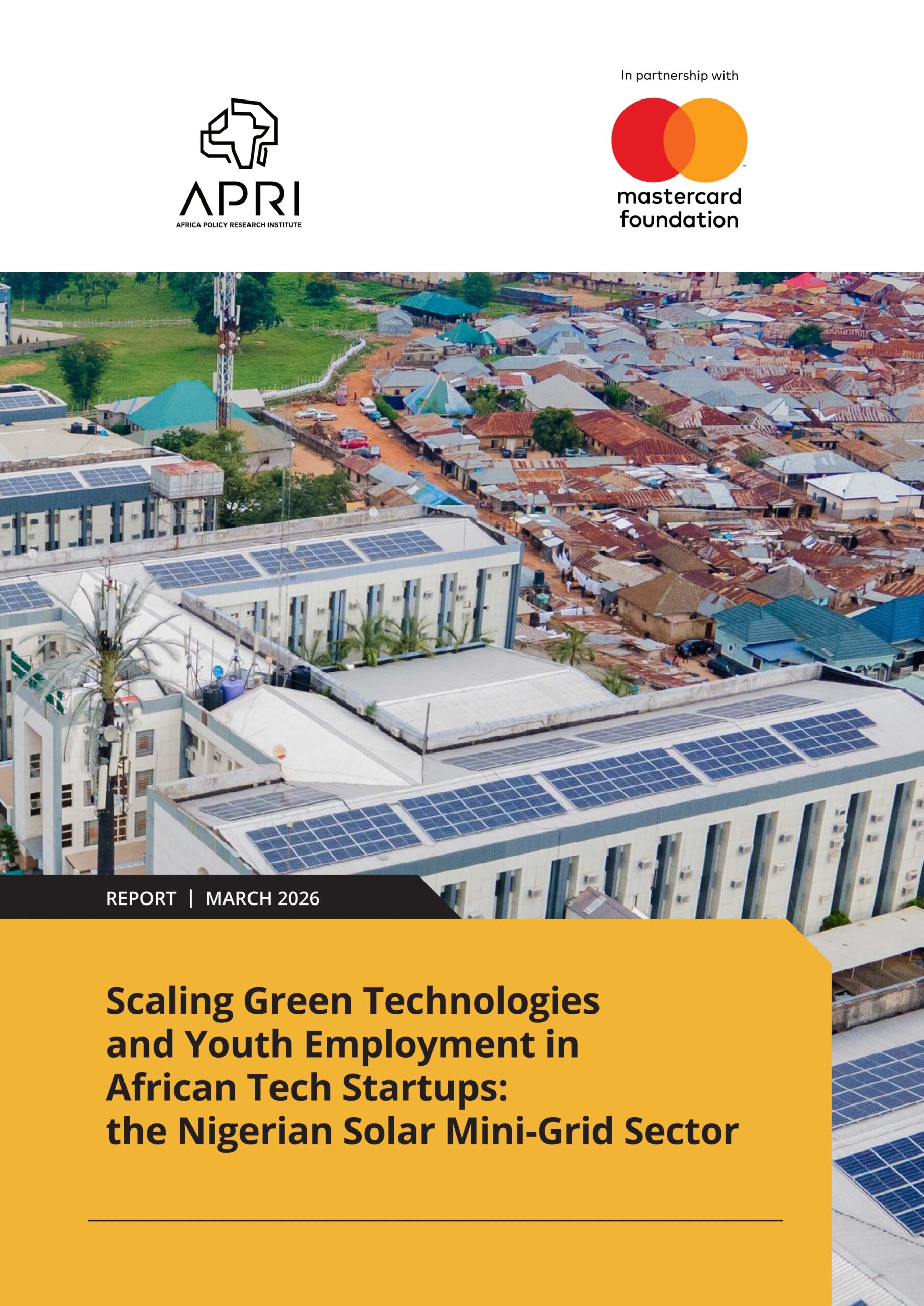
Scaling green technologies and youth employment in African tech startups: The Nigerian solar mini-grid sector
This report examines the nexus between green technology and youth employment within Nigeria’s solar mini-grid sector. It identifies significant growth potential, noting that youth comprise 82% of the workforce. However, systemic barriers in finance, policy coherence and technical skills persist. Recommendations include targeted funding and integrated policy frameworks.
Please login or join for free to read more.

OVERVIEW
Nigeria faces the interconnected challenges of climate change, slow economic growth and high youth unemployment, with 25.7% of Africa’s youth population aged 15 to 29 recorded as not in education, employment or training (NEET) in 2022. Green technologies, specifically solar mini-grids, offer a promising solution by creating jobs while addressing energy poverty. Nigeria is currently the largest mini-grid market in West Africa, with over 90 million people lacking electricity access. This report examines how policy, finance, skills and innovation shape youth employment outcomes in the emerging green sector.
Labour dynamics and job opportunities in the solar mini-grid sector
The solar mini-grid sector is a vital component of Nigeria’s green growth strategy. It is estimated that by deploying over 10,000 mini-grids, the sector could create 212,688 direct full-time informal and productive use jobs. Currently, the workforce is heavily youth-driven, with young people making up an average of 82% of full-time staff. However, they are underrepresented in leadership, holding only 19% of chief executive officer (CEO) roles. Gender dynamics are progressive compared to broader African energy utilities; women represent 34% of full-time employees and 53% of management staff, though they only make up 8% of technical roles.
Needs and priorities for youth in the solar mini-grid sector
Youth in the sector prioritize skills development, access to finance and technical assistance. There is a notable shortage of job-ready talent, particularly in specialised fields such as design, installation, and project management. Educational disparities contribute to gender gaps, as women represent only 7% of engineering and technology graduates. Furthermore, access to finance remains a critical barrier for young entrepreneurs. The sector may require up to USD 8 billion to connect 35.4 million people, yet it remains heavily donor-dependent due to high commercial interest rates exceeding 22% and a lack of secondary markets for mini-grid assets.
Key recommendations
Policymakers and stakeholders are encouraged to create explicit policy targets for youth and gender inclusion, disaggregated by age and gender, to ensure these groups are integrated as the sector matures. Recommendations include institutionalising youth involvement by establishing youth wings within industry associations like the Renewable Energy Association of Nigeria (REAN). Financial institutions should develop tailored funding mechanisms with relaxed eligibility criteria for youth-led ventures, complemented by technical assistance. Additionally, vocational training should be standardised and decentralised to equip youth and women with practical experience.
Introduction
The potential for green tech to drive job creation aligns with the philosophy of Africapitalism, which emphasises the role of the private sector in generating economic prosperity and social wealth. Despite this potential, the Frontier Technology Index reveals that sub-Saharan Africa is the least prepared to adopt cutting-edge technologies. Nigeria was selected for this study due to its vibrant startup ecosystem and its status as the fastest-growing market for private mini-grids in the region, with approximately 200 systems installed by 2023.
Solar mini-grid innovation and youth employment in Nigeria
The decarbonisation agenda provides opportunities to adopt new technologies and build capabilities in new industries. Nigeria has committed to cutting greenhouse gas emissions by 45% by 2030, with the energy sector accounting for the majority of these reductions. The mini-grid value chain comprises diverse actors, including original equipment manufacturers (OEMs), developers and service companies. While many components are currently imported, local contribution to mini-grid equipment reached 19% by 2021.
Tech startups, local innovation and youth employment: enablers and barriers
Startups face high capital entry barriers, with the median cost of a mini-grid in 2018 recorded at USD 140,000. Accessing early-stage patient capital remains a systemic challenge, as dominant funding models are grant-based. Regulatory hurdles, including historically long approval timelines averaging 50 weeks, also constrain experimentation. However, the regulatory environment is evolving; the World Bank’s RISE indicators rank Nigeria first in Africa for its mini-grid framework, providing a foundation for growth.
National policy and regulatory framework
Existing frameworks, such as the National Renewable Energy and Energy Efficiency Policy (NREEEP), focus on broad electrification goals but pay limited attention to youth employment. There is a significant policy coherence gap between energy, youth and labour policies. The report identifies a ‘missing middle’ where specific green-jobs-for-youth policies are lacking. Cross-ministerial collaboration is essential to create integrated strategies for green jobs and inclusive industrial growth.
Innovation in the solar mini-grid sector
Innovation in the sector is predominantly needs-based and necessity-driven, aimed at reducing costs and improving efficiency. Radical innovations, such as the transition to lithium-ion batteries and mesh grids, are frequently imported. Home-grown radical innovations are rare due to weak manufacturing capabilities and research-to-industry pipelines. Indigenous knowledge (IK) is currently harnessed in local manufacturing (such as metres) and project management but faces challenges in scaling due to a scarcity of makerspaces and long-term support hubs.
Scaling local innovation in solar mini-grids: the way forward
The path forward requires deliberate systemic interventions, including aligning international policies with local realities and mainstreaming mini-grids into national development plans. Establishing more renewable energy innovation hubs can provide young entrepreneurs with the mentorship and infrastructure needed to scale their ideas. Finally, mandating that rural electrification initiatives prioritise local youth employment in project design will ensure that economic benefits are geographically dispersed and sustainable.




