

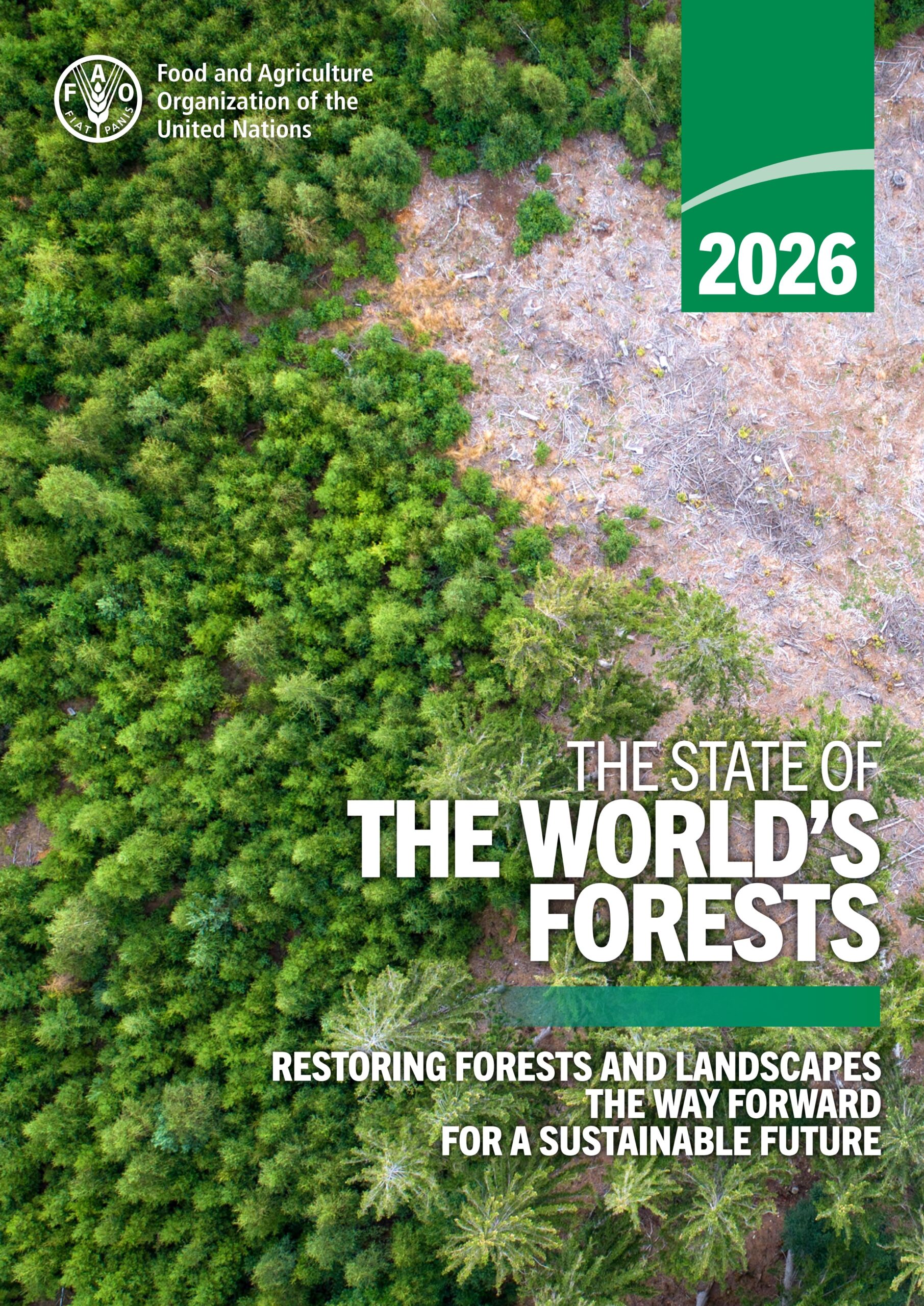
The state of the world’s forests 2026: restoring forests and landscapes – the way forward for a sustainable future
This 2026 report evaluates global progress in forest and landscape restoration. While commitments cover over 1 billion hectares, only 44 million hectares of forest are currently under restoration. Meeting 2030 targets requires restoring 470 million hectares through integrated pathways involving people, finance, land management and policy coherence.
Please login or join for free to read more.

OVERVIEW
Forests and landscape restoration in the 2020–2030 decade: context, trends and opportunities for global impact
Forests cover 4.14 billion hectares, representing approximately 32 percent of the Earth’s land surface and hosting up to 80 percent of terrestrial biodiversity. Despite their importance, deforestation and land degradation persist. Since 1990, an estimated 489 million hectares of forest have been lost. Currently, 1.56 billion hectares of land are degraded globally, including 460 million hectares of forest lands. Disturbances are intensifying, with fires affecting around 127 million hectares of forest annually, while pests, diseases and weather events damage at least 50 million hectares. Urbanisation and rising global demand for forest products are increasing pressure on resources, necessitating a shift towards high-quality, integrated forest and landscape restoration (FLR).
Restoring the world’s forests: from commitments to progress
Over the past two decades, global and regional initiatives have pledged more than 1 billion hectares for restoration. Reported commitments vary across frameworks, with 614.1 million hectares under land degradation neutrality (LDN), 291.4 million hectares in nationally determined contributions (NDCs) and 250.8 million hectares through the Bonn Challenge. The Global Forest Resources Assessment 2025 (FRA 2025) provides the first global dataset on forest-specific restoration, where 91 countries reported quantitative pledges totalling 190.5 million hectares. However, actual progress remains uneven; nearly 44 million hectares of forest are reported under restoration through FRA 2025, and 206.5 million hectares of terrestrial ecosystems are reported under restoration towards the Kunming–Montreal Global Biodiversity Framework (KMGBF) Target 2. To meet 2030 goals, an additional 470 million hectares must be brought under restoration.
Cost-effective ways to deliver the multiple benefits of forest and landscape restoration investments for people and nature
Ecosystem restoration is a high-impact solution that can generate returns of up to USD 30 for every dollar invested. Benefits stem from improved ecosystem services valued at USD 992 billion annually, including water regulation and soil fertility. Restoration and the avoidance of degradation could provide approximately one-third of the climate change mitigation needed by 2030. In regions such as China’s Loess Plateau, vegetation recovery has significantly reduced soil erosion and sediment yields. Furthermore, FLR supports 1.3 billion people living on degraded agricultural land and can generate substantial annual revenue for the private sector through sustainable forest management and premium markets for certified products. The cost of continued inaction, estimated at USD 878 billion to USD 6.3 trillion per year, far exceeds the investment required for restoration.
Integrating key pathways for impactful restoration
Effective scaling of FLR requires the integration of four interlinked pathways. The people pathway ensures that local communities and Indigenous Peoples are recognised as key actors whose rights, knowledge and priorities shape outcomes. The land pathway focuses on managing multifunctional landscapes and mosaics of land use. The finance and business pathway addresses the significant funding gap; current annual finance for nature-based solutions reached USD 84 billion in 2023, but needs to quadruple to USD 296 billion by 2030. Reforming the USD 2.6 trillion in annual harmful subsidies is identified as a critical fiscal intervention. Finally, the policy coherence and law pathway establishes the legal foundations for planning, implementation and enforcement across forestry, agriculture and environment sectors.
Knowledge, standards and adaptive learning for transformative change in forest and landscape restoration
Scaling up implementation requires three foundational pillars: knowledge systems, standards and capacity, and monitoring and adaptive learning. Bridging the gap between scientific research and field practice is essential, as is the braiding of Indigenous and local knowledge into restoration processes. Standards of practice, such as the UN Decade Standards of Practice, provide over 300 recommendations to improve the quality of restoration. Monitoring must shift from measuring hectares alone to tracking ecological integrity, biodiversity recovery and socioeconomic benefits. Robust data systems and interoperability between platforms like the Framework for Ecosystem Restoration Monitoring (FERM) and national reporting tools are required to enhance transparency and accountability.
Conclusions: from ambition to impact through high-quality forest and landscape restoration
The report provides seven actionable recommendations for scaling high-quality FLR: prioritise quality over quantity by adhering to international standards; embed restoration as a national development priority across climate and agrifood agendas; strengthen tenure security and inclusive governance for Indigenous Peoples and local communities; scale financing that matches restoration timelines and links to verified outcomes; invest in monitoring systems with spatially explicit reporting; promote capacity development through professional certification; and align restoration with sustainable production to create resilient, deforestation-free value chains.




