

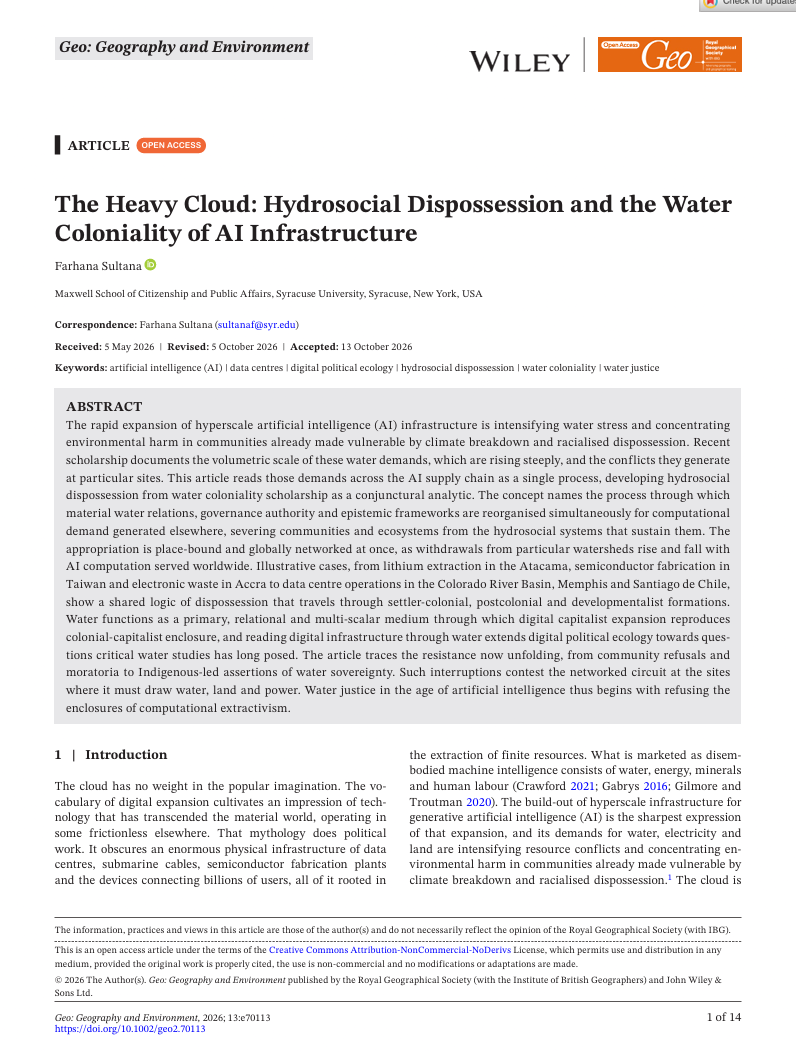
The heavy cloud: Hydrosocial dispossession and the water coloniality of AI infrastructure
This research examines “hydrosocial dispossession” driven by AI infrastructure expansion. It explores how data centres and supply chains intensify water stress in the US, Chile, Taiwan, and Ghana. The report highlights the material, governance, and epistemic harms of computational extractivism while documenting growing community resistance and moratoria.
Please login or join for free to read more.

OVERVIEW
The mythology of a “weightless” cloud obscures a vast physical infrastructure of data centres, submarine cables, and semiconductor plants. This expansion, particularly for generative artificial intelligence (AI), intensifies competition for finite resources such as water, electricity, and land. The build-out of hyperscale infrastructure drives cycles of extractivism that deepen spatial and social inequalities, concentrating environmental harm in communities already made vulnerable by climate breakdown and racialised dispossession.
Theorising hydrosocial dispossession
This research introduces the concept of “hydrosocial dispossession” to define how material water relations, governance authority, and epistemic frameworks are simultaneously reorganised for computational demand generated elsewhere. This process severs communities and ecosystems from the systems that sustain them. It operates across three registers: the material register (physical diversion, depletion, or degradation of water flows), the governance register (proprietary data regimes and non-disclosure agreements that strip publics of the ability to contest water allocation), and the epistemic register (the delegitimisation of Indigenous and local ways of knowing water).
The structural dynamics of AI’s water appropriation
AI’s water footprint must be understood through the lens of supply chain capitalism and ecologically unequal exchange. The computational power required for generative models translates to massive electricity demand, which in turn requires vast amounts of water for cooling and thermoelectric power generation. Direct on-site water use for cooling is significant; for example, evaporative systems convert potable water to vapour that exits the local watershed entirely, representing an unrecoverable loss. While the industry promises perpetual optimisation, improvements in hardware efficiency often trigger the “Jevons paradox,” where increased efficiency induces higher absolute demand. Furthermore, corporate “water-positive” pledges are characterised as a form of “green grabbing” that relies on the flawed logic of fungibility, where restoration in one region is used to justify depletion in another.
Hydrosocial dispossession in practice: Connected conjunctures
The report details several illustrative cases of dispossession. In the Colorado River Basin, hyperscale data centres withdraw substantial water in a region where Indigenous Diné (Navajo) households lack reliable tap water. In Memphis, Tennessee, the xAI Colossus facility in the predominantly Black neighbourhood of Boxtown threatens the Memphis Sand aquifer. Projected withdrawals of several million gallons a day could lower water levels and draw contaminants into the drinking water supply. In Chile’s Santiago Metropolitan Region, Google’s data centre plans faced significant community opposition due to their projected impact on the Maipo River basin during a prolonged drought. In Taiwan, the state prioritises semiconductor fabrication over agriculture, moving water from farms to science parks during droughts by administrative decision.
The supply chain extends beyond operations into extractive frontiers. Lithium mining in the Atacama Desert diverts critical freshwater from Indigenous Lickan Antay communities to support “green” technologies. Downstream, electronic waste accumulates in toxic geographies like Agbogbloshie in Accra, Ghana. Here, groundwater sampled beneath the scrapyard was found unfit for drinking, and residents showed elevated lead exposure. These nodes form a coherent geographic arc of extraction where local water resources are commanded by global computational demand.
Governing and refusing hydrosocial dispossession
Resistance to these enclosures is growing worldwide. Local opposition has blocked or delayed tens of billions of dollars in US data centre projects, and similar mobilisations have occurred in Ireland, Spain, and Chile. In July 2026, New York issued the first statewide moratorium on hyperscale data centres to assess cumulative impacts. Seattle also adopted a one-year municipal moratorium. The demand for environmental data justice includes mandatory facility-level disclosure and the prohibition of non-disclosure agreements in public utility contracts. Furthermore, water justice requires the recognition of Indigenous water ontologies as constitutive bases for decision-making, rather than mere cultural perspectives to be accommodated within technocratic frameworks.
Conclusion
Water dispossession under AI expansion is a conjunctural process where different legal instruments—from settler-colonial prior appropriation to neoliberal water codes—produce similar extractive outcomes. Dispossession does not always require a volumetric shortage; it can occur through the degradation of water quality or the severing of social relations. The “cloud” is heavy, and its weight falls on households in the Colorado River Basin, the Maipo River basin, and the Atacama. Ultimately, water justice in the age of AI begins with refusing the enclosures of computational extractivism and protecting water as a fundamental human right.




