

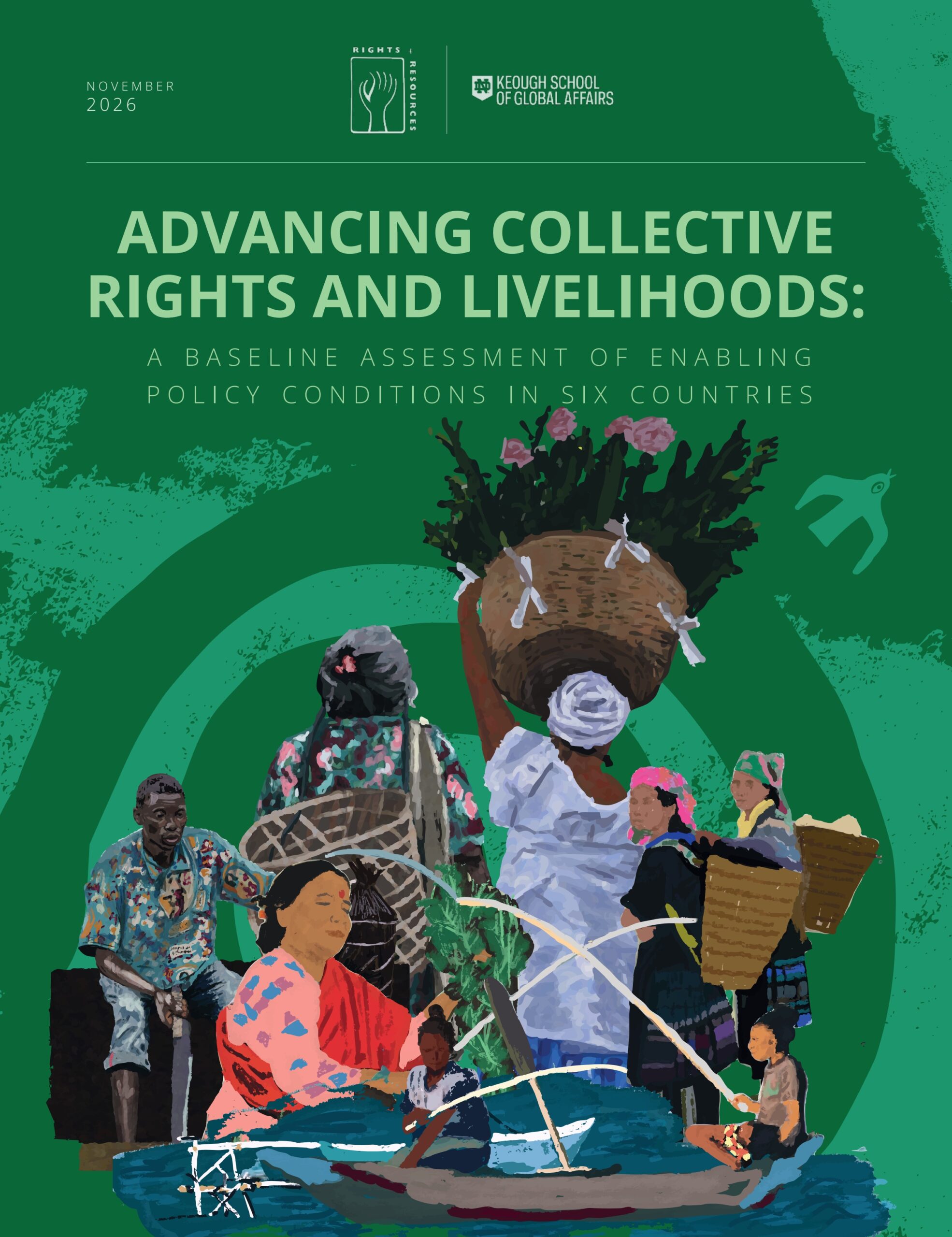
Advancing collective rights and livelihoods: A baseline assessment of enabling policy conditions in six countries
This report evaluates the policy conditions enabling collective livelihoods for Indigenous Peoples and local communities across six countries. It identifies significant gaps between legal recognition and the ability to exercise rights, revealing how national statistics often mask disadvantages in tenure security, infrastructure, and institutional accountability in remote territories.
Please login or join for free to read more.

OVERVIEW
Introduction
Significant progress has been made over the past two decades in recognising the collective tenure rights of Indigenous Peoples, Afro-descendant Peoples, and local communities. Since 2002, the forest area legally designated for or owned by these communities has increased by over 250 million hectares, which is more than four times the size of France. This progress is particularly significant in lower- and middle-income tropical forest countries. While a substantial body of research demonstrates the importance of secure collective tenure for climate mitigation and biodiversity conservation, legal recognition does not necessarily translate into the effective ability of communities to exercise their rights or realise their livelihood aspirations.
Collective livelihoods and the framework
Collective livelihoods are understood as the capabilities, assets, activities, rights, and relationships through which communities sustain their ways of life. This conception, supported by the Livelihoods Vision and the Brasília Declaration of May 2026, places self-determination at the centre of the agenda. The study proposes a framework for analysing broader enabling conditions across five interconnected policy domains: tenure security; institutional autonomy and accountability; livelihood development and capacity building; infrastructure and connectivity; and inclusive governance and cultural respect.
Data and methods
The research team selected 23 indicators across the five policy domains to translate the framework into observable measures of performance. These indicators examine three dimensions of government performance: de jure conditions (rights and procedures in law), de facto conditions (implementation and institutional performance), and protection from harm (actions to prevent violence or corruption). The study methodology combines national statistics with structured interviews involving 190 key informants from six countries: Brazil, Colombia, the Democratic Republic of the Congo (DRC), Indonesia, Nepal, and Peru.
How to read the baseline
The baseline employs two principal comparisons to interpret results. The first examines how conditions in forest territories differ from national statistics to identify where national averages may obscure local circumstances. The second examines how far localised estimates fall below the levels of government performance that key informants consider acceptable within each country. This diagnostic approach helps identify specific gaps to inform priorities for policy reform and public investment.
Results
The baseline identified four recurring findings across the six countries. Firstly, national averages frequently obscure conditions in forest territories. In 92 per cent of indicator-country comparisons, informants estimated that conditions facing forest communities were less favourable than those reflected in national statistics. Localised estimates were typically about 85 per cent of corresponding national values. Secondly, legal recognition of collective rights does not ensure the conditions needed to exercise them. For instance, while all six countries recognise community land or forest rights in law, significant gaps remain in tenure security and government accountability.
Thirdly, political voice, security, and accountability are consistent weaknesses. Indicators measuring protection from harm show larger median shortfalls than those measuring de facto conditions (40 versus 20 percentage points). The risks are stark; between 2012 and 2024, 509 land and environmental defenders were killed in Colombia and 413 in Brazil. Finally, limited access to sustained capacity development is a shared constraint. Participation in adult education and vocational training is exceptionally low, with localised estimates ranging from 1.1 per cent in Indonesia to 6.3 per cent in Brazil, falling well below acceptable levels of 54 to 71 per cent.
From evidence to policy action: illustrative country applications
In Peru, property-rights protection in forest territories is estimated at 66 per cent, compared to 80 per cent nationally. Policy entry points include simplifying management procedures and addressing insufficient technical assistance. Colombia exhibits the highest localised property-rights security in the study at 85 per cent, yet violence and intimidation remain significant constraints. Suggested actions include strengthening territorial protection mechanisms and adapting enterprise finance to collective ownership. Nepal has an established system of over 23,000 Community Forest User Groups managing 2.5 million hectares, but barriers remain in translating management into viable enterprises.
In the DRC, only approximately 4 per cent of forest land is recognised as community-owned or managed, and localized property-rights security is estimated at 21 per cent. An integrated approach to enterprise development and grant finance is required. Brazil has an extensive legal framework, but rights and protections vary substantially across tenure regimes, with a need for stronger enforcement against encroachment. Indonesia faces a significant capacity gap and is the only study country where national law does not acknowledge Free, Prior and Informed Consent (FPIC) standards, with only 6.7 per cent of forest land formally recognised for communities.
Scope, limitations, and priorities for strengthening the baseline
This assessment is descriptive and identifies patterns rather than establishing causes or attributing gaps to specific policies. The framework focuses primarily on the role of national governments and measures conditions expected to support livelihoods rather than livelihood outcomes themselves. Future priorities for strengthening the baseline include distinguish the conditions experienced by women and youth and better reflecting dimensions of cultural respect, traditional knowledge, and food systems.
Conclusion
Legal recognition of tenure remains foundational but does not, on its own, ensure access to finance, training, effective participation, or territorial security. Progress must ultimately be judged by whether Indigenous Peoples, Afro-descendant Peoples, and local communities have the conditions and agency to exercise their rights and pursue their own development priorities. Creating these conditions is essential for sustaining community stewardship of forests on which biodiversity conservation and climate mitigation depend.




