

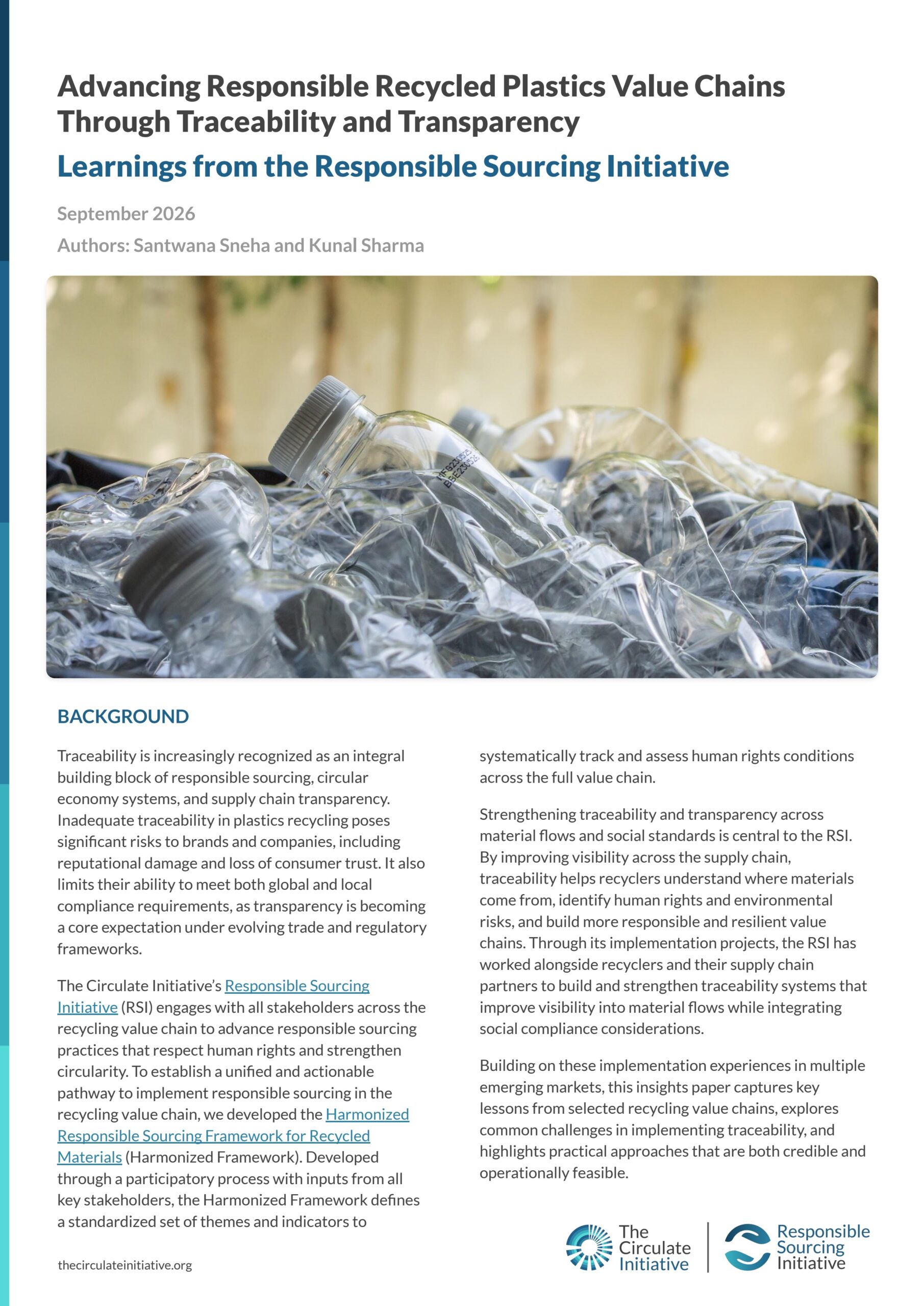
Advancing responsible recycled plastics value chains through traceability and transparency: Learnings from the Responsible Sourcing Initiative
This report explores implementing traceability in recycled plastics value chains. Drawing on pilots in Viet Nam and Indonesia, it identifies misaligned incentives and data governance as primary barriers. It recommends integrating traceability into existing business processes and provides a decision framework to support organisations at different maturity stages.
Please login or join for free to read more.

OVERVIEW
Background
Traceability is increasingly recognised as an integral building block for responsible sourcing, circular economy systems, and supply chain transparency. Inadequate traceability in plastics recycling poses significant risks to brands and companies, including reputational damage and loss of consumer trust. It also limits their ability to meet both global and local compliance requirements, as transparency is becoming a core expectation under evolving trade and regulatory frameworks. The Circulate Initiative’s Responsible Sourcing Initiative (RSI) engages with stakeholders across the recycling value chain to advance practices that respect human rights and strengthen circularity. To establish a unified pathway, the RSI developed the Harmonized Responsible Sourcing Framework for Recycled Materials to systematically track and assess human rights conditions across the full value chain.
Insights from piloting traceability in RSI implementation projects
Designing traceability systems requires a grounded understanding of how recycling value chains operate and the incentives that shape behaviour. The RSI adopted a structured, step-by-step approach to pilot traceability in selected chains, focusing on identifying practical implementation strategies across different contexts. The process began with a landscape assessment involving a desk review of over 40 tools and in-depth interviews to identify key drivers and barriers. Based on these insights, a shortlist of tools with the potential to track both material flows and social indicators was developed. In consultation with an expert working group, the tools BanQu and CleanHub were selected for pilot implementation in Viet Nam and Indonesia. The RSI worked with tool providers to adapt these solutions and align them with the Harmonized Framework indicators, ensuring social dimensions were captured.
Key learnings
The pilots represented fragmented and highly informal value chains common in emerging markets. Evidence shows that challenges to traceability are not primarily technological but are driven by structural, operational, and behavioural constraints across different actors. Successful implementation depends not only on appropriate technology but also on systems that reflect operational realities while establishing trusted approaches to data governance.
Barriers to successful implementation of traceability systems
Evidence identified two broad categories of barriers: limited incentives for participation, particularly among upstream actors, and operational and data governance constraints. These factors continue to constrain the adoption and scaling of traceability systems across recycling value chains.
Misaligned and insufficient incentives limit traceability adoption
A key barrier is the absence of clear incentives for all actors, especially informal ones at lower tiers. Traceability is often perceived as a compliance requirement rather than a value-adding business function. Upstream actors, such as small aggregators and waste pickers, receive limited direct financial or operational benefits for providing data. This challenge is compounded by the low economic value of many recycled materials and thin margins, making it difficult to absorb additional costs. This is reflected on the ground; one small aggregator in Indonesia noted they would rather sell materials elsewhere than face the administrative burden of such systems. Furthermore, these expectations often do not translate into consistent demand or price premiums from buyers.
Operational and data governance constraints challenge effective implementation
Implementation is challenging among informal actors who often operate with limited infrastructure, lacking digital weighing systems, smartphones, and reliable internet connectivity. Transactions are frequently cash-based and recorded manually. A small aggregator in Bekasi, Indonesia, described how their elderly sellers refuse digital transfers, fearing that complicated systems would reduce supply volumes. Concerns around data governance also persist, as transaction data is commercially sensitive. Pilots highlighted strong concerns among recyclers about sharing data through third-party platforms, particularly when providers also operate within the waste management sector, creating perceived conflicts of interest. Concerns around data privacy, ownership, and control continue to restrict upstream data sharing and visibility.
Strategies for successful implementation of traceability systems
Implementation experience highlighted practical approaches to improve scalability, including embedding traceability within routine business processes and creating meaningful incentives. Supporting this integration requires tools and processes aligned with existing practices and an organisation’s level of digital maturity.
Embed traceability within business processes and systems
Traceability is most effective when integrated into procurement, supplier management, and inventory systems. For example, Green Mining in Brazil uses a proprietary platform involving blockchain, georeferenced data, and photographic records. This material and social data are integrated into operations at Factory-Price Stations to support end-to-end traceability and compliance with labour and environmental standards.
Create meaningful incentives to support long-term integration of traceability
Incentives are vital for sustaining participation among upstream actors. Examples include direct financial rewards, access to technical assistance, and stronger buyer relationships. Mr. Green Africa in Kenya provides waste pickers with payments through cash or mobile money, plus ‘green points’ redeemable for food, utilities, and safety equipment. This system provides brands with end-to-end information on impacts, creating value for downstream buyers through greater visibility.
Pathways to designing successful traceability systems
Effective traceability is not a one-size-fits-all solution. Three practical pathways exist: strengthening existing documentation, adopting third-party platforms, and developing in-house systems. Early-stage enterprises often benefit from strengthening existing practices to build foundations without unnecessary complexity. As operations mature, third-party platforms support greater standardisation and coordination. Organizations with advanced capabilities may choose to develop in-house systems for greater flexibility and control. A practical decision framework helps organisations choose the most appropriate pathway based on technical capacity, market demand, and resource availability.
Way forward
Scaling traceability requires coordinated action from industry, governments, and investors. Success depends on creating appropriate incentives, strengthening organisational capacity, and designing systems that reflect the operational realities of recycling value chains. Capacity-building remains essential to help organisations adopt digital tools and improve data quality. The Harmonized Framework supports this transition by establishing common standards and a shared global language for responsible sourcing. Ongoing pilot implementation will continue to refine practical approaches and generate evidence to support technically robust, commercially viable, and socially inclusive systems.




