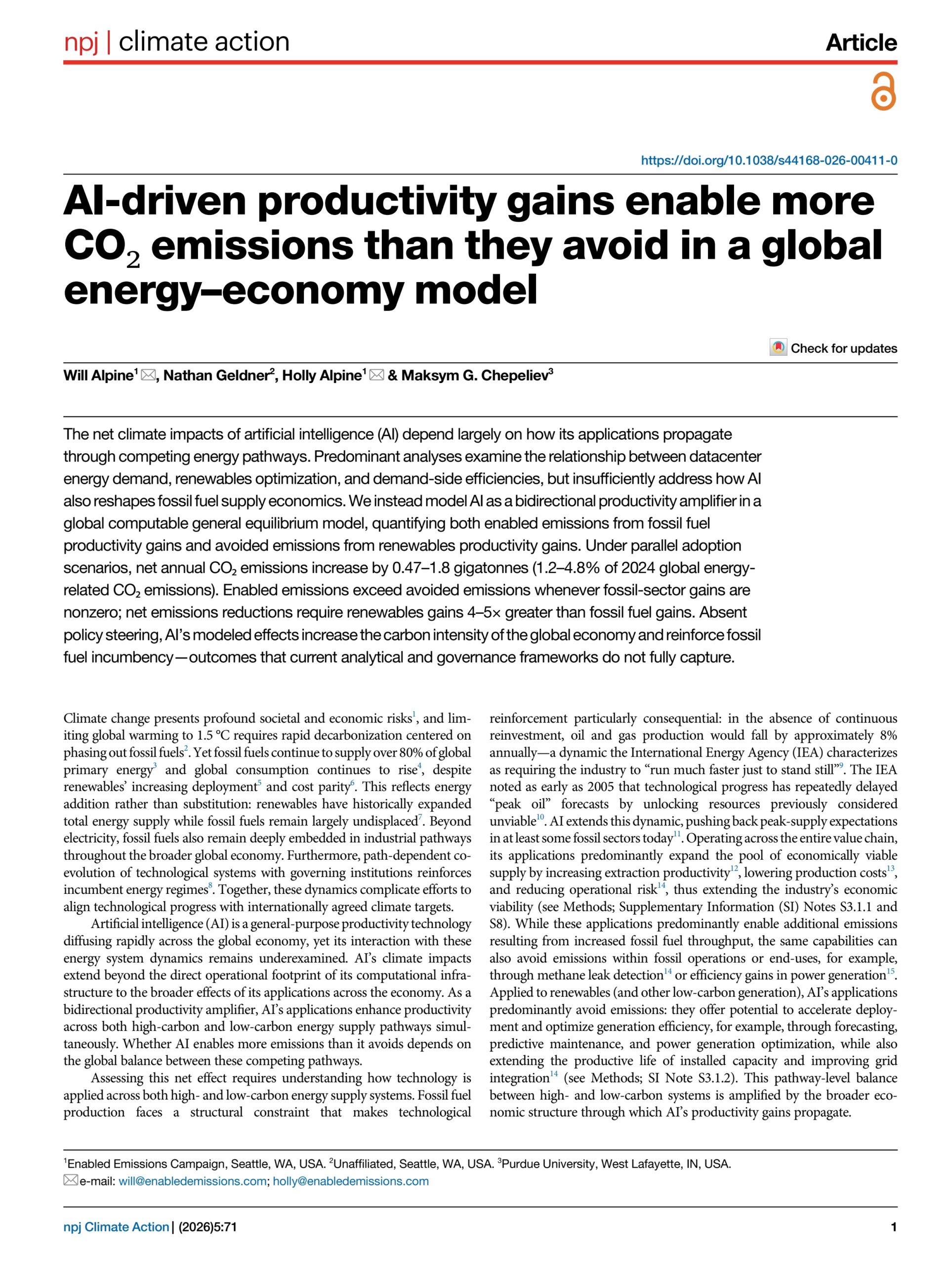
AI-driven productivity gains enable more CO₂ emissions than they avoid in a global energy–economy model
Research using a global energy-economy model indicates that AI-driven productivity gains increase net annual CO2 emissions by 0.47–1.8 gigatonnes under parallel adoption. Enabled emissions from fossil sectors consistently exceed avoided emissions from renewables. Achieving net reductions requires renewable productivity gains to be four to five times greater than fossil gains.
Please login or join for free to read more.

OVERVIEW
Results
Overview
Using a computable general equilibrium (CGE) model, this research quantifies the CO₂ emissions consequences of AI-driven productivity gains across competing energy supply pathways. The study characterises artificial intelligence (AI) as a bidirectional productivity amplifier that enhances efficiency across both high-carbon (fossil fuel) and low-carbon (renewables) sectors. The analysis moves beyond direct operational footprints to address indirect, system-wide impacts such as rebound and induction effects, where technological improvements stimulate additional consumption and reshape production economics.
Net global emissions increase under parallel adoption
Under parallel adoption scenarios—a neutral benchmark where all energy pathways receive uniform productivity shocks—AI-driven productivity gains increase net global annual CO₂ emissions by 0.47–1.8 gigatonnes (Gt). This increase represents approximately 1.2–4.8% of total global energy-related CO₂ emissions in 2024. The research identifies fossil fuel productivity gains as the primary driver of this net increase, with renewables optimisation only partially offsetting the enabled emissions. Enabled emissions, ranging from 0.6–2.4 Gt CO₂ annually, exceed the International Energy Agency’s (IEA) 2025 datacentre emissions estimates by 3.3–13.3 times.
Renewables gains must exceed fossil gains by 4–5× to reach breakeven
A significant structural asymmetry exists between fossil fuel and renewable pathways. To achieve a net-zero emissions outcome (breakeven), renewable productivity gains must outpace fossil fuel gains by a ratio of 4–5 to 1. Specifically, every 1% marginal productivity gain in fossil fuels requires 4–5% gains in renewables to avoid a net increase in emissions. This asymmetry is rooted in upstream fossil fuel extraction productivity, where even small efficiency improvements can significantly expand economically viable supply and delay “peak oil” expectations.
Directional asymmetry is robust across scenarios, baselines, and parameter variation
The 4–5× asymmetry remains robust across 64 empirically derived scenario combinations and various sensitivity tests. Adjustments to baseline assumptions, parameter variations (such as capital-energy substitution elasticities), and changes in the underlying energy mix did not reverse the directional outcome. This indicates that the core asymmetry is rooted in the deep economic structure of a global system still largely anchored in fossil fuels, where AI productivity gains propagate through incumbent, carbon-intensive pathways.
Fuel-neutral efficiency gains do not reverse the asymmetry
The research evaluated whether fuel-neutral applications, including grid infrastructure improvements and demand-side efficiency gains (such as maritime shipping and energy-intensive manufacturing), could moderate the supply-side balance. While these improvements reduced net emissions, they did not reverse the underlying asymmetry. In a high fuel-neutral adoption scenario, net emissions were reduced by only approximately 0.1 Gt CO₂ annually, suggesting that efficiency gains alone are insufficient to offset the emissions-increasing effects of fossil fuel productivity growth.
Carbon pricing narrows—but does not reverse—the asymmetry
Implementing carbon pricing narrows the gap between enabled and avoided emissions but does not eliminate it. At a carbon price of $308/tCO₂, enabled emissions (0.3 Gt) still exceeded avoided emissions (0.2 Gt), resulting in a net increase of 0.1 Gt CO₂. Net emissions reductions were only achieved when fossil-sector productivity gains were zero or when renewables gains substantially outpaced fossil gains. This suggests that price signals alone are insufficient to overcome the structural advantage of fossil fuel productivity gains enabled by AI.
Carbon intensity of economic growth increases under parallel adoption
At the macroeconomic level, AI-driven productivity shocks increase the carbon intensity of gross domestic product (GDP). Under parallel adoption, CO₂ emissions grow faster than economic activity, leading to negative decoupling. Absolute decoupling—where emissions fall as the economy grows—occurred only when supply-side AI productivity gains in the fossil fuel sector were zero. The results indicate that AI-driven productivity reinforces fossil fuel incumbency rather than displacing it.
Discussion
The findings challenge the prevailing framing of AI’s climate impact as a trade-off between energy consumption and avoided emissions. On the basis of these results, the study proposes five governance priorities for AI and climate policy:
- Recognise enabled emissions as a distinct policy-relevant category and implement supply-side production constraints.
- Address first-order operational impacts and higher-order indirect effects in tandem.
- Pair support for AI-driven renewables acceleration with explicit constraints on AI-enabled fossil productivity.
- Evaluate AI-driven efficiency gains for whole-system impacts rather than assuming inherent decarbonisation.
- Implement structural interventions, such as carbon pricing, as part of a broader portfolio that includes direct limits on AI-enabled fossil fuel productivity.
Methods
The study utilised the GTAP-E-Power computable general equilibrium model, calibrated to a 2017 base year with adjustments to approximate the 2024 electricity generation mix. AI adoption was represented as productivity shocks across 20 economic sectors and five global regions. The model endogenously resolves market responses, including factor reallocation and price feedbacks, but is limited to tracking CO₂ emissions from fossil fuel combustion.