

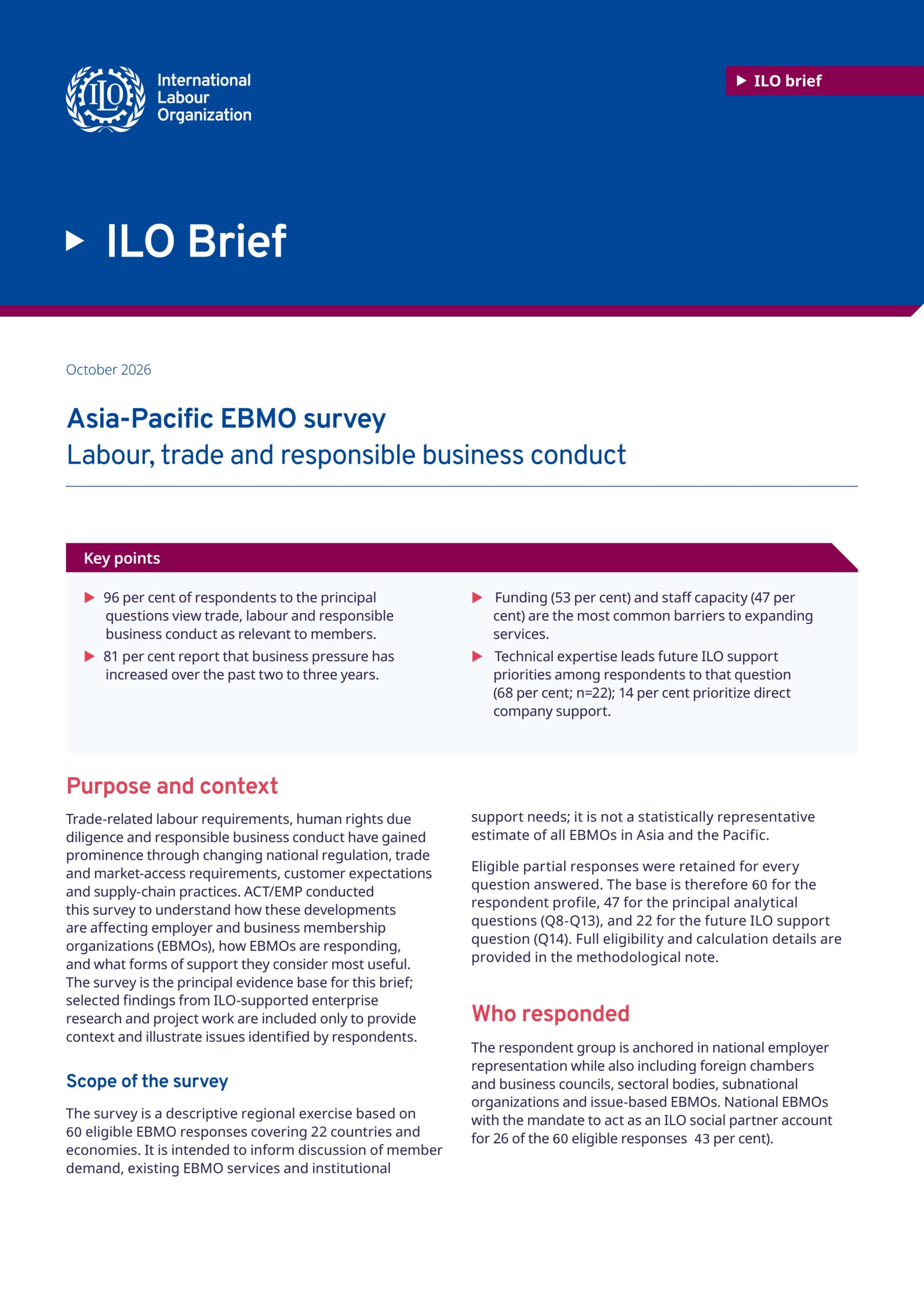
Asia-Pacific EBMO survey: Labour, trade and responsible business conduct
This report analyses how Asia-Pacific employer organisations address trade-related labour requirements and responsible business conduct. While 96 per cent of surveyed EBMOs view these issues as relevant, rising business pressure and capacity constraints — particularly in funding and technical expertise — limit their ability to provide comprehensive member services.
Please login or join for free to read more.

OVERVIEW
Key points
This research highlights that 96 per cent of respondents consider trade, labour, and responsible business conduct (RBC) to be relevant to their members. A significant 81 per cent of organisations report that business pressure regarding these issues has increased over the past two to three years. The most common barriers to expanding services are identified as funding (53 per cent) and staff capacity (47 per cent). When considering future support from the International Labour Organization (ILO), 68 per cent of respondents prioritise technical expertise, while only 14 per cent prioritise direct company support.
Purpose and context
The survey was conducted by the Bureau for Employers’ Activities (ACT/EMP) to understand how trade-related labour requirements, human rights due diligence (HRDD), and responsible business conduct are affecting employer and business membership organisations (EBMOs). These issues have gained prominence due to shifting national regulations, market-access requirements, and evolving supply-chain practices. The report provides an evidence base to determine how EBMOs are responding and what forms of institutional support they find most useful.
Scope of the survey
This descriptive regional exercise is based on 60 eligible EBMO responses across 22 countries and economies. It is intended to inform discussions on member demand and existing services rather than providing a statistically representative estimate for the entire Asia-Pacific region. The analytical base for the principal questions was 47 respondents, while 22 respondents provided data regarding future ILO support priorities.
Who responded
The respondent group is primarily anchored in national employer representation but also includes foreign chambers, business councils, sectoral bodies, subnational organisations, and issue-based EBMOs. National EBMOs with a mandate as an ILO social partner accounted for 26 of the 60 eligible responses, representing 43 per cent of the total participant pool.
Countries and economies represented
The eligible responses covered 22 countries, with Southeast Asia accounting for 70 per cent (42 responses). Other participating regions included East and North-East Asia (12 per cent), South Asia (10 per cent), and the Pacific (7 per cent). One organisation reported global coverage. Because response numbers vary considerably by country, the findings should not be interpreted as specific national estimates.
Importance for companies
There is a broad and intensifying agenda surrounding labour and trade. Among the 47 EBMOs answering analytical questions, 26 per cent describe the agenda as one of the most important business priorities, and 34 per cent consider it an important priority. A further 36 per cent state it matters particularly for certain sectors or exporters, bringing the total relevance rating to 96 per cent.
A broad and intensifying agenda
Pressure on businesses is rising significantly, with 40 per cent of EBMOs reporting a significant increase and another 40 per cent reporting some increase over the last three years. Only 9 per cent reported no material change, while 6 per cent reported a decrease. This trend underscores the growing necessity for EBMOs to provide relevant support and guidance to their members.
What is driving demand
The primary driver for demand is the maintenance of market access or export competitiveness, cited by 47 per cent of respondents. This is followed by new national labour, HRDD, or responsible business regulation (40 per cent) and trade-related labour requirements (36 per cent). Other drivers include supply-chain mapping and traceability (34 per cent), ESG reporting (34 per cent), and international buyer requirements (30 per cent). The findings suggest that demand is driven by overlapping commercial and regulatory factors rather than a single compliance channel.
Services provided or planned by EBMOs
EBMOs are responding through policy advocacy and advice on workplace management systems, each reported by 43 per cent of respondents. Developing HRDD or labour-risk tools is reported by 38 per cent, while 36 per cent provide briefings on market requirements. Less frequent services include enterprise research (26 per cent), support with customer assessments (23 per cent), and assistance with ESG reporting (21 per cent).
Strong demand, but limited cost recovery
Despite rising demand, 47 per cent of respondents provide relevant services free of charge. Only 13 per cent report that services are mostly paid, while 28 per cent charge for only some services. This limited cost recovery indicates that many EBMOs face challenges in creating sustainable service models for these complex technical issues.
Capacity constraints affect service development
Funding and staff capacity are the most common barriers to expanding services, cited by 53 per cent and 47 per cent of respondents respectively. Expertise gaps in HRDD, ESG, or trade are reported by 34 per cent, while 30 per cent struggle with the lack of practical tools and the difficulty of keeping pace with changing requirements.
Priorities for future ILO support
Respondents primarily seek support that strengthens their own internal capabilities. 68 per cent prioritise technical expertise, 45 per cent seek practical tools for members, and 41 per cent each prioritise longer-term support and stronger policy analysis. Only 14 per cent prioritised direct ILO training for companies, indicating a strong preference for institutional development.
What the findings indicate
The survey results signal a high demand for technical depth within EBMOs. There is a clear link between institutional capacity and service sustainability, as funding and staffing constraints affect the ability to maintain expertise. Furthermore, EBMOs report a need to translate member experience into evidence for policy dialogue and advocacy.
Conclusion
Trade, labour, and responsible business conduct are significant and growing concerns for EBMO members in the Asia-Pacific. While EBMOs are responding, they are constrained by limited resources and specialist expertise. Future support should focus on strengthening EBMO capability through technical expertise, adaptable tools, and policy analysis to ensure service sustainability.




