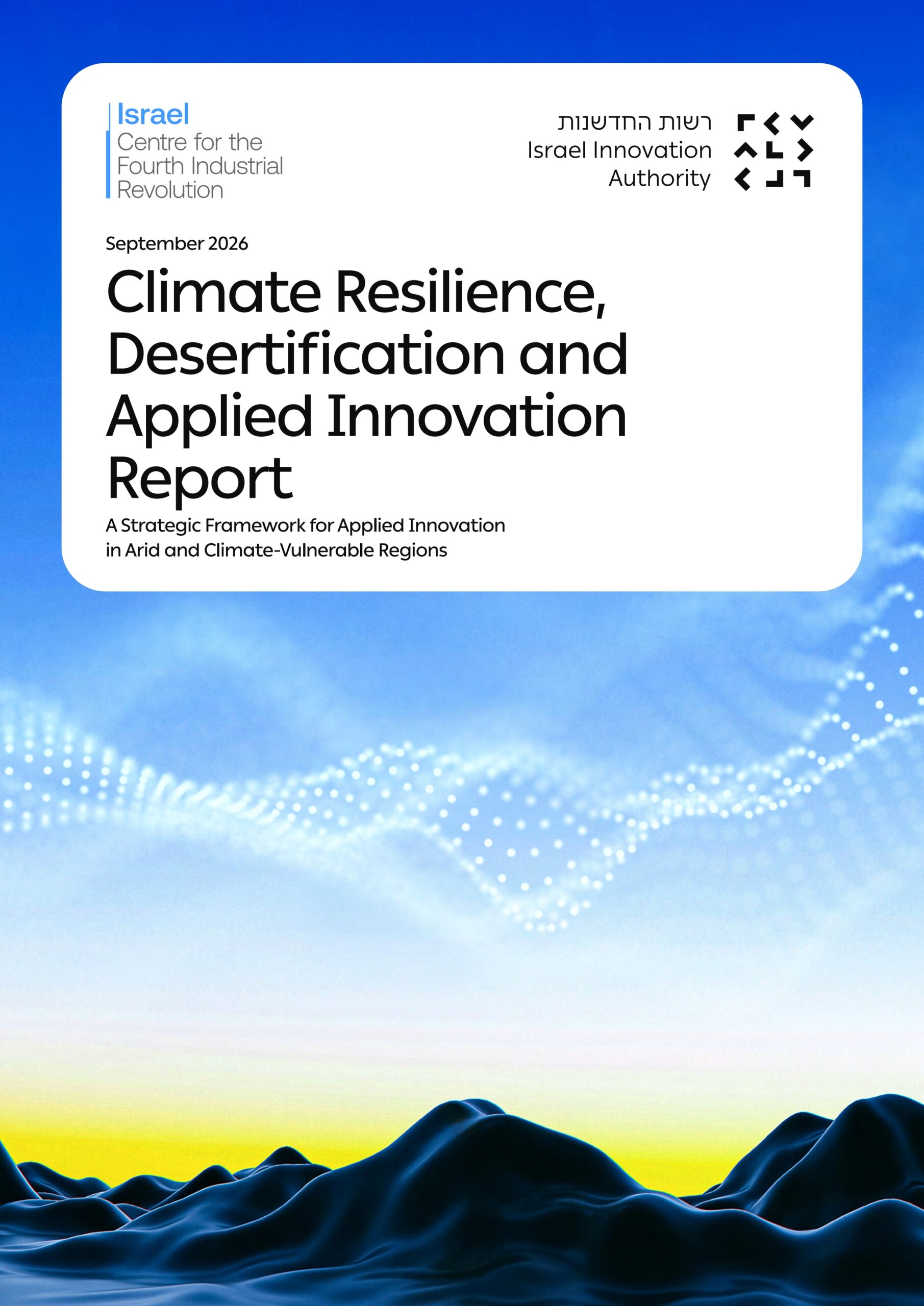
Climate resilience, desertification and applied innovation report: A strategic framework for applied innovation in arid and climate-vulnerable regions
This 2026 report establishes a strategic framework for climate resilience in arid regions. It examines technological solutions in water, agriculture, and energy, highlighting Israel’s innovation ecosystem and Azerbaijan’s renewable energy transition. The document advocates for integrated systems, cross-border cooperation, and robust governance to combat global desertification and land degradation.
Please login or join for free to read more.

OVERVIEW
This 2026 report reframes desertification as a systemic resilience risk affecting more than 170 countries and directly impacting 250 million people. It argues that while technologies to combat land degradation exist, scaling them requires integrated systems that connect water, agriculture, soil health, environmental intelligence, and distributed energy. The document identifies Israel and the Negev as reference models for arid-climate innovation, demonstrating how scarcity can drive applied research and successful public-private collaboration.
Desertification as a global systemic challenge
Desertification is defined as land degradation in arid, semi-arid, and dry sub-humid areas, affecting over 4 billion hectares of the Earth’s surface. It is both a cause and consequence of poverty, with the livelihoods of approximately one billion people threatened. Human factors such as overcultivation and deforestation, combined with climatic variations, turn fertile soil non-fertile. The report notes that 70 per cent of the 5.2 billion hectares of drylands used for agriculture are already degraded. In China, expanding deserts have affected nearly 700,000 hectares of cultivated land since the 1950s, while 135 million people worldwide are at risk of displacement due to desertification.
Core technological solution areas
The report identifies four key water domains for resilience: reuse, desalination, smart irrigation, and smart infrastructure. Israel is a global leader in this field, reusing approximately 90 per cent of its treated wastewater for agriculture. In the agriculture-desertification nexus, frontier technologies like CRISPR-Cas are used to develop climate-resilient varieties; in India, genome-edited rice varieties have increased yields by 19 per cent. Precision agriculture platforms such as SaliCrop have demonstrated yield improvements of 10–25 per cent under stress, while the Fasal platform in India has saved over 52 billion litres of water across 10,000 acres.
Soil health is described as critical natural infrastructure. Earth observation and AI-driven mapping enable predictive land management instead of reactive restoration. In Israel, approximately 100 companies operate in data, sensing, and AI technologies relevant to desertification. Renewable energy solutions, particularly in Azerbaijan, show potential for decarbonising water and food systems. Azerbaijan’s economically viable renewable potential is estimated at 27 GW, including 23 GW of solar energy. The country targets at least 30 per cent renewable energy in its installed electricity-generation capacity by 2030.
Enablers beyond technology
Technology alone is insufficient for resilience. Governance and policy frameworks must create conditions where solutions move from isolated pilots to scalable systems. Australia’s Murray–Darling Basin and Israel’s water pricing provide examples of mechanisms that reflect resource scarcity. Financing remains a significant hurdle; the report recommends blended finance, green bonds, and innovative insurance models. OKO Finance, for instance, provides automated parametric crop insurance to smallholder farmers via mobile wallets, bypassing traditional banking barriers to reach the ‘last mile’.
Pathways for replication, adaptation, and implementation
The Negev functions as a ‘living laboratory’, providing authentic operating conditions for validating technologies under real-world stresses like salinity and drought. Academic institutions, led by Ben-Gurion University of the Negev, anchor this ecosystem by bridging research with entrepreneurship. Regional cooperation in the Middle East and North Africa is highlighted as essential to reduce regulatory fragmentation and share data. The report also addresses governance failures in California’s Central Valley, where groundwater levels continue to decline despite the 2014 Sustainable Groundwater Management Act. It argues that building resilience requires integrated governance that manages hydrological, economic, and social realities simultaneously.
Call to action: from innovation to impact
The final call to action urges governments, investors, and research institutions to build integrated resilience systems. Five priorities are identified: building integrated desertification resilience systems, creating real-world validation environments, financing the full deep-tech pathway from R&D to deployment, developing environmental intelligence as shared infrastructure, and strengthening local capacity for replication. International cooperation should focus on connecting regions facing similar dryland challenges to create adaptable implementation pathways that can be replicated across diverse arid and climate-vulnerable regions.