Corporate Climate Targets Database and Dashboard
A longitudinal database tracking voluntary climate commitments and greenhouse gas targets for U.S. public companies in the Russell 3000 index from 2000 to 2024.
Please login or join for free to read more.

OVERVIEW
The Corporate Climate Targets Database and Dashboard is a research-led initiative that tracks the voluntary climate commitments of U.S. public companies over a 25-year period (2000–2024). Developed by researchers at Harvard University, the tool provides a comprehensive longitudinal view of how companies have framed, adopted, and modified their greenhouse gas emission targets. It is particularly relevant to finance professionals seeking to distinguish between consistent decarbonisation strategies and transient corporate pledges.
Organisation behind the tool
The tool was developed and is maintained by the Salata Institute for Climate and Sustainability at Harvard University, in collaboration with researchers from Harvard Business School. Funding for the project was provided by both the Salata Institute and Harvard Business School.
What the tool does
The tool allows users to explore a dataset covering Russell 3000 firms. Key features include:
- Tracking of target types, including net-zero, carbon neutral, and specific percentage reduction goals.
- Analysis of the magnitude and time horizons of climate pledges.
- Historical records of when targets were announced, updated, or removed.
- A dashboard interface for visualising trends across different sectors and timeframes.
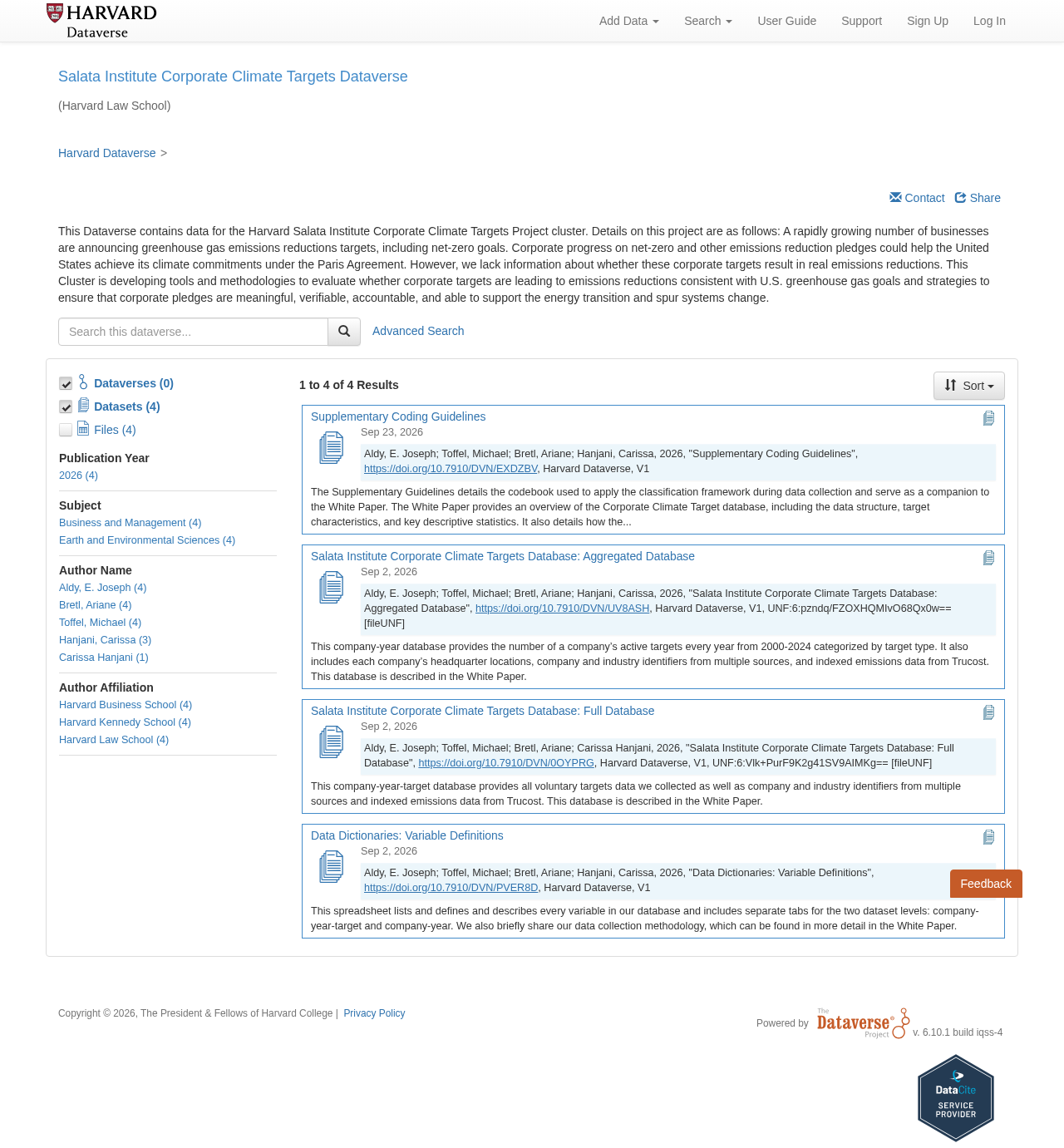
- Access to underlying data via the Harvard Dataverse for detailed academic or institutional research.
Target audience
The primary audience includes institutional investors, ESG analysts, academic researchers, and policymakers interested in the evolution of corporate environmental governance in U.S. public markets.
Relevance to finance professionals
- Risk assessment – Evaluation of transition risk by comparing historical target-setting behaviour with actual emissions reductions.
- ESG analysis – Provision of granular data on corporate commitments to support internal benchmarking and sustainability reporting.
- Investment context – Identification of long-term environmental trends and corporate accountability by monitoring target revisions and “greenwashing” indicators.
- Market insights – Benchmarking of climate ambition across the Russell 3000 index to inform portfolio construction and engagement strategies.