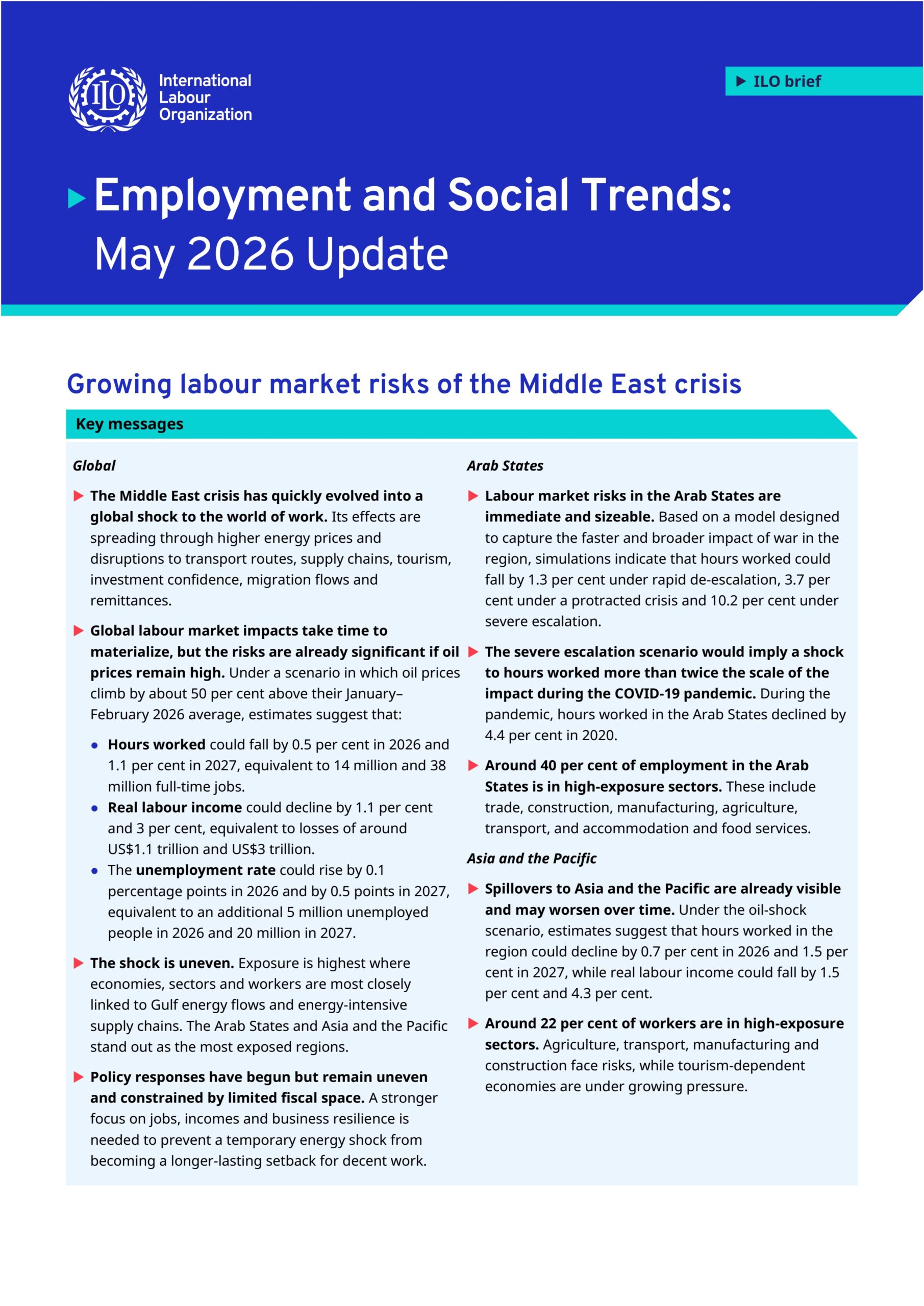
Employment and social trends: May 2026 update: Growing labour market risks of the Middle East crisis
This report analyses the global labour market risks of the Middle East crisis. It estimates significant potential declines in working hours and real labour incomes, highlighting heightened vulnerabilities in the Arab States and the Asia-Pacific region due to disrupted energy markets, supply chains, and transport routes.
Please login or join for free to read more.

OVERVIEW
Introduction: Gathering clouds over global employment and the world of work
The Middle East crisis has disrupted energy markets, transport routes, supply chains, tourism and investment confidence (p. 2). These pressures are unfolding at a time when the global economy was already marked by weak growth prospects, elevated uncertainty and persistent decent work deficits (p. 2).
I. Global overview: Impact beyond the conflict zone
Estimates suggest that hours worked could be lower by approximately 0.5 per cent in 2026 and 1.1 per cent in 2027 (p. 3). This would be equivalent to a global loss of about 14 million full-time equivalent jobs in 2026, and 38 million in 2027 (p. 3). Real labour income could also decline by 1.1 per cent in 2026 and 3 per cent in 2027, corresponding to losses of around USD 1.1 trillion and USD 3 trillion (p. 3-4). The unemployment rate would rise by 0.1 percentage points in 2026 and by 0.5 points in 2027, equivalent to an additional 5 million unemployed people in 2026 and 20 million in 2027 (p. 4). Around 52 per cent of employment in transport services falls into the high-exposure category (p. 4).
II. The Arab states: Immediate and direct impact
Simulations suggest that total hours worked in the Arab States would decline by 1.3 per cent and employment by 0.7 per cent in 2026 (p. 7). Under a protracted crisis, hours worked are projected to fall by 3.7 per cent and employment by 2.1 per cent; under escalation, the losses could reach 10.2 per cent and 5.9 per cent (p. 7). Around 40 per cent of workers in the Arab States are employed in high-exposure sectors (p. 8). For every 1 per cent decline in employment among nationals, employment among non-nationals falls by 4 per cent (p. 10).
III. Asia and the Pacific: Shockwaves beyond the Middle East Region
Hours worked in the region are projected to fall by 0.7 per cent in 2026 and 1.5 per cent in 2027 (p. 12). Real labour incomes could fall more sharply, by 1.5 per cent and 4.3 per cent (p. 12). The unemployment rate is projected to rise by 0.2 percentage points in 2026 and 0.8 percentage points in 2027 (p. 12). Around 22 per cent of workers are in high-exposure sectors (p. 12). Early evidence suggests that labour migration flows are already being disrupted. Migrant worker outflows to GCC countries have slowed sharply in some countries of origin, while repatriations have increased (p. 14).
IV. Uncertain prospects: Policy responses and outlook
Countries have introduced a range of measures to ease energy costs, support households and preserve economic stability (p. 15). The most common intervention has been a reduction in energy costs through cuts to fuel excise and taxes (p. 15). A sharper focus on jobs and incomes is therefore essential (p. 16). Labour market support should be aligned with humanitarian efforts helping to bridge short- and long-term interventions (p. 16). Social dialogue should play an important role in articulating and adjusting policy responses (p. 16).