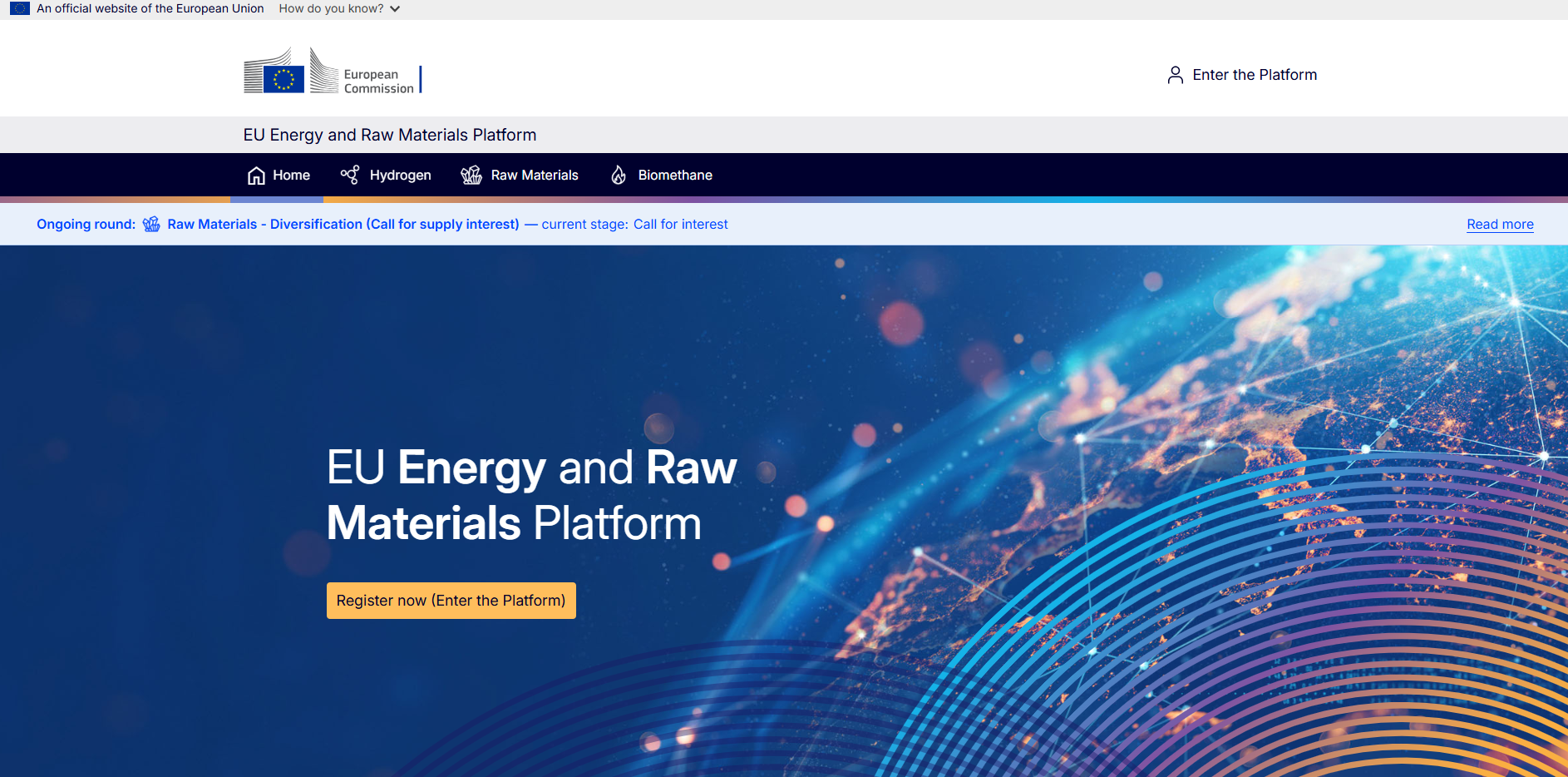
EU energy and raw materials mechanism platform
EU Commission platform aggregating demand for critical raw materials to connect buyers, suppliers, and financial institutions across strategic sectors.
Please login or join for free to read more.

OVERVIEW
The Raw Materials Mechanism is a European Commission platform designed to aggregate demand for critical raw materials and connect buyers with suppliers, financial institutions, and storage providers. Launched on 13 April 2026, it is a voluntary, market-based tool built on the existing EU Energy Platform infrastructure. It aims to reduce the EU’s dependence on a limited number of third-country suppliers by giving visibility to alternative sources.
Organisation behind the tool
The platform is developed and maintained by the European Commission’s Directorate-General for Internal Market, Industry, Entrepreneurship and SMEs. It builds on the EU Energy Platform and forms part of the EU’s broader strategy to strengthen economic security in the face of growing geopolitical risks.
What the tool does
The platform enables buyers of critical raw materials to pool demand and connect with a wider network of suppliers, financial institutions, and storage providers. It provides visibility into alternative supply sources, with a focus on strategic sectors including rare earths, defence materials, and battery materials. The tool complements existing commercial relationships without intervening in negotiations between parties.
Target audience
The primary users are companies that purchase or supply critical raw materials, particularly smaller firms seeking to build partnerships beyond their existing networks. Financial institutions and storage providers are also intended participants. Policymakers and industry bodies with an interest in EU supply chain resilience are secondary audiences.
Relevance to finance professionals
The platform provides insight into EU-level efforts to de-risk critical raw material supply chains, which is directly relevant to commodity exposure analysis, ESG supply chain assessments, and investment decisions in sectors dependent on rare earths and battery materials. It also offers context for assessing geopolitical and economic security risks affecting European industry.